Army seeks acoustic detection systems to counter small drones
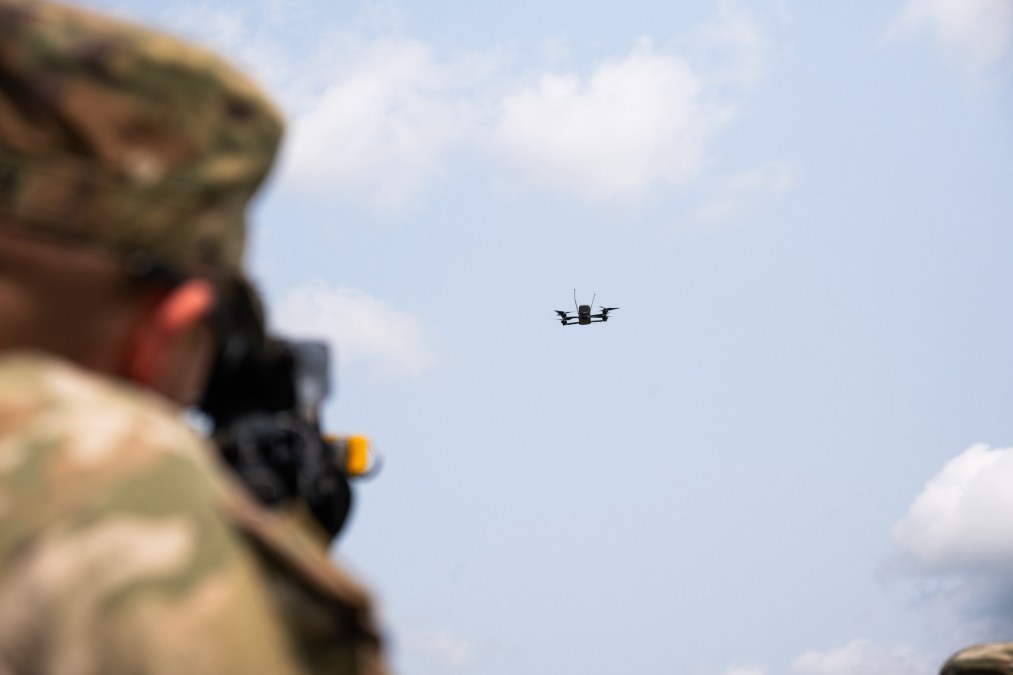
The Defense Department is searching for new acoustic detection capabilities to help soldiers defend themselves against small unmanned aerial systems.
The Command, Control, Computers, Communications, Cyber, Intelligence, Surveillance and Reconnaissance (C5ISR) Center under the Army Combat Capabilities Development Command is conducting market research to see what tools are available.
A request for information issued Jan. 14 is intended to inform future requirements and prototyping efforts.
More specifically, the Army seeks an acoustic detection solution for Group 1 and Group 2 UAS for dismounted troops. The RFI characterizes a Group 1 drone as weighing 20 pounds or less, and a Group 2 drone as weighing 21-55 pounds.
The outreach to industry comes as the Army and the Pentagon are trying to ramp up their development and acquisition of a variety of new capabilities to counter small uncrewed platforms, which can be hard to detect because of their size and the low altitude at which they fly. An acoustic detection system could give troops another means for sensing overhead threats — such as drone swarms — before it’s too late.
U.S. defense officials are taking lessons learned from the Ukraine-Russia war and other conflicts where drone and counter-drone operations have played a major role.
In August of last year, Secretary of Defense Pete Hegseth directed the Army to establish a new organization called Joint Interagency Task Force-401 to serve as the Pentagon’s lead organization for developing capabilities to defeat small drones.
“Everybody is going to have to be able to defend, you know, defend themselves against UAS. Everyone, every formation that we have. And that’s how we’re trying to build it. We went up to Secretary Hegseth and asked to stand up JIATF-401. We are doing that, and for both sense, decide and act [functions], trying to give you tools that everybody can easily operate. Everybody’s going to have to be able to easily operate these things,” Army Chief of Staff Gen. Randy George told soldiers during a town hall at Fort Drum, New York, last week alongside Army Secretary Dan Driscoll and other officials.
The new RFI noted that the Army wants an acoustic detection solution that can function on-the-move in a variety of environments and weather conditions and be integrated with other soldier equipment, such as the Tactical Assault Kit and Nett Warrior.
“The desired system shall passively detect UAS signatures through acoustics to determine location, bearing and classification of the target. The system will then notify a Soldier through their smart device and display the location of the detected UAS via Tactical Assault Kit (TAK),” officials wrote.
Other preferred attributes for the technology include small size, light weight and less power consumption, and “Embedded Detection algorithms.”
The deadline for industry responses to the RFI is Feb. 17.