New U.S. defense strategy ‘barely mentions technology’

The new National Defense Strategy broadly prioritizes the Trump administration’s plans for protecting U.S. territories and assets and juicing the military’s industrial base, but contains few references to specific technologies of interest.
As it pivots the primary focus of America’s military more inward around the Western Hemisphere and urges allies to take on more burden-sharing against severe global challenges in other regions, the 2026 NDS includes noticeably less technology callouts than its recent predecessors.
“The 2018 and 2022 strategies treated emerging technologies as the cornerstone of American military dominance — AI, hypersonics, quantum, directed energy, biotechnology,” said Stacie Pettyjohn, a senior fellow and director of the Defense Program at the Center for a New American Security (CNAS). “The 2026 NDS barely mentions technology at all. AI appears once — for factories, not warfighting.”
The Pentagon published this year’s unclassified, 34-page version of the NDS online Friday evening without the typical fanfare for the path-setting directive.
Released approximately every four years, each NDS reflects the current administration’s modern strategic framework to guide force structure and defense operations — and outlines how the military will enable the White House’s National Security Strategy. President Donald Trump issued the most recent NSS in December.
The latest NDS echoes the overarching theme of “America First” that steers the NSS.
“We recognize that it is neither America’s duty nor in our nation’s interest to act everywhere on our own, nor will we make up for allied security shortfalls from their leaders’ own irresponsible choices. Instead, the department will prioritize the most important, consequential, and dangerous threats to Americans’ interests,” Secretary of Defense Pete Hegseth wrote in a memorandum unveiling the new defense strategy.
The 2026 NDS is organized around four key lines of effort that each involve related guidance: defend the U.S. homeland; deter China in the Indo-Pacific “through strength, not confrontation”; increase burden-sharing with U.S. allies and partners; and “supercharge” the U.S. defense industrial base.
This year’s NDS elevates border security and takes a softer tone on threats posed by China and Russia, compared to the defense strategies produced in 2018 under the first Trump administration and in 2022 under then-president Joe Biden.
And unlike those preceding guides that spotlighted a wide range of existing and emerging warfighting technologies for tactical adoption, the 2026 NDS includes only a few mentions of particular capabilities — primarily eyeing options that are commercially available or otherwise accessible at scale.
“The department will prioritize bolstering cyber defenses for U.S. military and certain civilian targets,” the NDS states, “[and] also develop other options to deter or degrade cyber threats to the U.S. Homeland.”
Trump’s Golden Dome for America initiative to shield the nation from next-generation missile threats is mentioned three times in the new strategy. Officials note in the NDS that, in developing the Golden Dome, DOD will “focus on options to cost-effectively defeat large missile barrages and other advanced aerial attacks.”
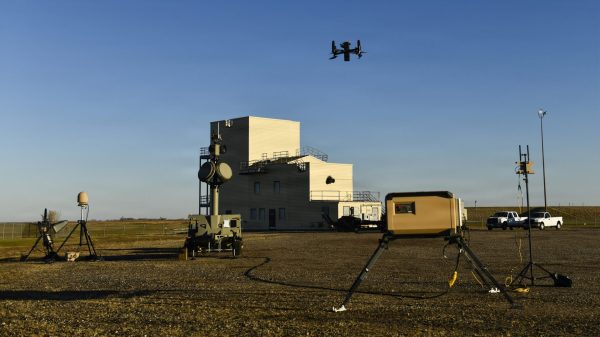
It will also deploy counter-drone systems and ensure U.S. forces have electromagnetic spectrum access.
And to “supercharge” the country’s industrial base, the strategy commits to reinvesting in U.S. defense production, “building out capacity; empowering innovators; adopting new advances in technology, like artificial intelligence (AI); and clearing away outdated policies, practices, regulations, and other obstacles to the type and scale of production that the Joint Force requires for the priorities before us.”
That sentence marks the only NDS inclusion with the term “technology.” Tech was referenced in some form more than 70 times in the 2022 NDS and more than 20 times in the 2018 defense strategy.
More specifically, “hypersonics, quantum, and directed energy are absent entirely,” Pettyjohn told DefenseScoop on Monday.
“This matters because the National Defense Strategy is supposed to establish defense priorities, which then drive investments in technology development and ultimately shape the military capabilities we field,” she said. “A strategy silent on technology is a strategy that cedes the innovation race.”
The 2022 NDS treated technology as the arena of great power competition, where American ingenuity would outpace Beijing.
“The 2026 NDS retreats behind a defensive shield, prioritizing Golden Dome and counter-drone systems while saying nothing about competing with China technologically. The implicit bet is that we can out-produce China rather than out-think them. That’s a losing proposition. China has more shipyards, more manufacturing capacity, and a larger industrial workforce. Production capacity matters — but without American ingenuity and technological edge, we’re fighting on their terms, not ours,” Pettyjohn said. “More factories are necessary. But factories building yesterday’s weapons won’t deter tomorrow’s threats.”
Pentagon spokespersons did not provide comments in response to DefenseScoop’s questions ahead of publication.