Salesforce lands $5.6B Army contract for data analytics, cloud capabilities
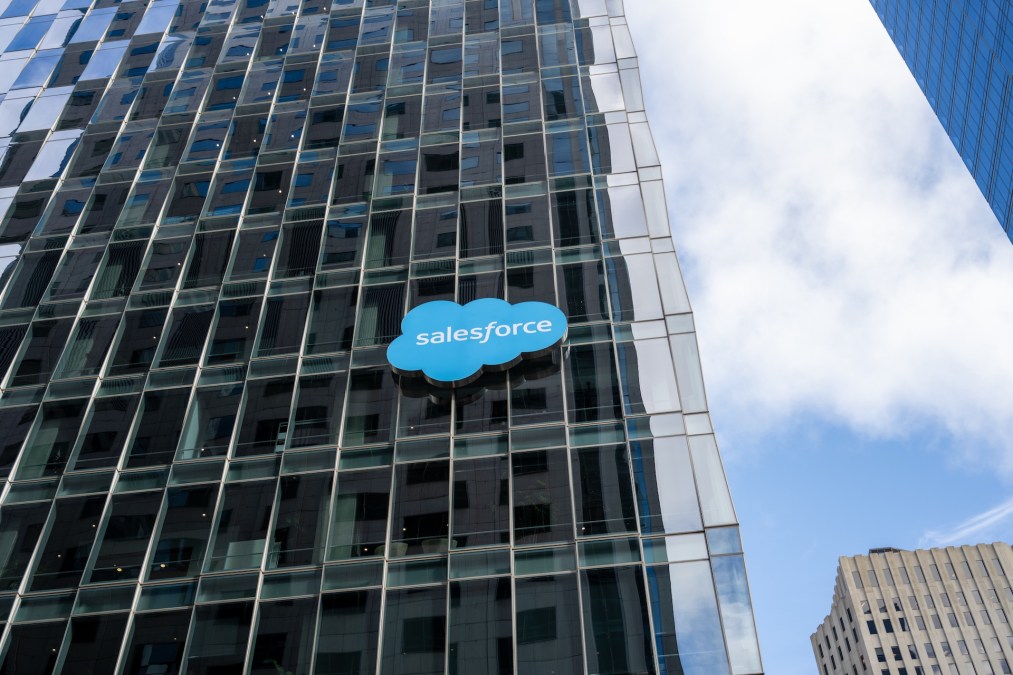
The Army has reached an agreement with Salesforce that the company says will help the Pentagon boost its data analytics capabilities and accelerate future agentic AI deployments.
The indefinite-delivery, indefinite-quantity (IDIQ) contract announced Monday is worth up to $5.6 billion and includes a five-year base ordering period plus a five-year optional ordering period.
Salesforce — a vendor of “customer relationship management” (CRM) tools and other workforce-enabling IT for commercial and government customers — has been increasing its focus on the defense marketplace. In September of last year, it launched its “Missionforce” initiative aimed at serving national security customers.
The new deal with the Army announced Monday was awarded to Computable Insights LLC, a subsidiary also known as Salesforce National Security. The organization is “a specialized entity” within Missionforce that delivers tools under specific government contracts, according to Salesforce.
In a press release Monday, Salesforce said the company’s offerings under the agreement will help connect the military’s disparate data sources and systems into a more unified platform.
“Through the new contract, the Army and the DOW can leverage Salesforce’s trusted data fabric and compliant cloud technologies as the foundation for its agentic enterprise and accelerate decision-making, optimize operations, and improve support for millions of warfighters, civilian personnel, industrial base partners, and dependents,” the vendor wrote in the release, using an acronym to refer to the Department of War, which is a secondary name that the Trump administration has been using to refer to the Department of Defense.
The company is touting its data analytics capabilities as tools that will streamline the department’s workflows and provide better visibility “across personnel, operations, and logistics, enabling faster, more informed decisions.”
According to the contractor, these improvements will help lay the groundwork for “future agentic AI deployment” and “enable the Army to activate AI agents as force multipliers to meet mission needs.”
The Pentagon, under the leadership of Defense Secretary Pete Hegseth and Pentagon CTO Emil Michael, has been pushing hard in recent months to integrate more generative AI capabilities across the DOD.
In December, it launched a new enterprisewide platform called GenAI.mil, which is integrating commercial large language models such as Google’s Gemini and Elon Musk’s Grok.
Earlier this month, Hegseth rolled out the department’s new AI acceleration strategy. The SecDef said the U.S. military needs to transform into “an ‘AI-first’ warfighting force across all components, from front to back.”
Peter Lington, area vice president for Department of War business at Salesforce, has noted that having solid data and managing it as a “strategic asset” will be key for enabling greater Pentagon use of AI.
“We’ve got to have trust in our data first and foremost. So I think that once we ground ourselves in good data that we can trust and we can start to take actions, you’ll see agents and service members working together. If I were to guess, I think it would kind of go across more of the back-office use cases first, like an HR case for benefits. We’ll see an agent start to take action on that. Maybe then it’ll go across logistics, positioning spares, that sort of thing. And finally, in operations where, again, this is where you definitely want to have a human and the agent working together, not an agent working autonomously. … That’s where I see things going,” Lington said in an executive interview with Scoop News Group at the DefenseTalks conference in December.
He added: “If AI is going to be this engine that transforms the Department of War, data is gonna be that fuel that feeds that engine. And so you just like an engine, you gotta have clean fuel, right? So your data’s gotta be clean. So I see this happening if the Department of War manages a really strategic approach and takes things into account like Master Data Management, API orchestration, I think most importantly unifying that data so you have that golden record, you have that data that you know is accurate to be able to take action, that we’ll be in great shape. And one of the things I’ve seen recently is that the department’s really taken [and] put some teeth behind this approach called MOSA, modular open-source approach. And what that does, it gets the department out of proprietary systems, custom systems, and it opens up the data for the department to utilize. And we’ve got to do our part as industry partners to make sure that data is available to utilize. And we do that, and I think we’ll be in great shape.”