Triumphs, trials and a tight timeline: the Army crowns its best drone soldiers for the first time
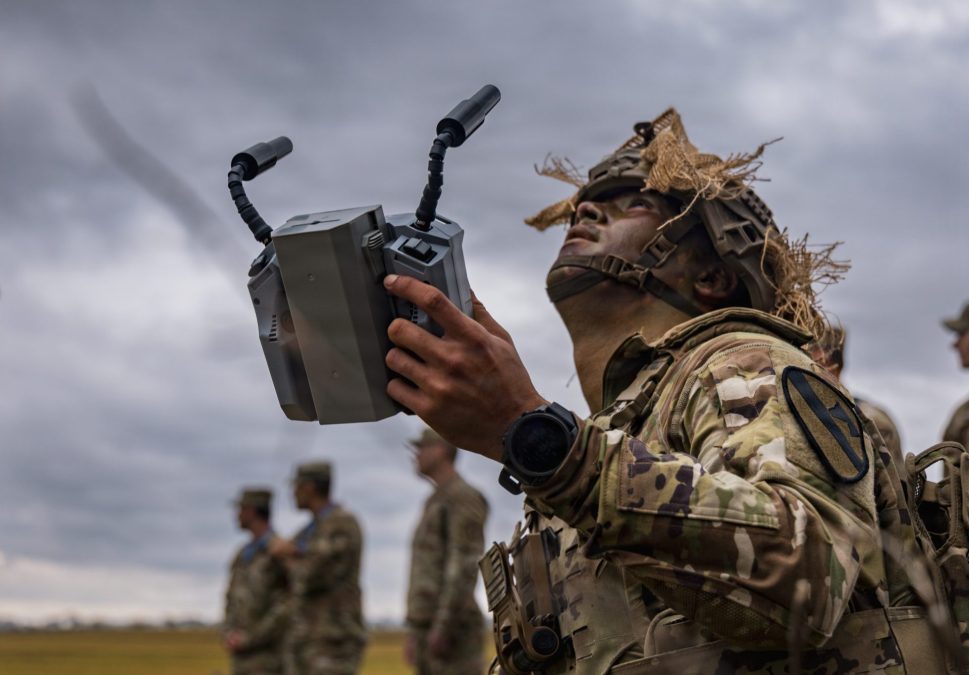
The Army dubbed seven soldiers champions of its first drone competition Friday, each taking home accolades in various categories as the service looks to build-out its unmanned aerial systems repertoire.
Dubbed the “Best Drone Warfighter Competition,” the three-day event in Huntsville, Alabama last week brought more than 100 soldiers from across the Army — including the National Guard and Reserve — to vie for the three top titles and a chance to join the service’s competitive UAS team.
Dozens of teams used the Neros Archer, Skydio and other platforms to demonstrate how quickly they could employ them under physical strain, identify targets after camouflaging themselves and showcase systems they built on their own at their home stations.
The drone competition approach has been adopted by other services and serves as a venue to identify talent, share lessons learned and assess improvements to skills and tech, officials said, as the military aggressively fields small UAS across the force over the next several years.
The Army’s competition marked a significant moment in the service’s part of that effort, opening the competition pool to soldiers from various non-UAS backgrounds and pitting them against each other to help measure where the service stands in its drone progress. That means officials not only saw how troops used the systems, but how they packed equipment and communicated.
“At the end of the day, it’s not about receiving trophies or awards, it is about what lessons can we take from this to find out who the best operator is and how they became the best operator,” said Col. Nicholas Ryan, director of the Army’s UAS transformation at the Aviation Center of Excellence in Fort Rucker, Alabama.
In a media roundtable last week, Ryan said the “competition is very much revealing some of the skill sets we need to improve upon and some of the training that we need to improve upon if we’re really gonna integrate drones across the formation to do combined arms.”
For example, soldiers competed in a “hunter-killer” lane, where they donned camouflage, physically exerted themselves and employed drones in tandem — one to identify targets, another to practice attacking them. For some teams, the event showed “a breakdown in that communication because they haven’t been trained on that,” Ryan said.
Another lesson officials learned from the competition revolved around equipment loadouts. Ryan said there was no specific requirement for which kinds of drones the competitors brought, which produced a variety of set-ups the teams had to contend with while they moved through scenarios.
“What is too much equipment? Like how many batteries? How many drones?” he said.
“Developing a standard packing list for a drone operator is one thing out of this competition that we haven’t defined or said yet, but we’re definitely seeing a range of solutions from soldiers,” Ryan added. “Some soldiers are packing very light and very minimal. And some soldiers are like carrying the kitchen sink on their back.”
Staff Sgt. Angel Caliz and Spc. Jonah Burks from the 2nd Cavalry Regiment won the hunter-killer test and were dubbed best in the tactical lane.
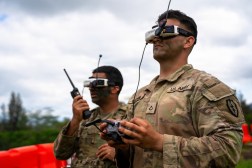
Another lane saw soldiers strapping on first-person view goggles to fly drones through obstacle courses, requiring a five-minute lap time to qualify. A best single lap moved a team up in the bracket, and whichever came out with the fastest time by the end won. Sgt. Javon Purcher with the 1st Cavalry Division took home that accolade.
The third event tested soldier innovation, officials said, where they showcased 3D-printed or otherwise homemade drones that needed to be built with parts compliant with U.S. laws regulating supply chains around the tech.
Pennsylvania National Guardsmen 1st Lt. Ryan Giallonardo, Chief Warrant Officer 3 Robert Reed, Chief Warrant Officer 2 Nathan Shea and Sgt. 1st Class Brent Wehr demonstrated an AI-enabled system called Project R.E.D. (Recovery Exploitation Drone) with 3D-printed components to win over judges.
Ryan said that soldiers were able to adapt to drones they may not have used before, having only received about two hours of familiarization on systems available at the competition. This showed officials that — even in the rapidly changing field of drone technology — soldiers could transfer skills from one platform to another with minimal instruction.
“A skilled UAS operator, if they’re trained in UAS operations and flying UAS and drones, it really doesn’t matter what the piece of equipment is, as long as they get a general good familiarization on it, they will be able to employ it,” according to Ryan. He added that soldiers had made tools to better use drones, mount goggles or carry antennas “that don’t exist in the Army today.”
Officials faced a tight timeline to plan and execute the competition, which was made worse during the government shutdown last year. Ryan said the idea for the competition was born in August, 2025, giving planners just six months to put the event together.
Ryan said they faced little red tape that had hindered previous drone efforts. However, though planners had eyed using kinetic strikes or electronic warfare scenarios, they “chose to not bring that level of challenge in as we only had, like, those few months to just pull off the competition in general.”
“And now as we look forward, at least we have about a year to plan the next one,” Ryan said. “So we’ve already got a pretty good lead time on it.”