Air Force begins adding weapons to CCA drone flight tests
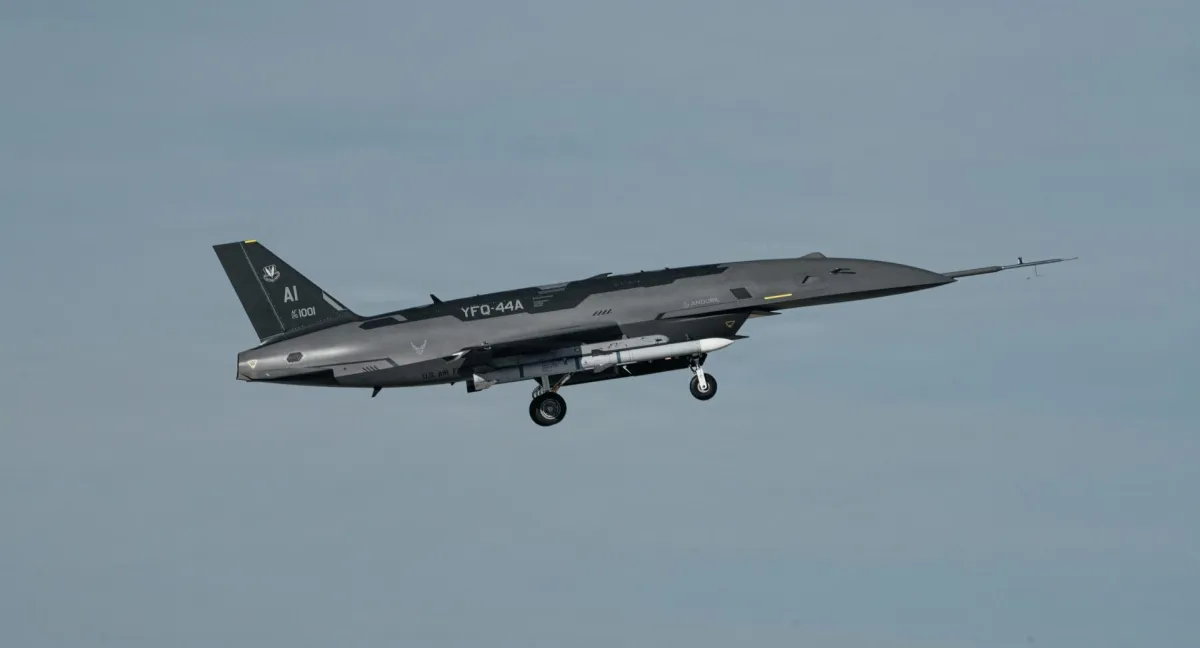
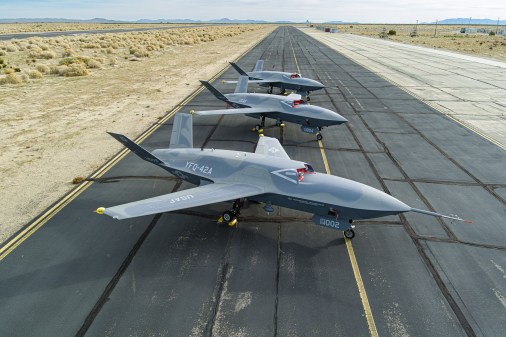
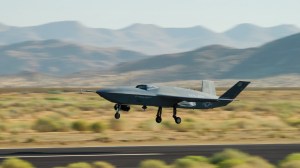
The Air Force has cleared another milestone in its Collaborative Combat Aircraft (CCA) program by successfully integrating munitions onto Anduril’s prototype during live flight tests.
The service recently initiated captive carry tests by strapping an AIM-120 Advanced Medium Range Air-to-Air Missile (AMRAAM) onto Anduril’s CCA platform, known as the YFQ-44A or “Fury.” The events involve unarmed weapons, allowing the Air Force to evaluate “the aircraft’s ability to safely carry external stores” and validate “structural integrity and aerodynamic performance” of the drone, the service said Monday.
“We are following the same detailed approach used in every other aircraft developmental test program to validate structural performance, flight characteristics and safe separation,” Chief of Staff of the Air Force Gen. Ken Wilsbach said in a statement. “This ensures the CCA can safely integrate inert weapons before future employment.”
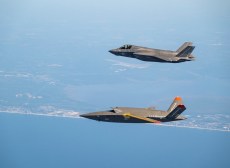
The captive carry tests are the latest milestone for Increment 1 of the Air Force’s CCA program, which seeks to develop a robotic wingman drone that can fly alongside manned sixth– and fifth-generation aircraft. As part of the service’s broader Next-Generation Air Dominance (NGAD) family of systems, the platforms are expected to conduct a range of missions — including intelligence gathering and offensive strike.
An Anduril spokesperson told DefenseScoop that the company has begun a series of flight tests alongside the Air Force that integrates training munitions onto the YFQ-44A. In 2024, Raytheon announced that it was working with the Air Force to integrate AMRAAMs onto the first batch of CCA prototypes during the program’s development phase.
C. Mark Brinkley, a General Atomics spokesman, declined to comment about the company’s CCA weapons integration schedule and referred DefenseScoop to the Air Force.
“General Atomics has been integrating weapons for decades. We’ve fired air-to-ground missiles, air-to-air missiles, bombs of various sizes, loitering munitions, and air-launched effects. Weapons from the wings and weapons from the internal bay. No one wonders if we can put steel on target. General Atomics is the most lethal uncrewed aircraft company in the world. That’s not changing,” Brinkley said.
An Air Force spokesperson told DefenseScoop that both contractors’ platforms in the CCA program are proceeding with their planned weapons integration testing. “The YFQ-44A has entered captive-carry flights, while the YFQ-42A is expected to begin this same phase in the very near future,” the spokesperson said.
According to a service news release, the latest development phase for the initiative is focused on safely integrating weapons onto the CCA platforms in a controlled environment — not testing operational deployment.
“Throughout development and testing, a human retains authority over weapons release decisions,” officials wrote in the release. “CCA is designed to operate within established command structures and legal frameworks that govern all Air Force weapons systems.”
During a keynote speech at the annual AFA Warfare Symposium in Colorado, Wilsbach highlighted the captive carry tests as an example of the service’s fast-track approach to the CCA program.
“The Collaborative Combat Aircraft development is progressing rapidly from concept to prototype in 16 months, to recently integrating inert weapons,” he said. “The development team is moving much faster than the traditional program.”
The Air Force is developing the CCA drones in spiral increments, with each iteration featuring the latest upgrades and capabilities. Anduril and General Atomics received prototype development contracts for Increment 1 in 2024, and both companies began live flight tests of their respective drones in 2025.
While the service is only funding development work for two CCA prototypes, other vendors are allowed to compete for the final Increment 1 production decision — expected in 2026 — with their own research-and-development dollars. Northrop Grumman announced it was vying for the contract with its prototype known as Project Talon, which the Air Force designated as the YFQ-48A in December 2025.
The revelations about the captive carry tests came after the service announced Feb. 12 that it has started testing mission autonomy packages to evaluate the autonomous-flight capabilities of the CCA drones. RTX Collins Aerospace and Shield AI have been tapped to build the autonomy software and integrate them onto prototypes developed by the prime contractors.
General Atomics has already flown its CCA — known as the YFQ-42A or “Dark Merlin” — with Collins Aerospace’s Sidekick Collaborative Mission Autonomy.
Anduril is partnering with Shield AI to conduct semi-autonomous flight tests and expects to begin doing so in the near future.
“CCA is a critical part of a larger, integrated system-of-systems that will give our warfighters the overwhelming advantage,” Wilsbach said in a statement. “This program is about delivering a network of effects that will sense, strike, and shield our forces in contested environments. We are empowering our teams to take smart risks and deliver this capability faster, ensuring we can deter, and if necessary, defeat any adversary.”
Updated on Feb. 24, 2026, at 3:50 PM: This story has been updated to include additional comments from the Air Force and a General Atomics spokesman.