U.S. Northern Command says it thwarted a drone threat over a ‘strategic’ installation hours into the Iran war
Shortly after President Donald Trump initiated Operation Epic Fury against Iran on Feb. 28, forces under U.S. Northern Command used a new “Flyaway Kit” (FAK) to eliminate a drone threat at an undisclosed strategic military base, according to a top commander.
Gen. Gregory Guillot, the head of Northcom and North American Aerospace Defense Command, spotlighted that incident in a written statement he submitted to the Senate Armed Services Committee ahead of a posture hearing he testified at Thursday morning.
Although many details remain unclear about that particular FAK deployment, his comments suggest counter-small unmanned aerial system (C-sUAS) flyaway kits are emerging as a viable rapid-response option for defending domestic military installations against contemporary drone incursions.
“In the early hours of Operation EPIC FURY last month, a deployed FAK successfully detected and defeated sUAS operating over a strategic U.S. installation,” Guillot wrote in his testimony.
He did not specify how many drones were involved in that event, or where it took place. The term “strategic” in U.S. military parlance is sometimes used to refer to assets linked to the nation’s nuclear arsenal.
“Soldiers and Marines assigned to Joint Task Force – Southern Border (JTF-SB) have also utilized CsUAS authorities and equipment over the last year to mitigate more than 100 sUAS that routinely track and monitor JTF-SB patrols and activities,” Guillot also noted.
Drone incursions over domestic U.S. military bases and critical infrastructure have surged in the last few years. Officials have raised concerns that some episodes could mark deliberate, high-tech surveillance operations involving foreign actors or cartels targeting sensitive sites.
Similar unexplained drone flights have also been reported over U.S. bases abroad, while the Pentagon continues to confront challenges in identifying the sources of the disruptive platforms.
Since Trump launched Epic Fury as an America-led, Israel-coordinated military operation to take out Iran’s leadership, naval and air power, manufacturing capabilities and nuclear infrastructure — fears of retaliation and unidentified drone activity have been increasingly documented on U.S. soil.
Northcom officials did not say whether they have determined if the drone incident over a strategic installation not long after Epic Fury began had any connections with Iran or Iranian sympathizers operating inside the United States.
When drone incursions are reported at U.S. military facilities in the continental United States and Alaska, Northcom plays an active role in ensuring its forces can quickly access the most effective assets to counter the systems.
Guillot’s written statement to senators noted that “the rapid development and deployment of effective C-sUAS capabilities in cooperation with [Joint Interagency Task Force 401] will remain a critical USNORTHCOM and NORAD priority as unmanned systems proliferate and malign actors continue to develop advanced tactics and technologies for use against U.S. forces.”
In response to questions from DefenseScoop on Thursday, Northcom spokespersons declined to confirm the exact U.S. military installation where the command deployed its FAK against a small-UAS threat shortly after Epic Fury kicked off.
“We will not name the base where our Flyaway Kit is deployed in order to preserve operational security. Specifically, connecting the Flyway Kit to a specific base can potentially illuminate that base’s vulnerabilities to an adversary,” a spokesperson said in an email. “Additionally, by confirming a specific Counter-small Unmanned Aircraft System (C-sUAS) platform, we would potentially give an adversary an advantage in circumventing our C-sUAS capabilities at that location.”
The official also would not specify whether the military base involved was associated with the U.S. nuclear enterprise or the brand and source of the drone that was taken down by the FAK.
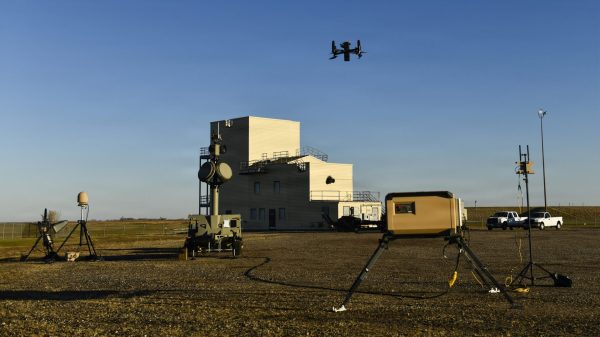
Designed to identify, track and eliminate drone threats at military sites, Flyaway Kits can feature AI-enabled technologies, like radar, optical sensors and UAS interceptors, that are networked to shield forces and installations around the transportable systems.
According to a press release Northcom published in November, the command’s “fly-away kit is an amalgamation of sensors and effectors.”
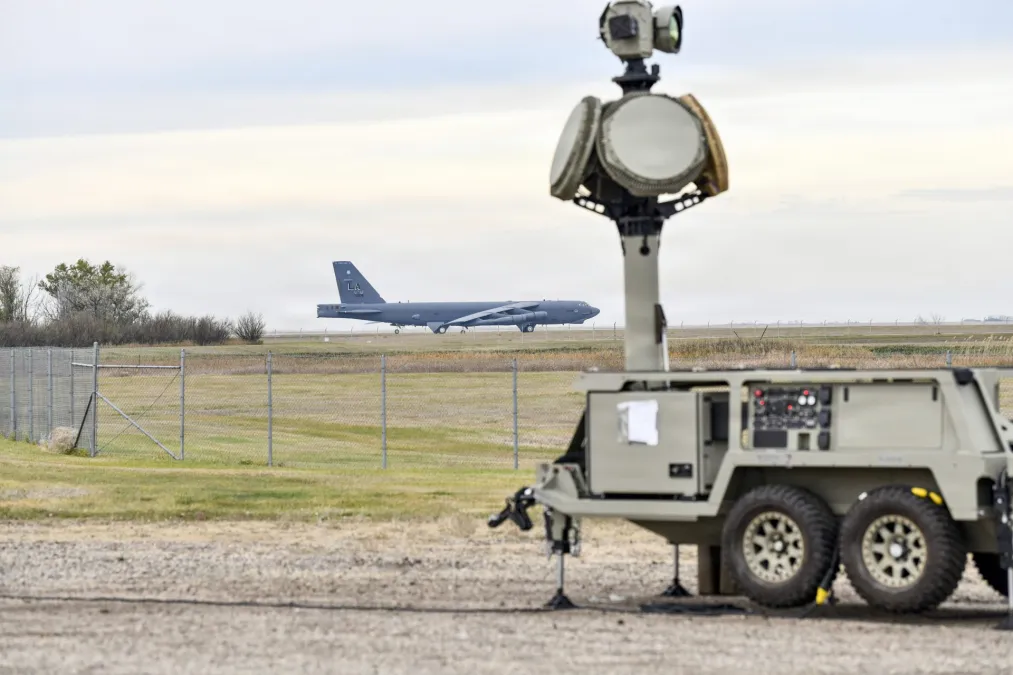
A version of a FAK that was tested last year included the Heimdal mobile sensor trailer that’s equipped with a continuous 360-degree pan and tilt unit, thermal optics and a radar, all working together autonomously for target acquisition; Anduril’s Anvil drone interceptors and launch box to attack other adversarial drones; an electronic warfare tool called Pulsar that features radio frequency detect, classify and deny options; and the Wisp, wide-area infrared system that is AI-enabled and provides situational awareness for operators, according to a description released by Northcom.
“You can’t have just one or two different defeat mechanisms. They have to be across multiple mediums — everything from denying satellite guidance, all the way to first-person-view and everything in between — which means that we have to expand our arsenal in ways that we didn’t think two or three years ago,” Guillot told lawmakers at Thursday’s hearing. “And we wouldn’t have known that without Ukraine.”
In his written testimony, the commander confirmed that Northcom previously purchased a FAK — “with more due in late Spring 2026 that can be rapidly deployed anywhere” in the command’s area of responsibility.
He further stated that in October 2025, Northcom’s FAK team deployed to Minot Air Force Base in North Dakota to participate in a weeklong counter-drone activity that was part of the U.S. Strategic Command’s Global Thunder exercise. Those efforts validated the ability to quickly deploy the kit and its operators in support of an installation experiencing drone incursions, Guillot said.
Stratcom oversees America’s nuclear arsenal. Minot is a base for nuclear-capable bombers and nuclear-armed intercontinental ballistic missiles.
That exercise also “resulted in the certification of the FAK, operators, and processes to effectively detect, track, deter and defeat sUAS,” Guillot told lawmakers in his written testimony.