Navy CNO kicks off new ‘containerized capability campaign plan’
U.S. Chief of Naval Operations Adm. Daryl Caudle is launching a strategic plan to guide the sea service’s deployments of modular, containerized weapons and payloads that can be quickly adapted to existing ships for distinct combat operations without the need for long, arduous or expensive asset overhauls.
This new strategy will mark a key element of Caudle’s broader modernization vision and “Fighting Instructions” to revamp the Navy into a hybrid force of flexible manned and unmanned platforms that expand the military’s global reach and capacity.
During the McAleese Defense Programs conference this week, the CNO announced a new effort the Navy is pursuing to create a “containerized capability campaign plan.”
“There should be no reason why I can’t place a modular container on the back of our ships and carry an array of capabilities to any region in the world. Now, that sounds simple,” Caudle said. “But there must be real engineering behind it. Do the doors drop down, and do they fold up? What’s it made of? What’s the volume, where? What goes inside? What’s the interface? Is it standardized to the combat and communication systems?”
Released in February, Caudle’s fighting instructions and associated “hedge” framework are designed to pivot the Navy from primarily relying on large, exquisite platforms toward more adaptable force packages that can be speedily reshaped as new conflicts and priorities emerge.
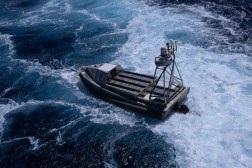
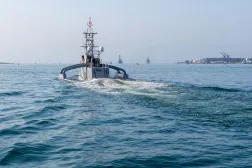
Containerization will enable these aims, as it can allow the Navy to rapidly configure suitable ships with modular payloads — including drones, weapons and sensors — to confront localized threats without requiring a massive carrier strike group or other hefty fleet deployments.
“Recent events have shown that the carrier strike group, though it remains one of our Navy’s greatest assets, wasn’t designed to be our nation’s silver bullet or to answer every single tactical problem. Consider Venezuela, when the Ford Strike Group left the Mediterranean, where was the other strike group to take her place? Imagine the flexibility we can do if, instead of a strike group replacing her, we’re able to provide [U.S. Southern Command] with other maritime options, like one of my new frigates paired with containerized, unmanned options,” Caudle said.
Tailored force packaging will not replace the Navy’s general-purpose fleet, according to the CNO. Instead, the notion is that it will supply military decision makers with “greater degrees of freedom” and help the Navy to “punch above its current weight class.”
At the McAleese conference, Caudle urged members of America’s maritime and defense industry to “get clever” with ideas about what the Navy can containerize in the near term, such as directed energy weapons and drone swarms.
“I want to containerize everything,” Caudle said. “That’s why I kicked off the containerized capability campaign plan to get after this challenge at scale.”
The CNO did not share a timeline for releasing that plan publicly.