New DOD innovation hub will confront ‘unacceptable vulnerabilities’ in production of military fabrics
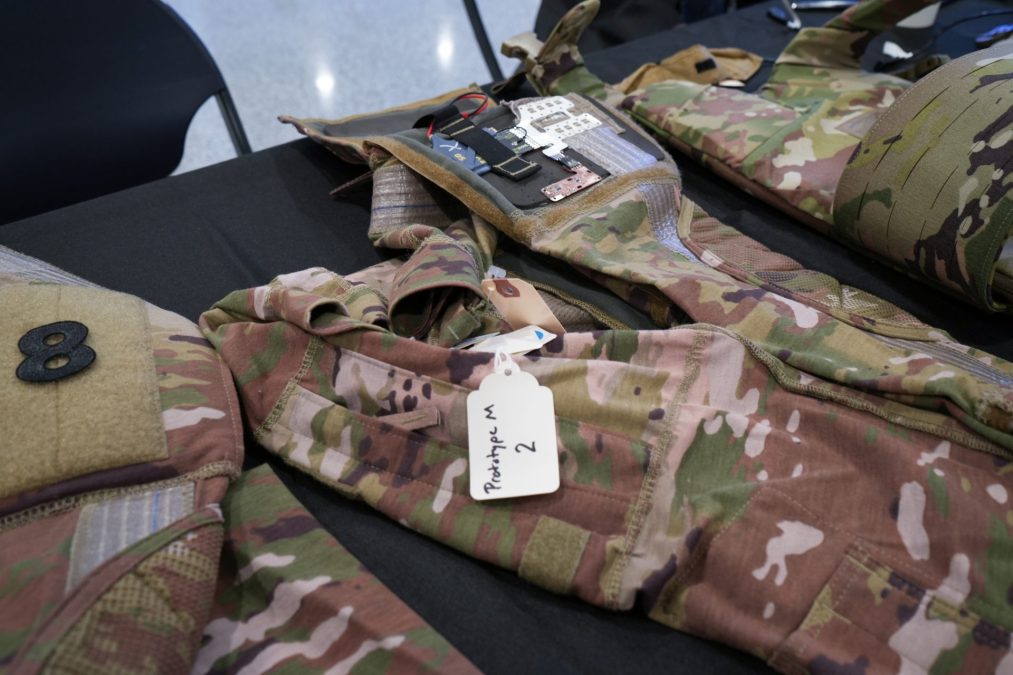
The Defense Department’s next Manufacturing Innovation Institute will focus on reviving America’s domestic fabric production capacity and enabling modern and much better-performing military materials.
Senior defense officials unveiled plans on Monday to launch the department’s ninth MII at Gaston College in Belmont, North Carolina, a long-standing U.S. hub for textile training and development.
“We’re talking about innovating the very fiber in our warfighters’ uniforms, parachutes, and camouflage to keep them performing better and safer,” Assistant Secretary of Defense for Science and Technology Joseph Jewell said. “Ultimately, this means increased survivability, better protection, and enhanced lethality for our warfighters on the front lines.”
He and others shared updates at the Pentagon Monday during the ManTech Program Honors Ceremony — the first of a two-day event commemorating the 70th anniversary of the DOD’s Manufacturing Technology Program.
On Tuesday, the team will host the ManTech Exhibition in the Pentagon’s 2nd Floor Apex to spotlight impacts from the last seven decades and showcase some of the program’s latest in-development innovations.
“When you look back at the 70 years of history of this organization, it’s about recognizing how we’re driving the future of warfare. We’re going to hear a lot about the future of warfare in the coming months because of the nature of the threat environment. We’ve learned a lot in Iran, in Venezuela, and we’re continuing to learn a lot about the pacing threat in China and the future — and how we think about autonomous systems, how we think about contested logistics, how we think about directed energy, hypersonics — and things that we have to do while looking at the things we have, and having to make sure they work in the modern era,” said Under Secretary of Defense for Research and Engineering Emil Michael. “It’s an extraordinary task, but I have confidence that this is the right group to do it.”
ManTech is designed to fund and mature advanced U.S. production capabilities and manufacturing processes that are necessary to arm the military with the weapons and equipment needed to fight and win wars, as opposed to building out those assets directly.
At the awards ceremony, which DefenseScoop attended, Michael noted that ManTech was established in 1956, when the government was keen to solve industrial gaps exposed by World War II.
“On the 60th anniversary, I’m quite sure in this room we weren’t talking about a pacing adversary — an adversary that had mobilized one of the greatest military buildups of all time — and so the urgency was different,” Michael said, alluding to recent modernization moves made by China’s armed forces. “I would argue that the urgency right now is what it was probably pre-World War II.”
The program is composed of individual investment programs operated by the Army, Navy, Air Force, Defense Logistics Agency, and Office of the Secretary of Defense. Each component leads their own organization-specific processes, mandates, and procedures for executing projects, but collectively, they operate under one unified mission.
Since 2012, the department has also been sponsoring Manufacturing Innovation Institutes around the country.
Every institute encompasses a public-private partnership that is designed to overcome serious challenges affecting the military and manufacturing innovators across different technology areas, like aerospace and biotech.
Roughly one month ago, a DOD source selection committee approved to set up FutureTEX — the DOD’s ninth MII, which will prioritize accelerating innovations in fibers and textiles manufacturing — at North Carolina’s Gaston College.
Jewell noted that America’s “reliance on foreign manufacturing has created unacceptable vulnerabilities” across the defense and national security supply chain.
“On the surface, you might think there’s nothing critical or innovative about making cloth or fibers, but textiles play a crucial role in warfighters’ lives, and we need better-performing materials as well as the capability to manufacture those products in the U.S. For decades, the manufacture of advanced fibers and textiles has been offshore,” he told the audience. “We are going to change [that]. The revolutionary fibers and textiles MII will help reestablish deterrence by leveraging advanced automation and robotics to enable the domestic production of these types of materials.”
The “Best of the Best” technologies that were honored at the 70th anniversary awards ceremony included: an Army effort that resulted in the production of the lighter, stronger ballistic helmets to protect soldiers; Navy work that led to affordability improvements for the F-35 aircraft electro-optical targeting system; an Air Force project that enabled automation of advanced aircraft coatings; a Defense Logistics Agency initiative to solve microcircuit obsolescence for long-lived weapon systems; and Manufacturing Science and Technology Program-led activities to manufacture precursor foamable celluloid material for combustible munitions components.
The Air Force also received the top “Principals Honor Award” for its F‑35 Inlet Duct Robotic Drilling Program. That work replaced a dangerous, ergonomically brutal 50‑hour manual drilling process for humans with reliable robotics for stealth airframes that drastically reduced manufacturing defects.
“The [project] really helped shift the entire defense aerospace manufacturing base, setting the standard and the push to data-driven robotic processes, and we continue to see that legacy. It has continued to lead to numerous related efforts that have really improved production costs, timelines and capabilities — and made our workforce much more safe,” said Jennifer Fielding, chief of the Air Force Research Laboratory’s Composite, Ceramic, Metallic and Materials Performance Division, who accepted the award.