After Army commits to Joint Laser Weapon System program by 2028, Pentagon critical tech official presses other services to do the same

Following a commitment by the Army to transition to the Joint Laser Weapon System program within the next two years, the Pentagon’s critical technology chief is putting the pressure on other services to do the same.
The Defense Department awarded two contracts for the JLWS program to nLIGHT Defense, a high-powered laser company based in Colorado, and Lockheed Martin for an initial value of $86 million with a ceiling of $847 million.
The JLWS program is designed to field directed energy weapons en masse, a significant effort by the department to adopt a more cost-effective alternative to shooting down enemy drones and cruise missiles as it faces a strain on expensive interceptors, especially amid the Iran war.
“We’re really bullish on our directed energy, the Army’s already committed to transition it,” Michael Dodd, assistant secretary of defense for critical technologies, said at the National Defense Industrial Association’s Emerging Technologies for Defense Conference on Wednesday.
True to his nickname, “The DoddFather” is making the other military branches an offer they can’t refuse. “I’ll say it here, I’m going to knuckle roll the other services to do the same.”
Dodd said his office is committed to fielding critical technologies, including directed energy systems, within 24 months or less. The Army will follow the same timeline for the JLWS, according to Dodd.
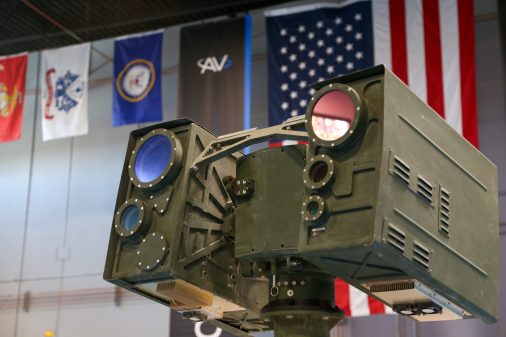
Earlier this month, the Army awarded AeroVironment a $464.8 million, landmark deal for the service’s Enduring-High Energy Laser (E-HEL) program, which AV officials touted as the first production contract for directed energy weapon systems in American history.
AV officials said they expected to deliver dozens of the company’s LOCUST X3 laser weapons to the Army under the deal.
High-energy lasers have already been employed by the military, including on the border where the task force assigned to the area recently said it shot down several “cartel-linked” drones, DefenseScoop reported.
“The technology is there, it has existed for some time. The cost per system is still high,” Dodd said. “That’s because we’re not scaling the systems.”
He said his office will fund certain directed energy systems “but the services need to pick those up and procure them by the dozens or hundreds, and we start to get into installation defense and theater defense” which are key for scaling and cost-efficiency.
“I think everyone is aware and tracking the inverted cost per shot currently that we are kind of constrained by, right?” Dodd said. “We’re shooting down $1,000 one-way attack drones with multi-million-dollar systems. It’s completely unsustainable.”