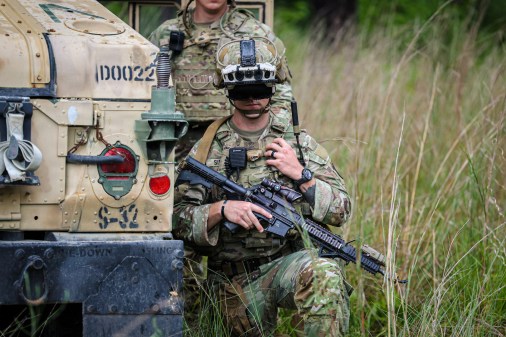
Anduril expanding into laptop manufacturing in partnership with Qualcomm
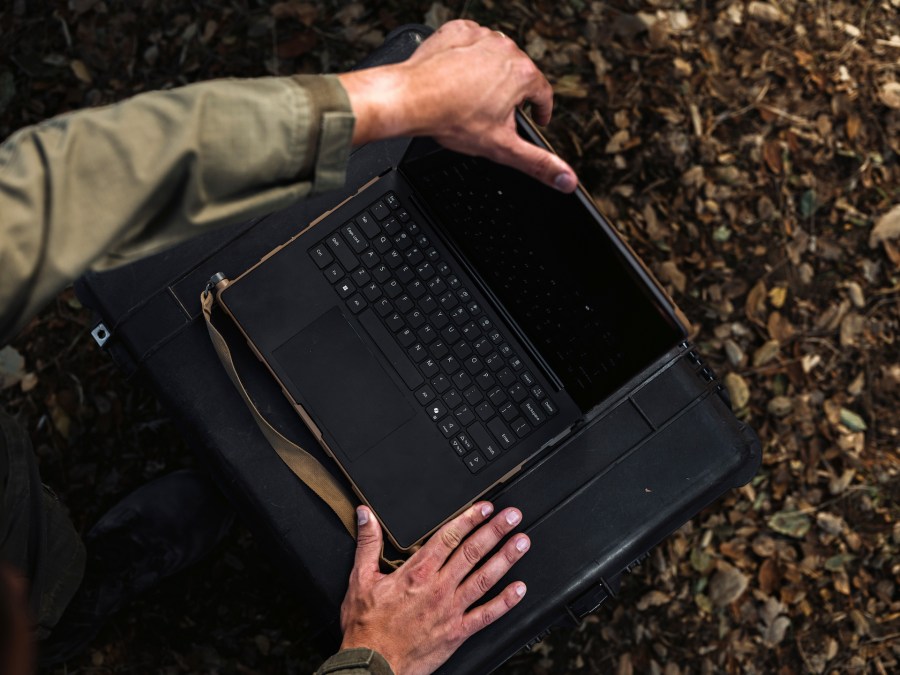
Defense technology company Anduril, best known for building drones and AI-enabled software for the military, is branching out into a new product manufacturing business: laptops.
The company on Tuesday announced the launch of a computer initiative, dubbed BlueChip, in partnership with wireless tech giant Qualcomm.
Anduril has already developed “functional prototypes” of the laptops, according to a press release. Qualcomm’s Snapdragon X Series will provide the core computing capabilities for the devices, including “general-purpose processing, graphics, and on-device AI.”
The companies plan to begin taking orders next year.
The firms touted BlueChip as an effort to boost manufacturing in America and reduce the nation’s reliance on foreign supply chains.
“The United States pioneered personal computing and continues to lead the world in designing advanced technology, but decades of offshoring have left America dependent on foreign manufacturers for the computers and components that power everything from personal devices to critical government infrastructure. This dependence creates a national security vulnerability. Conflict or disruptions to overseas supply chains could limit access to essential computing hardware and undermine America’s ability to sustain production when it matters most,” company officials wrote in the press release.
The organizations plan to market the tech to government and military customers, among other potential buyers.
“It might sound crazy for a company like Anduril to be doing something like this,” Anduril co-founder and leader Palmer Luckey told reporters ahead of the official announcement.
However, he suggested that the BlueChip product line isn’t far outside of Anduril’s wheelhouse.
“What we’ve been doing at Anduril, including with Qualcomm, is not actually very different from building a computer. You look at any of our autonomous drones, we’ve got a CPU, a GPU, memory, storage, mainboard, battery, sensors, wireless radios. It’s basically all the same stuff you’d have in any computer. The only difference is the shape and that it has a screen and a keyboard. Even on the display side, actually, we have a number of drones that have status screens, so it’s really not all that different,” he said.
During a call with reporters ahead of the announcement, Luckey declined to say what the production targets are for the new laptops.
“We’re not sharing any quantities yet. We’re gonna have a lot more to announce next year. I think it’s really, really tough right now to announce these things. To be totally candid, we’re in an unprecedented time, as it were, for building computers given … the AI explosion, and so we’re not going into full-rate production until next year. We’re in very early prototyping production. Like, we have a very small line put together, very small quantities of these right now to build out the manufacturing process. But I’m not going to know quantities until we have a little more clarity on the manufacturing side, the vendor supply chain side. There’s a lot of moving pieces,” he said.
Anduril plans to use its Arsenal-1 facility in Ohio — where it’s also building autonomous drones for the Air Force’s Collaborative Combat Aircraft program — for BlueChip manufacturing.
Cristiano Amon, president and CEO of Qualcomm, told reporters during the call that chips for the laptops will be made at a TSMC facility in Arizona.
Luckey added that the companies also have “some stuff going on” in California related to the effort, though he didn’t provide details.
“There’s certainly going to end up being other facilities. This is another one of those things where it’s still in flux, exactly which facility is going to do which step. So, I can’t get into as much detail as I’d like,” he said.
Luckey noted that, while the laptop will be the first product in the BlueChip line, the companies’ vision is to expand the offerings and it’s “very likely” that some of those will be made at other facilities.
Currently, the laptop’s bill of materials is about 90% from the U.S. and allies, according to Luckey. The aim is to eventually get that number up to 100%.
Regarding the workforce, the Anduril boss said he’s been “diverting some of our best people to this project for quite some time,” including those who worked on some of the other offerings that the company is better known for, such as attack drones.
The U.S. government has not yet provided any subsidies or contracts to Anduril and Qualcomm to develop the laptops, according to Luckey, who noted that the companies have been putting their own R&D dollars into the initiative. He did not disclose how much money is being invested in the effort to get to full-rate production.
“I’d say the worst case here is that this is going to be a low-volume laptop for critical industries and government … that desperately need something like this to exist. That is a healthy business for Android to run, even if it doesn’t get bigger. I happen to believe it’s going to be much, much, much bigger,” he told reporters.
Amon noted the AI boom that’s unfolding across the economy.
“I think when you look at how AI is evolving, computers are also becoming token machines,” he said. “In addition to what you do with a laptop, it’s going to run models, it’s going to be part of this entire compute fabric that’s going to be running AI. And you’re going to have different ecosystems and needs for [the tech] across different industries. It’s very possible that you’re going to have certain industries … in addition to the federal government, that will want devices. They have different kinds of requirements and compliance with security and across the supply chain. … So, I think this could create an interesting opportunity when you think about the addressable market. It’s just a different world going forward when you think about the role of PCs.”
Luckey added that the chips in the new laptop are “extremely good” for AI inference.
“Maybe not training large models, but on the inference side, they’re fantastic. And so, I’ve been using my BlueChip laptop to do a whole bunch of local model work where … I don’t want to — and actually am not allowed to — send certain information out into the cloud. And so having devices that can do a really good job of onboard AI inference running local models is actually really, really important,” he told reporters.
The BlueChip systems are designed for potential military customers.
“This is aimed squarely at the defense side of things as the pace-setting element of the design because it’s the most stringent part of the design. So basically I have to design for the military users because they’re the ones that are going to be beating these things up the most. They have the most stringent security requirements, the most stringent environmental requirements, shock and vibration, all of that,” Luckey said.
For the average individual consumer, the price tag for the extra-rugged devices might not be cost competitive with other laptop offerings on the market, he suggested.
Anduril has been testing out the BlueChip tech with multiple operating systems, Luckey noted.
“As of right now, we have it running Windows and two particular flavors of Linux that are very popular with the U.S. military to make sure that all the drivers work, make sure that all the applications work,” he said.
One of the applications that has been integrated into the BlueChip system is Anduril’s Lattice software platform that serves as the backbone for some of the military’s high-priority modernization initiatives, such as Next Generation Command and Control (NGC2).
“It’s critical that we be able to run Lattice, both the version that processes locally and the version that commands and controls systems that are processing at the edge with Lattice,” Luckey said.