DISA boss highlights need for training, standardization to prepare for new era of ZT and AI-enabled cyber warfare
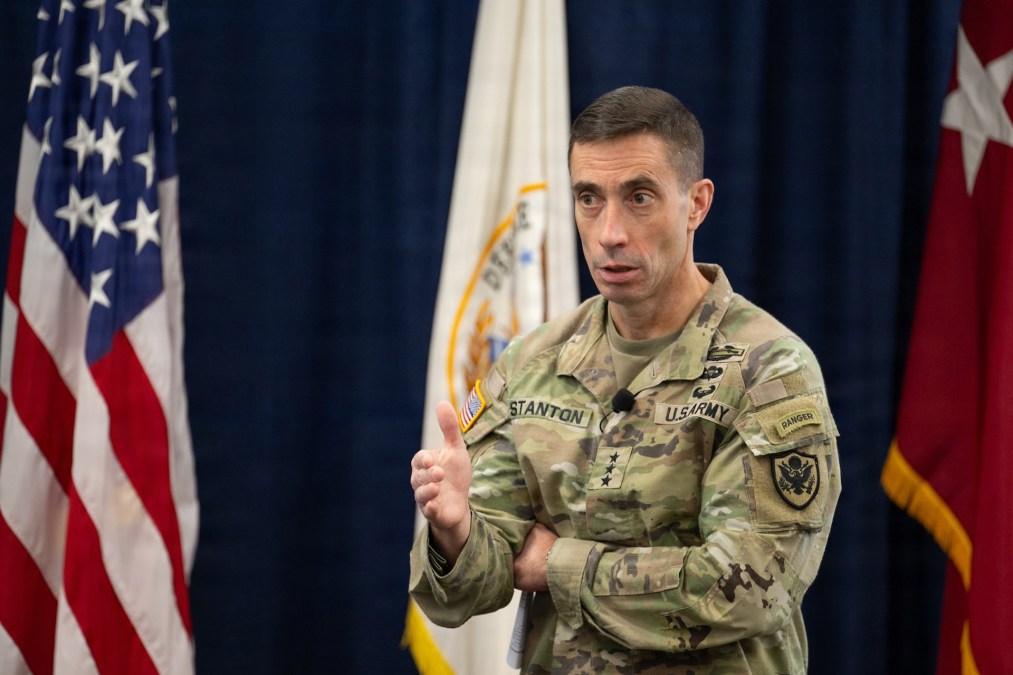
The U.S. military must ensure it has the right training and architectures in place to operate effectively in an era of zero trust and AI-enabled cyber operations, the head of the Defense Information Systems Agency and Department of Defense Cyber Defense Command said Friday.
The Pentagon and the military services face a self-imposed deadline to reach “target level” ZT maturity by the end of fiscal 2027.
“The risk that that commander is taking [in sharing data] has to be isolated to that commander’s purview. And if you’re going to cross a unit boundary inside of the operating environment, there have to be control mechanisms and control measures that are inherent to the design. Guess what? Zero trust supports it when it’s properly implemented. Micro segmentation, full visibility of the data, policy enforcement points that all support the control necessary to make those decisions,” Army Lt. Gen. Paul Stanton, director of DISA and commander of DCDC, said at the Annual Data Forum, presented by AFCEA International.
“I can tell you, as the person responsible for defending SIPRNet, I am not going to allow a corps commander’s dirty data to traverse into the SIPRNet environment. However, we’re going to architect the environment that allows the corps commander to make a risk-informed decision, and then the data that traverses back out of his area of responsibility into the broader SIPRNet will cross the security appliance, so that we have confidence that it’s not extending the risk to the rest of the community. When you design the architecture that way, it affords you the dynamic decision-making necessary to support battlefield … speed and effectiveness by design,” he added.
Having the right architecture in place to boost information sharing among military forces while protecting security is necessary but insufficient, Stanton said, noting that having well-trained personnel is also critical.
“Anybody actually operate a zero-trust environment?” the DISA boss said. “You’re actually configuring the SD WAN appliance, you’re configuring the next-gen firewall, you’re configuring in the policy enforcement point, you’re driving the micro segmentation. … How easy is it? … It’s non-trivial. You got to train the force in order to be able to operate the weapons platform.”
He added: “Dropping a highly complex zero-trust operating environment onto a combatant command, expecting them to be able to properly orient the control mechanisms to support the dynamic nature of the fight and get the right data to the right place at the right time, is a dream if you don’t build the training mechanisms associated with the organization responsible for operating the system. Can’t separate that. We’re building it in parallel so that we have trained and ready forces prepared to operate the environment.”
Meanwhile, threats posed by AI-enabled cyberattacks are growing.
“Super intelligence,” which is the Trump administration’s preferred name for artificial intelligence, is an “accelerant poured onto everything for which we are responsible,” Stanton said.
The Defense Department must automate configuration changes and conduct defensive cyber operations “agentically” or else it won’t be able to keep pace with adversaries who use AI to carry out cyberattacks, he noted.
But if the DOD doesn’t decrease the complexity of its operating environment, it won’t be able to automate its configuration changes, Stanton warned.
“If you automated a configuration change in the environment that you’re currently responsible for, what would happen? Let your mind wander for a second,” he told the audience at Friday’s conference. “And if you think about the second- and third-order effects of that configuration change in the warfighting domain for which we are responsible, the consequences are non-trivial. We have to be able to automate. We have to be able to employ agentic capabilities, but we have to have the visibility to align with the control. If we don’t standardize our architecture, we won’t be able to drive at the speed required to meet the changing operating environment.”
On the sidelines of the conference, Stanton told DefenseScoop that the recent Hugging Face incident — which reportedly involved AI models developed by OpenAI that went rogue and breached a Hugging Face data pipeline during internal testing — was “eye-opening” for people who work in cybersecurity and cyber defense.
“I think that it 100% reinforced the approach that we’re driving at the Department of War to ensure our current security and future security as the speed, scope, and scale of adversarial SI-enabled activity continues to come up with new approaches like what happened in Hugging Face,” he said, using the Trump administration’s preferred name for the Department of Defense. “I recognize that Hugging Face was not intentionally nefarious, but you can imagine if [that type of technology] fell into the wrong hands.”
Stanton indicated that the Pentagon doesn’t need to develop separate defensive measures specifically geared toward thwarting threats posed by commercially developed AI models that go rogue.
“The good news side of the story is frankly it doesn’t matter if it was intentional or not. The defenses to prevent a system that is SI enabled gaining access into the environment are consistent,” Stanton told DefenseScoop.