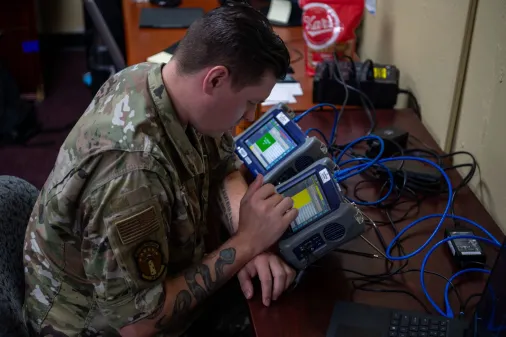
DISA testing Mission Partner Environment capabilities in Indo-Pacific

BALTIMORE — The Defense Information Systems Agency is deploying capabilities within U.S. Indo-Pacific Command that will create a secure space for the Pentagon to share information with its international partners and allies.
After months of testing capabilities for an effort known as the Coalition Information Environment (CIE), the agency is now preparing to demonstrate the new technology during the joint force’s Olympus Fires exercise in Indopacom, according to Lt. Col. David Courter, DISA’s chief of combatant command plan integration.
“That is the mechanism — the ways and the means — in which we will continue to deploy our CIE environment that will scale,” Courter said Tuesday during a panel at AFCEA’s TechNet Cyber conference.
The CIE is the network infrastructure provided by the Pentagon for the Mission Partner Environment (MPE), which serves as a framework to provide a single digital workspace where the U.S. and international partners can share intelligence and plan operations.
The MPE seeks to improve American military cooperation with allied nations, which have been hampered by incompatible network infrastructure that makes data sharing cumbersome. The effort is closely related to the Mission Network-as-a-Service program that is developing a unified network for all the U.S. combatant commands, but instead focuses on breaking down IT silos between allies.
“You have to nest what we’re doing with Mission Partner Environment inside of the overall Mission Network-as-a-Service initiative,” Courter said. “We need to simplify the environment in order for us to defend it as optimally as we can. We cannot continue to have 11 different [Secret Internet Protocol Router] Networks on the island of Oahu and five different versions of [Combined Enterprise Regional Information Exchange System].”
At its core, CIE provides the architecture and networking services that will create a single digital workspace for international partners. The capabilities are centered around data-centric security and zero-trust cyber principles to protect information within the environment, Courter added.
Following the demonstration during Olympus Fires, DISA will continue to iteratively deploy CIE capabilities within Indopacom and scale the architecture to U.S. European Command, Courter said.
DISA is taking a flexible approach to fielding CIE by using the software acquisition pathway, which allows the agency to iteratively purchase and deploy new capabilities while continuously upgrading them, Nick Cresswell, portfolio acquisition executive for MPE, said during the panel.
The program is using demonstrations and real-world operational testing and assessments for CIE to properly assess how it functions, as well as working closely with warfighters to receive feedback for adjustments, he said.
“If you’re looking or expecting a large monolithic program to take us five or six years to be able to bring to fruition, then all of a sudden it’s just magically in the environment the operator is using it — that is absolutely not the approach that we’re taking here,” Cresswell said.
DISA plans to have a minimum viable capability release for CIE by January 2027 and is currently standing up a continuous-integration/continuous-deployment (CI/CD) pipeline that will deliver the first code for the environment, he noted.
Furthermore, the agency is establishing a global network operations and security center (GNOSC) that will reach initial operational capability soon, Courter said. The center will be responsible for managing, securing and defending the CIE network.
“That will expand to multiple [regional network operations and security centers] given multiple regions, but we don’t fully know what a mature model looks like because there is still learning that we have to do,” he said.