GDIT puts Vion mission partner environment technology through its paces during Pacific exercise
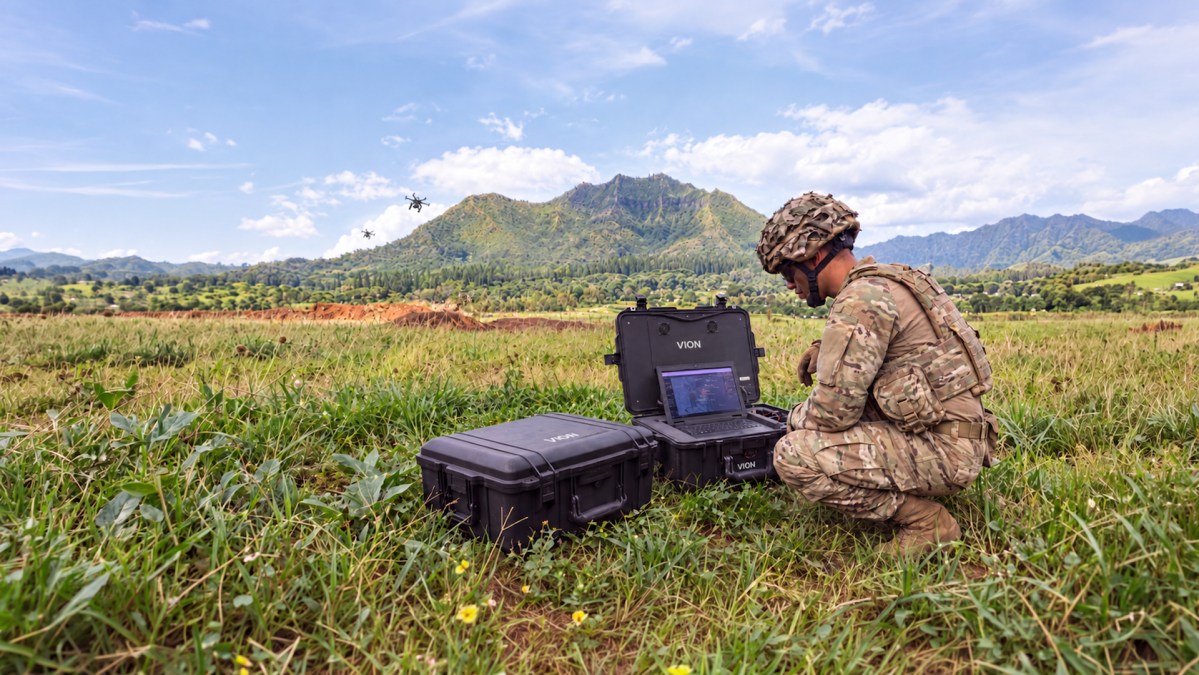
General Dynamics Information Technology’s Vion mission partner environment kit was incorporated into the U.S. military’s recent Olympus Fires exercise in the Pacific, the company announced Thursday.
The exercise came as the Defense Information Systems Agency and other military components are working to boost information sharing among allies.
The demonstration of GDIT’s Vion system capabilities was the culmination of years of effort and internal investment by the company, according to Jason Myers, vice president of GDIT’s defense agencies business.
“We’re actually selling it as that integrated hardware and software bundle. So, kind of view it as four different layers, if you will, of the … mission-ready tech stack: deployable cloud hardware, a secure zero-trust platform, the common data-centric services, and then the [command-and-control] mission applications,” Myers said in an interview ahead of the official announcement.
“A lot of these pieces have really been in the works. But one of the things that was really critical to me this year was really doubling down to make sure that we’re putting this into users’ hands. And so that’s where a lot of these culminations really came together. And then we had certain goals we wanted to set for ourselves. You know … it’s easy to say ‘zero trust,’ it’s easy to say ‘AI.’ You know, they’re very buzzwordy. But how do you actually operationalize them? How do you influence a mission advantage? And that’s where we really felt like we came together … and we wanted to test that out at exercise and prove it. And now we feel very comfortable with what we’ve been able to go ahead and demonstrate,” he added.
The deployment of the Vion system in an exercise had multiple elements to it.
“First and foremost is the ability to have our own core services, right? So, when we talk about our own core services, it’s having secure AI-enabled collaboration tools, so offering real-time translation services. One of the things that people take for granted on translation is it’s been around a very long time. But that being said, it’s very tabular in nature, right? X word equals Y other word. And in the military context, that’s really difficult. Military jargon, acronyms, codes — all of those things really do play and complicate typical translation services. And so, having AI assistance to understand the context of what you’re trying to say was really, really paramount. And we used that with a number of our foreign partners,” Myers told DefenseScoop.
The tech offers advanced voice, video, chat and email collaboration tools, according to GDIT.
AI-assisted software development is another capability Vion brings to the table, Myers noted.
Recent real-world conflicts have highlighted the importance of software innovation.
“There are certain elements where, as we’ve seen in Ukraine, the ability to adapt, overcome [is critical]. You’re going to have new sensors, you’re going to have new drone feeds, you’re going to have all these things that you’re going to have to provide the warfighter, but you’re not going to have … a software development team necessarily sitting there next to those warfighters. So, how do you give somebody that’s maybe never developed before, the ability to go and build that? And that’s exactly what we were able to demonstrate on Vion with the exercise. And probably the most paramount one was how do you solve problems rapidly?” Myers said.
“There were a number of customers that had interesting dynamics with their network. And they were able to take all of their network diagnostics, put it into Vion and our … secure AI-assisted platform, and not just identify what the problem was, but actually get [information telling them] here’s what you need to go fix, here’s what the fix is,” he said.
As an example, Myers described a situation where some video elements were impacted.
“We were able to use AI to say, ‘here’s the problem, here’s some of the logs,’ and within minutes we were back up and running and able to federate those services again,” he told DefenseScoop.
Zero trust and identity, credential, and access management (ICAM) are key elements of the tools, Myers suggested.
“Anybody that has a laptop and is connected to Vion has access to all of our foundational capabilities. But really the major advancement as well is the ability to then federate those services with our foreign partners. So now our foreign partners actually can reach into Vion and get access to those services as well,” he said.
An aim is to prevent under-sharing and over-sharing of sensitive information.
“By using our identity management, we know exactly who is trying to request access, and then leveraging that with the data tagging on the back end, we’re able to make sure that only those right partners with the right clearances and the right accesses can get access to that data,” Myers told DefenseScoop.
GDIT sees a lot of demand from the U.S. military and its allies for the types of capabilities that Vion offers, Myers said, though he declined to identify specific potential customers the company is in talks with.
The firm used its own money to develop Vion, he noted, an indication that the contractor had confidence that it could sell it to government buyers.
“I wanted to take a risk, right? I wanted to go and say ‘we know the customer space, we know what you need,’” Myers explained. “Vion was completely built by GDIT, and we had to go prove [the effectiveness of the technology] in exercise.”
GDIT isn’t fully on contract with the Pentagon for the Vion system, he told DefenseScoop.
“Now the next steps are, we’ve got a couple customers who have actually stated that they plan on supporting our accreditation and broader scale deployment across a number of different organizations,” Myers said. “Our focus was let’s prove it. And now the customer has said ‘you did prove it [and] we’re going to help you scale this.’”