Latest Air Force capstone tests AI, joint integration for battle management
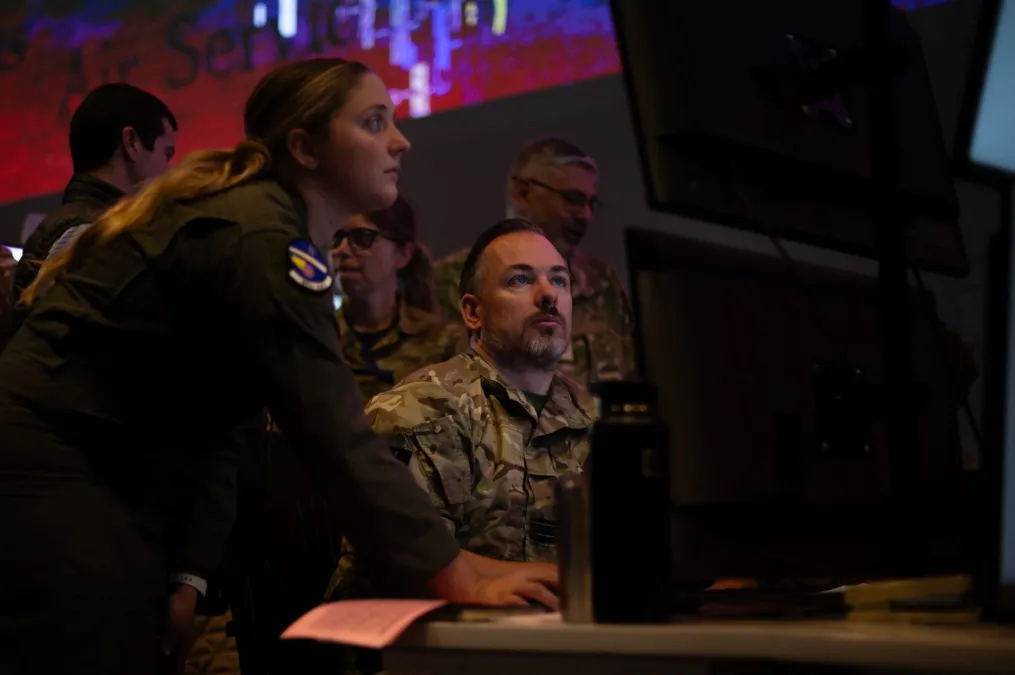
The Air Force conducted an experiment in November that further demonstrated how artificial intelligence can speed up battle management — an event that included participants from three other U.S. military services and all Five Eyes partners.
Capstone 2025 was led by the 805th Combat Training Squadron at Nellis Air Force Base, Nevada, and served as the unit’s latest in a series of experiments broadly focused on modernizing command-and-control missions with AI-enabled capabilities. The recent iteration tested a range of different battle management functions, while also incorporating forces from across the Defense Department and U.S. allies.
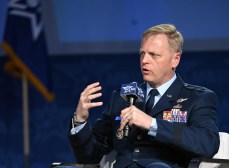
“This integration revealed new insights on how AI and machine learning can support diverse tactics and align exercises with [Combined Joint All-Domain Command and Control] goals,” 805th commander Lt. Col Shawn Finney said in a statement.
CJADC2 is a Pentagon effort to connect disparate sensors and weapon systems from across the U.S. military and international allies under a single network. By integrating artificial intelligence and other emerging capabilities, the department hopes to rapidly accelerate command-and-control functions and improve overall decision-making.
The 805th — also known as the Shadow Operations Center – Nellis (ShOC-N) — is helping the Air Force develop modern C2 technologies and tactics through different experiments. While other events known as the Decision Advantage Sprint for Human-Machine Teaming (DASH) wargames focus on future concepts, the unit’s biannual capstones like the recent one held in November are designed to test near-term AI-enabled capabilities.
Like previous capstone events, the ShOC-N tested AI tools’ ability to improve speed and accuracy of battle management functions, specifically dynamic mission re-planning and targeting.
However, Capstone 2025 featured unprecedented attendance from the other military services, as warfighters from U.S. Army Pacific, the Naval Surface and Mine Warfighting Development Center, the Naval War College and the Marine Corps Tactical Systems Support Activity participated. Warfighters from the United Kingdom, Canada, Australia and New Zealand also took part.
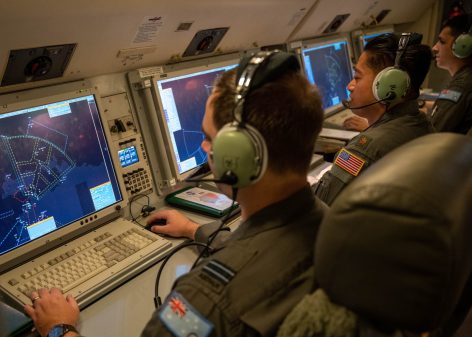
“Having coalition and joint partners collocated with U.S. Air Force and Alaska Air National warfighters as well as digitally connected via battle lab environments and communication pathways means we can holistically assess the interoperability of our tactics, techniques, procedures, and technology,” ShOC-N Director of Operations Lt. Col. Wesley Schultz said in a statement.
Throughout the experiment, warfighters ran through the same operational scenario that included two mission sets — one that mimicked the Air Force’s Bamboo Eagle exercise and another that focused on dynamic targeting, Finney told DefenseScoop.
“Both included joint forces, with dynamic targeting also including coalition partners,” he said. “The team introduced complexity by increasing the amount and capability of threats, introducing weather impacts, constraining asset and weapon availability, and air base closures.”
The mission area that resembled Bamboo Eagle experimented with dynamic mission re-planning (DMR) and asset tracking tools, Finney explained. DMR concerns rapidly adjusting mission plans in the event of unexpected changes in the environment — a process that is currently hampered by manual processes and siloed information.
“For effective DMR, operators need real-time intelligence updates, status alert changes, shared situational awareness and the ability to make informed decisions faster,” Finney said. “Capstone 2025, particularly through Experiment 4, aimed to address these challenges by automating the collection and processing of information.”
The Air Force used capabilities such as Palantir’s Target Workbench and the Joint Blue Accountability Tool when running DMR-focused scenarios. These enabled warfighters to rapidly create new courses of action when the environment changed suddenly, and allowed operators to make more informed decisions, Finney noted.
As for the scenario that tested dynamic targeting, the Air Force utilized assets across air, land, sea and cyber domains to understand interoperability between joint and international forces. The dynamic targeting experiments were supported by Palantir AI-enabled capabilities like Maven Smart System, Gaia, Target Workbench and Maverick — with Maverick being integral for “seeking to automate match effectors to enhance human-machine teaming in a joint and partner operation,” Finney said.
The experiment exposed service-specific integration challenges that will be key to future C2 missions, such as datalink alignment that ensures different services can seamlessly share data despite having different systems and formats.
“During Capstone 2025, the focus was on aligning the types of data passed between the Marines, Army and Air Force within Maven Smart Systems,” Finney explained. “This included standardizing data and creating adaptable formats to accommodate various import/export types. One significant advancement was enabling J-series messages from [tactical C2] to be received by [Maven Smart Systems], improving cross-service communication.”
Overall, the experiment demonstrated how warfighters can use AI-enabled battle management tools in real-world scenarios, according to the Air Force. Lessons learned during Capstone 2025 will not only inform C2 modernization efforts, but also future processes and tactics for conducting battle management alongside other U.S. services and international partners.
“A key highlight was the inclusion of joint and coalition officers as domain [subject matter experts] in the [long-range kill chain] experimentation, enabling operators to make faster, more accurate battle management decisions with AI/ML support,” Finney said. “Capstone 25 underscored the need for further inclusion of joint and coalition SMEs and identified promising areas of AI/ML refinement as the toolkits evolve to support increasingly complex decisions.”