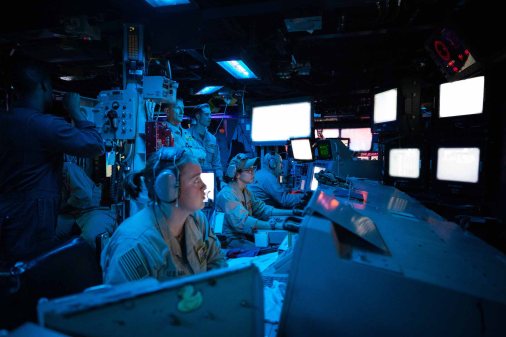
How the new Navy-Palantir ‘ShipOS’ partnership is informed by Project Maven
The Navy and Palantir recently announced a $448 million deal that will integrate the tech firm’s advanced AI software into multiple public and private shipyards and suppliers to optimize naval construction and readiness, and help surge U.S. nuclear submarine production under the second Trump administration.
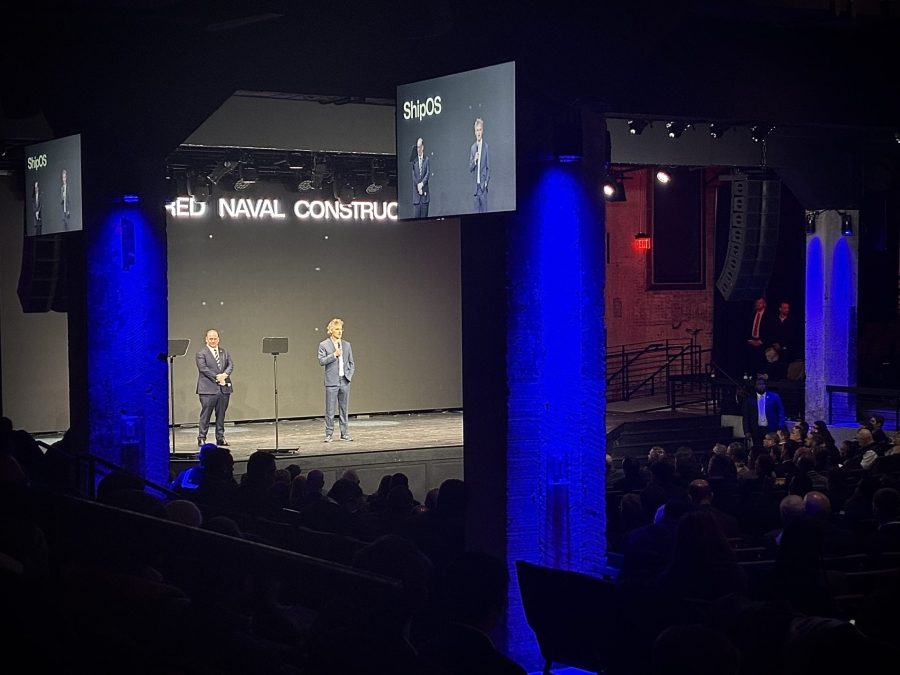
Senior officials from the sea service and the company briefed a small group of reporters on their plans for this AI-powered shipbuilding operating system — ShipOS — during an industry day event for the Navy’s new Rapid Capabilities Office earlier this month.
In response to questions from DefenseScoop, they also discussed the new system’s similarities to Palantir’s technologies that enabled and underpin the Pentagon’s well-established Maven assets and effort.
“I think of it as a software ‘Iron Man’ suit for every shipyard worker across the submarine industrial base. So, making them more productive,” said former congressman Mike Gallagher, who currently leads Palantir’s defense business.
“And [it’s really about making] what’s always going to be a hard job a little bit easier,” added Jason Potter, the Navy’s acting acquisition executive.
This new partnership was unveiled at a point when delivery timelines for some of the Navy’s most critical future warfighting capabilities are plagued by manufacturing challenges and other serious delays. It also comes as the Trump administration is prioritizing AI deployments across the government and hustling to reform the nation’s approach to weapons-buying and building.
ShipOS is envisioned to help users around the U.S. maritime industrial base better understand their business workflows, key performance drivers and choke points — and automate tedious manual tasks with AI.
“Every shipbuilder who partners with us will have AI-powered tools that optimize their work in real-time. Every supplier in the network will be connected to intelligent logistics. Every program manager will have unprecedented visibility into schedule, cost and risk. We’re not just building ships faster — we’re rebuilding American maritime industrial capacity for the AI age,” Navy Secretary John Phelan said onstage during the announcement.
Notably, this work involves a shared-savings contract mechanism, where Palantir’s payout is tied to the products’ impact and metrics.
“We’re taking some of the things we did in Project Maven, which you could look at as predictive maintenance of a negative kind. The adversaries are predictively taken off the battlefield instead of American heroes,” Palantir CEO Alex Karp told the audience. “We’re bringing that same technology to manufacturing, and we’re absorbing the risk along with you, which I love.”
Palantir supported the Defense Department’s Project Maven initiative since its early days around 2017, when it was developed to apply AI and machine learning assets to process and analyze heaps of data and imagery from drones and other military sources.
More recently, the company’s in-demand AI-powered platform — the Maven Smart System — emerged out of that work. MSS broadly transforms data from drone footage, social media, satellites and other systems into intel that informs targeting, logistics, resource allocation, and more.
“If you consider the Maven Smart System as sort of force projection and planning, like where do I have things around the world? What can I move? What does that mean, as far as readiness, contingency planning, action planning and comms planning, all of those? The strategic data, that pulls from granular data, that pulls from sensor data. And there are different levels of authorization for seeing certain things, right? And those levels may change over time as you’re engaged in activity,” Palantir’s Head of Shipbuilding and Naval Programs Matthew Babin told DefenseScoop. “This is that, but for force construction.”
He said that — in the same way that Maven supplies a comprehensive view of operations, troops, equipment and adversaries from the defense secretary’s office, through the combatant commands and down to individual units and decision-makers — through ShipOS, Palantir and the Navy want to ensure that those involved in building the next-gen nuclear submarine arsenal access shared data and insights to accelerate production and make more informed decisions about their processes and supply chains along the way.
“How does this give the Navy that same view of, ‘Here’s my program. Here’s what the Columbia-class program office looks like. Here’s the hulls that are in construction right now. Here’s where they are on schedule. Here’s where the supplies are coming in. Here’s who’s ahead of schedule. Here’s what I’m getting for the money that I’ve put in. Here’s the lever that I have to pull to make this piece go faster, or to make this part of the schedule, or this window shorten. So that’s where we think of this [being like Maven],” Babin explained.
“I’d say the incentive for us is we care about the outcome of the Navy building more boats faster. And we’re financially aligned to deliver that at a very, very high rate of speed,” he also told DefenseScoop.