Navy exploring options to solve its ‘unmanned dilemma’
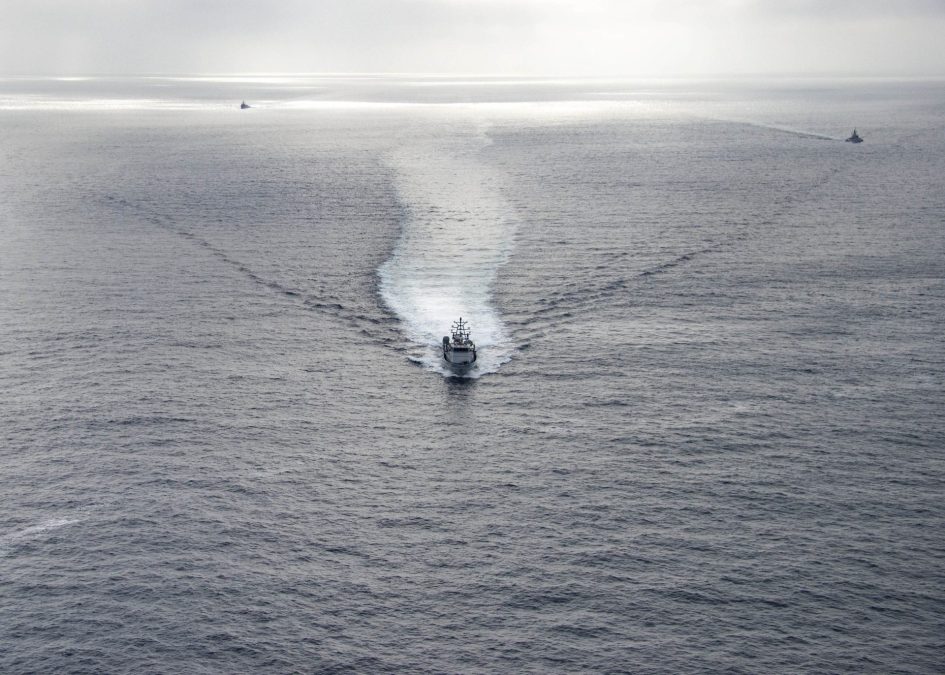
SAN DIEGO — As the Navy hustles to activate a hybrid, “hedge” force of manned and unmanned platforms that enhance the military’s global reach and capacity, senior officials recognize a growing need to establish a clear command structure for controlling those emerging assets.
The service’s new warfighting directions rely heavily on the integration of surface, undersea, and aerial drone swarms — or robotic and autonomous systems (RAS) — across the fleet. Those plans are backed by billions in investments.
“It’s not a challenge getting this type of capability,” Chief of Naval Operations Adm. Daryl Caudle told DefenseScoop on Tuesday. “It’s a challenge making an ensemble of these types of capabilities in a meaningful way that combatant commanders and Navy component commanders can ask for in a way that solves one of their key operational problems.”
The Navy’s highest-ranking officer shared new details about how his team is approaching the complexities of RAS organization and deployments during a meeting with a small group of reporters at the 2026 WEST summit.
Historically, Caudle noted, the Navy has organized the delivery of its weapons platforms and associated systems by the domains in which they operate.
“If you peel into [this] with our ships, you will find that instead of being organized in accordance to mission, we’re organized to do our preventive and corrective maintenance,” he said. “Now, I find myself with this unmanned dilemma. So, my first inclination is to go and put this type of kit into the domain — that’s where we are today — and so you’ll see [unmanned underwater vehicles], they’re with the submarine force. [Unmanned surface vehicles] are with the surface force. [Unmanned aerial vehicles] are with [the aviation force].”
However, in the CNO’s view, “that’s not packaged” properly — because one of those types of capabilities, generally, isn’t sufficient to complete a full mission set. It’s therefore essential that the Navy quickly determines how to build out those units of force so that they can be asked for in a logical way, and are accompanied by appropriate command and control structures.
The service’s California-based unmanned vessel squadrons are developing tactics and operational concepts to help tackle the challenge.
“But I think, ideally where my head is — and we’re not there yet — is I need a RAS warfighting commander. It’s almost a joint task force commander just for these systems alone,” Caudle explained. “Now this RAS commander, if you will, knows how to command and control these packages of unmanned capabilities to achieve the mission outcomes that the strike group commander may want.”
He told DefenseScoop that this idea is very nascent, having emerged sometime over the last two weeks.
“So this needs to be flushed out. But you can see, because it is cross-domain, that to integrate that effectively could conceivably need a command structure like that,” Caudle said.
On Monday, the CNO released a new set of naval “Fighting Instructions” to guide how the sea service organizes and operates at an uncertain time with unfolding wars and intense global competition. The document notably calls for RAS capabilities to be “describable in standard terms, interfaces and outcomes,” in order to be effectively integrated in the sea service’s force delivery model.
“The Navy must address the associated doctrinal shortfalls, organizational seams and process gaps, including determining how we will allocate RAS in service decisions like strategic laydown, dispersal and global force management,” Caudle’s instructions state.