Navy brass sees future battleship as catalyst to scale next-gen laser weaponry
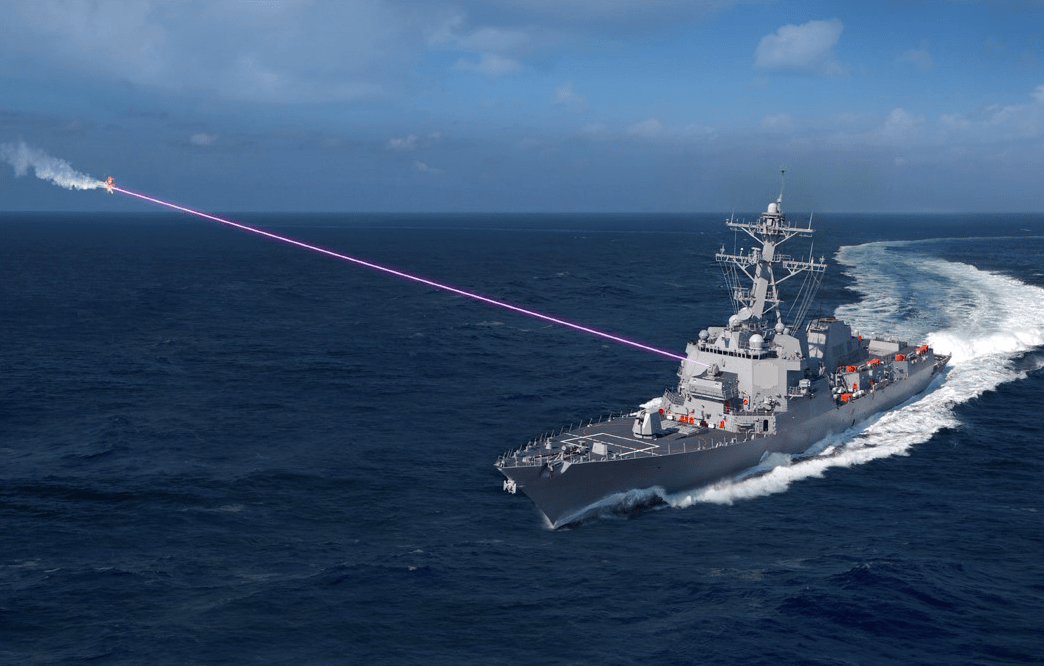
SAN DIEGO — The Navy must embark on an aggressive push to integrate advanced lasers, high-power microwaves and other directed energy weapons across the fleet as part of its broader plan to counter intensifying and emerging drone and missile threats, according to two of the sea service’s top officials.
Largely due to technical, environmental, industrial and other complexities, Navy insiders have struggled for decades to make DE capabilities a shipboard reality at-scale.
More recently, the U.S. military’s urgent need to counter cheap, swarming adversarial drones in multiple regions has heightened calls for maritime, laser-enabled weaponry.
“The Navy has not, in my opinion, put the demand signal out there to go all-in on solving some of the technological challenges on shipboard laser utilization. You have to target the laser, and that typically takes optics, [which] typically don’t do well in high-mist, high-wave environments. But that’s an engineering problem,” Chief of Naval Operation Adm. Daryl Caudle said. “Lasers come in various form factors that can be chemically based, electrically based; there’s different sources that stimulate the coherent light. And that’s an engineering problem — that’s not a Navy problem.”
At the WEST conference last week, both he and the Navy’s top surface warfare officer, Vice Adm. Brendan McLane, shared details about the service’s vision to incorporate directed energy options on more of its vessels down the line.
President Donald Trump announced plans in late 2025 to compel industry to develop a new class of next-generation battleships — part of the so-called “Golden Fleet” — that would be equipped with hypersonic weapons, electronic rail guns and other powerful capabilities.
Caudle noted that directed energy weapons will be a “prominent element” on the so-called Trump-class battleships. As CNO, he is eager to use that initiative “as the forcing function to solve this for other Navy ships.”
“I see [directed energy weapons] solving problems — not for just shipboard use — I see it solving problems for base protection as well. And so, this idea that I can put directed energy in places where anything that’s in line of sight can be taken out without shooting a kinetic weapon is appealing to me,” Caudle said.
While studying at the Naval Postgraduate School, his thesis work focused on high-energy lasers. And now that he’s the Navy’s highest-ranking officer, Caudle is engaging with experts so that he can “truly get [his] hands around the limitations on why we have not scaled this.”
His recently released Fighting Instructions notably direct the Navy to “develop a comprehensive DE strategy that clearly defines priorities, capability thresholds, and timelines, ensuring investments are aligned across platforms, mission areas, and Future Years Defense Programs (FYDPs).”
“After seeing what a laser can do at megawatt-class power, you kind of scratch your head why we’ve not scaled this to be employed on surface ships for a whole suite of missions that could offload defensive weapons and allow me to increase my offensive capacity,” the CNO said. “I think this is about technology commitment more than an engineering challenge.”
As of early 2026, the destroyer USS Preble is the only Navy vessel with a high energy laser for counter-drone operations — called the Integrated Optical-Dazzler and Surveillance (HELIOS) system. Beyond that, the USS Dewey and USS Stockdale are each equipped with lower-powered Optical Dazzling Interdictor, Navy (ODIN) lasers.
During a separate meeting with reporters at the WEST summit last week, Naval Surface Forces commander Vice Adm. Brendan McLane suggested that Zumwalt-class destroyers could offer a unique testbed to explore and de-risk lasers and other high-tech capabilities, such as hypersonic weapons, to reshape surface warfare.
“The Zumwalt has an amazing capability to generate electricity, which is something we need for lasers. And that would be kind of a match made in heaven. And then the other thing is, the Zumwalt has an inherent difficulty [integrating] the tech built into ship design. I’m sure that’s something that the people who are working on the design of battleships are going to be interested in too,” he said. “Plus, it’s really big.”
Plans call for Golden Fleet battleships to be armed with hypersonic missiles in addition to lasers and other high-tech capabilities.