Pentagon preparing for drone swarm ‘crucible’
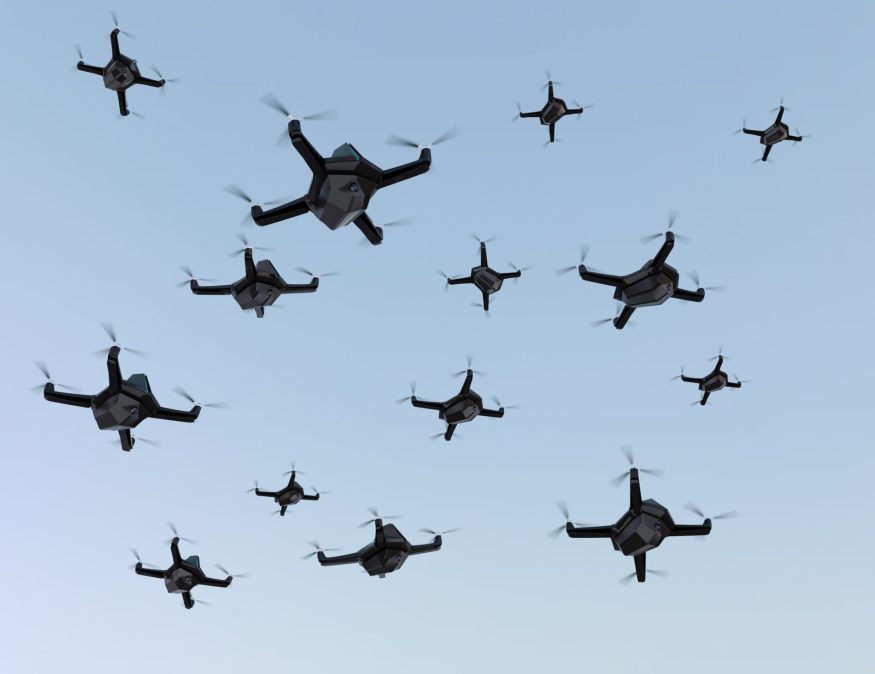
The Defense Department is moving forward with an autonomous drone swarm initiative that aims to give the U.S. military new tools for locating and destroying targets on the battlefield.
The Pentagon’s Chief Digital and AI Office recently issued a solicitation for the Swarm Forge effort, which is one of the “pace-setting” projects that Defense Secretary Pete Hegseth called for in a memo released in January outlining the department’s artificial intelligence strategy.
In June, the DOD plans to put industry’s drone swarm capabilities through their paces at a demonstration event, dubbed “Crucible.”
Although the U.S. military conducted what officials said was the first kinetic drone swarm on American soil during an exercise earlier this year, the Pentagon’s solicitation for Swarm Forge noted shortfalls in the current arsenal.
“The United States currently lacks the inventory and the doctrine to deploy massed, coordinated, low-cost robotic systems. Legacy platforms and slow acquisition cycles constrain operational adaptability and limit the ability to generate massed effects. Traditional research and development approaches are insufficient to keep pace with evolving threats and do not produce deployable solutions at the speed of relevance. The absence of integrated doctrine, training, and operational concepts for large-scale robotic employment leaves the joint force at risk of strategic and tactical disadvantage,” according to the solicitation released by the CDAO on its Tradewinds website.
Swarm Forge aims to help the department address those problems by accelerating the validation and fielding of AI-enabled collaborative, autonomous systems.
Via quarterly Crucible events and other efforts, the Pentagon aims to deliver “validated swarm packages,” to include integrated platforms, mission software, coordination logic, interfaces and tactics, that are ready for transition to operational units in 90 days or less, according to the solicitation.
The focus will be on evaluating small unmanned aerial systems and “heterogeneous autonomy technologies” in a field environment.
“For Swarm Forge, heterogeneous swarming implies multi-vendor UAS command, control and autonomy, not simply the use of different platforms offered by a singular vendor,” the solicitation explained.
At the Crucible event this summer, the drone swarms must include a minimum of four UAS in operation at the same time.
Officials want to see the “end-to-end autonomous completion” of various mission sets such as intelligence, surveillance and reconnaissance (ISR) or targeting under the “Find, Fix, Finish” concept. The Pentagon is also interested in modular payload systems that can be tailored to meet a variety of mission needs.
Among the list of desired attributes included in the solicitation are AI agents that can autonomously coordinate the efforts and role assignments of robotic systems, a concept that officials are calling “inter-agent collaboration.” The architecture would need to have decentralized control to avoid single points of failure in case a system is taken out of the fight, the solicitation noted.
Regarding “human-in-the-loop” requirements for command and control, officials wrote that there should be “minimal operator intervention required for swarm control,” but the systems will remain under “meaningful human command.”
The platforms are to be equipped with automatic target recognition and machine learning capabilities, including “multi-class ATR models with dynamic operator control” and “adaptive and emergent behaviors based on environmental feedback.” So-called “in-field learning” would provide the ability “to adjust confidence thresholds and classification types” during missions, according to the solicitation.
Mindful that adversaries might employ jamming tactics, as seen during the Ukraine-Russia war, the Pentagon wants drone swarms that can navigate and communicate in GPS-denied and electronic warfare environments, using capabilities such as visual or inertial navigation systems and resilient comms links.
The solicitation did not explicitly address how Swarm Forge will flesh out doctrinal issues that the military is facing.
The due date for industry white papers is April 17.
Notably, the government may use AI and machine learning tools “to assist in the administrative review and technical assessment of proposals and whitepaper submissions.” However, humans will have final say over evaluations and award decisions, according to the solicitation.
Offerors whose proposals make the cut will be invited to the Crucible event, which is slated for June 22-26 and expected to result in downselects for awards. Additional contracting opportunities for vendors could come from follow-on efforts to further develop and integrate heterogeneous drone swarming tech, officials wrote.