Army commissions 3 more tech executives into Detachment 201
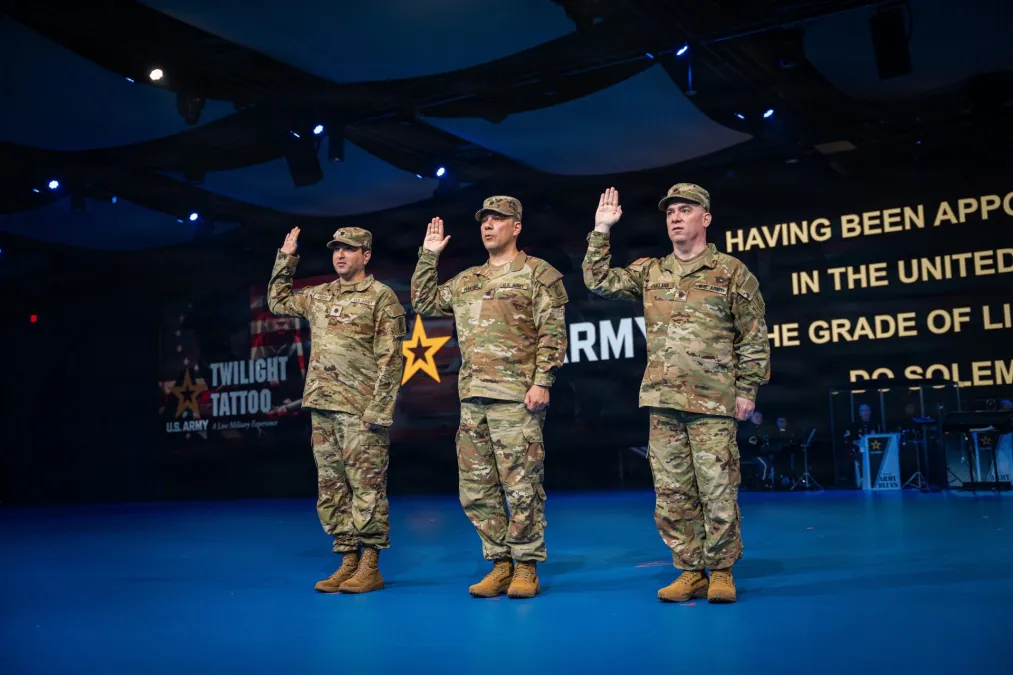
The Army commissioned a new batch of tech executives into its reserve ranks this week, the service said, the second cohort to enter a new unit officials say is meant to bring the private sector and military closer together to boost defense technology.
The Army established Detachment 201 last year to recruit tech execs into the reserves as senior advisors, ones who are tasked with helping the Army quickly develop and scale modern capabilities. At the time, the service tapped four technologists from Palantir, OpenAI and Meta into the Army Reserve as lieutenant colonels.
Now, Det. 201 is adding three more executives after the service overhauled its direct commissioning pipeline, reducing the length of a program that places high-skilled civilians directly into the officer corps by roughly a year.
Dane Knecht, chief technology officer for Cloudflare; Sam Pullara, managing director and chief technology officer for Sutter Hill Ventures; and Serkan Piantino, who co-founded Facebook’s AI research arm and is the former vice president of products at Reddit, were commissioned as lieutenant colonels in a ceremony at Joint Base Myer-Henderson Hall, Virginia, on Wednesday.
“The Army’s most pressing technology challenges in AI, cyber defense, and large-scale distributed systems require leaders who can evaluate a technical architecture in the morning and advise a general in the afternoon,” Pullara said about his new role, according to a news release.
The service is more than a year into its Army Transformation Initiative, a program Army Secretary Dan Driscoll heralded as an effort to restructure the military branch into a “leaner,” tech-forward force for modern conflict. That effort has wrought increased closeness between the Army and tech industry, of which Det. 201 is a prime example.
“The program selects applicants who are highly skilled civilian technology professionals at the executive or C-suite level to serve as part-time strategic advisers,” the press release said. “These officers use their advanced expertise in commercial tech and private industry to offer a different perspective and advise senior Army leaders on solving military problems.”
The Army said the first cohort of tech executives in Det. 201 “provided strategic counsel” on critical Army challenges and their work “influenced key initiatives” related to munitions supply chain data analysis, industrial base investments, autonomous systems and counter-drone technology, according to the release, which did not provide additional details about that work.
An Army spokesperson reiterated those efforts in response to a DefenseScoop question about Det. 201’s work.
In an interview earlier this year, Army Chief Technology Officer Dr. Alex Miller told DefenseScoop: “What we’ve done is that we have allowed them to embed with units, learn what’s going on — in uniform, not in their civilian capacity — to actually help us figure out what to do next in a couple areas.”
He echoed several of the efforts listed in the press release and specified that the initial Det. 201 cohort helped develop the deployment of software developers to operational units, such as one of the Army’s de facto tech testbed units, the 4th Infantry Division; identify current critical munition supply chains to reduce manufacturing cycles; and translate commercial autonomy efforts for self-driving cars to aerial and maritime robots.
After the initial cohort of tech executives was commissioned into the Army Reserve, Military.com reported that some officials across the Pentagon and Congress signaled excitement about the concept and its opportunity to speed innovation for a service sorely needing it.
The nearly two dozen sources, who spoke to the publication anonymously and included defense analysts, also raised concerns about ethical boundaries between newly commissioned tech executives — who have a financial stake in their own companies that make deals with the military — and the service, which is embracing their expertise as senior advisors.
Then-Army spokesperson Steve Warren said the tech execs wouldn’t be making acquisition decisions, according to Military.com.
During the January interview, Miller said “we put very tight guardrails on them,” using one of the lieutenant colonels, Palantir chief technology officer Shyam Sankar, as an example. “He cannot deal with any program AI, anything in his reserve capacity, but he has been very helpful on talent management at the Army level.”
An Army spokesperson told DefenseScoop Thursday that guardrails for the new officers included mandatory recusal from business dealings.
“Recusal from any matter affecting the financial interests of members of Detachment 201 is mandatory,” said Lt. Col. Orlandon Howard, the spokesperson, citing Joint Ethics Regulations. “The process includes mandatory confidential financial disclosure (OGE Form 450), annual ethics training, and a legal review of each work task.”
When asked if the Army considers the tech executives’ service when making decisions about procurement, including for contracts that may involve their companies, he said: “The Army has a clear functional separation of duties for Detachment 201 officers who are legally barred from the vendor selection process.”
The Army has pitched their commission and involvement in Det. 201 as a willingness to serve and solve the service’s technological problems. Some of the new reserve officers have reflected that sentiment publicly.
When asked why they could not perform their roles as senior advisors as civilians, Miller said they wanted to serve in uniform and the Army recognized “they have — in line with the law for the direct commissioning [program] — the education, the talent, and the expertise to actually serve at a higher rank than you would come in as a lieutenant.”
“The added benefit is — and I’m saying this as a very senior civilian in the Army — there’s a difference that units see when someone is wearing the cloth of our nation to get down into the problems and actually solve them,” he said. “So the fact that they’re willing to do that and serve and get dirty and wear the same face paint and get shot at — because they are deployable assets — is really important.”