Autonomous Corsair maritime drone rescues US military pilots after crash near Oman
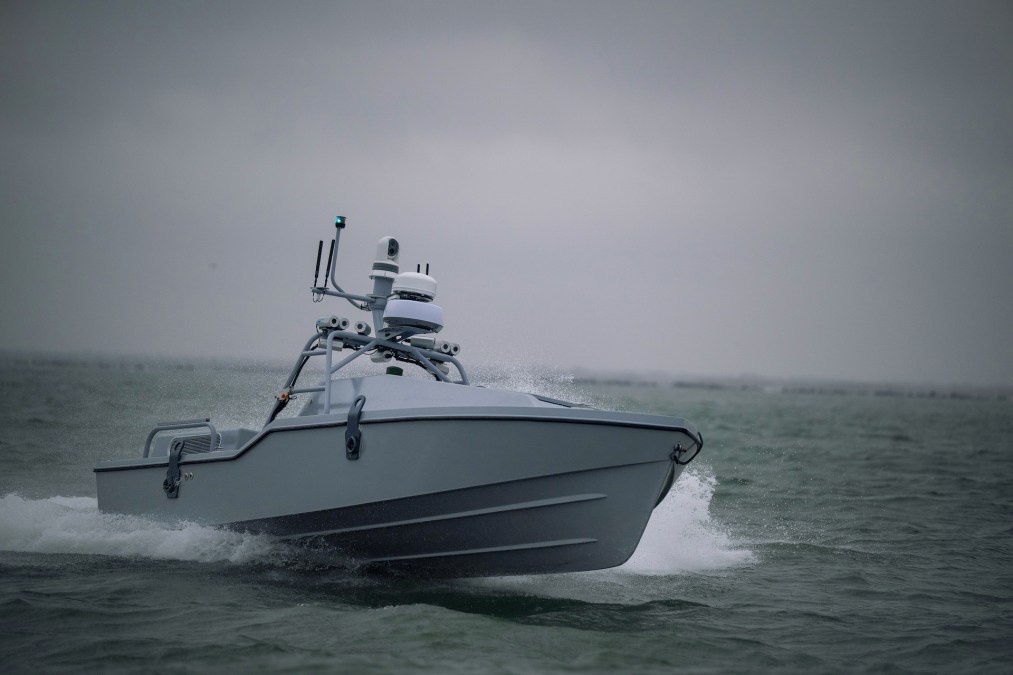
The American military deployed an autonomous Corsair maritime drone built by Saronic to find and recover two soldiers who were stranded near the Strait of Hormuz on Monday after their Army AH-64 Apache helicopter crashed during a patrol operation, U.S. Central Command spokesperson Capt. Tim Hawkins told DefenseScoop.
The confirmation of this unique rescue mission comes as military tensions are surging in the Middle East amid the United States-Iran conflict.
It marks the U.S. military’s first publicized use of an autonomous surface vessel to locate and retrieve downed aircrew in real-world warfare, following years of experimentation with different types of sea drones.
“The surface drone that assisted in last night’s rescue of the Apache crew off the coast of Oman was a U.S. Navy Corsair unmanned surface vessel operated by U.S. 5th Fleet’s Task Force 59,” Hawkins said.
In that rescue operation, he told DefenseScoop, the maritime drone picked the two pilots up “and transported them to another location on the water where they were then hoisted up to a helicopter for further transport.”
The Corsair is a 24-foot autonomous surface vessel (ASV) that’s designed for rugged, long-duration missions. The drones can operate at speeds greater than 35 knots and carry up to 1,000 lbs over 1,000 nautical miles, according to Saronic’s product specifications.
The ASVs are equipped with sensors that provide 360-degree passive sensing capabilities for day and night operations, which likely helped in locating the two soldiers off the coast of Oman after their helicopter went down.
Military personnel in the Navy and other services have been trying and buying Corsair vessels for various missions, like investigating watercraft of interest and assisting patrols, over the last year.
As Hawkins suggested, the Navy’s unmanned systems and AI integration unit based in the Middle East — Task Force 59 — is one of those teams, as it’s deploying the vessels to expand Centcom’s maritime domain awareness against escalating threats.
“The task force began fielding these drones in theater in late March,” Hawkins told DefenseScoop.
Last year, the Navy tapped Texas-based Saronic to produce multiple batches of its autonomous maritime drones by mid-2031 under an other transaction agreement (OTA) worth more than $392 million.
Centcom sent a statement to reporters early Tuesday confirming that the soldiers who were downed in the Apache crash “were safely rescued within approximately two hours” and that the “cause of the incident is under investigation.”
President Donald Trump indicated in a social media post hours later that military advisors informed him that “Iranians shot down one of our highly sophisticated Apache Helicopters while patrolling over the Strait of Hormuz” on Monday night.
“There were two pilots involved, both are safe and uninjured,” Trump wrote. “Nevertheless, the United States must, of necessity, respond to this attack.”
In response to DefenseScoop’s request for comment, a Saronic spokesperson said: “The U.S. military has acknowledged that a Saronic Corsair autonomous surface vessel was used in the recent rescue operation following the downing of a U.S. Army helicopter.”