Pentagon wants ‘low-collateral’ drone interceptors at all U.S. military installations, task force director says
The Pentagon is looking to put “low-collateral” kinetic drone interceptors at every U.S. installation as part of its attempt to bolster security around stateside military bases against unmanned aerial system threats, according to the director of the department’s counter-UAS task force.
Brig. Gen. Matt Ross, director of Joint Inter-Agency Task Force-401, told reporters Tuesday that net launchers and “kinetic energy” systems were necessary to protect homeland facilities, in part because they allow the military and law enforcement to better assess where the UAS came from and what it was doing after it gets brought down.
“I see us using low-collateral kinetic interceptors at all installations in the homeland,” he said, adding that the task force received guidance from Deputy Secretary of Defense Steve Feinberg “to make sure that we’ve got kinetic capability at every location.”
Ross’s comments came after the Pentagon announced it had boosted installation commanders’ authorities to defend against drones beyond the “fence-line,” a bid to expand defensive perimeters around stateside bases and address confusing policies that hampered their ability to respond to growing UAS incursions over the last several years.
In an earlier panel at the Apex Defense conference Tuesday, Ross rebuked the idea that kinetic capabilities could not be used for homeland installation defense. Some drone experts have said stateside counter-UAS introduces complex policy challenges when it comes to how drones can be knocked down in U.S. airspace, which is stringently managed to minimize risks to civilians and planes.
“I would caution anybody on the panel or in the audience about self-limiting and thinking that because we’re working in the homeland, we cannot use kinetic effectors,” he said. “I just fundamentally disagree.”
He used Alaska, the National Capital Region and Guam as examples of locations that constitute the wide range of areas that fall under counter-drone homeland defense. Ross said that countering UAS threats abroad versus at home aren’t “that different.”
“We have global basing where we are subject to the same types of threats, and we have to have layered defenses in those locations, just like we would inside the homeland, sometimes with the exact same considerations,” he said, adding that installations in Okinawa or Poland often have “the exact same concerns” as Fort McNair in Washington, D.C.
In response to a DefenseScoop question about how installations would mitigate civilian harm or infrastructure damage that may come with using kinetic counter-UAS capabilities in the U.S., Ross said those tools will be “low collateral” and managing those systems responsibly is up to the commander.
“How do you manage the collateral? That comes down to how the tools are employed, the systems are employed by the installation commanders,” he said. “They can determine … when or if they’re going to engage with a low-collateral interceptor.”
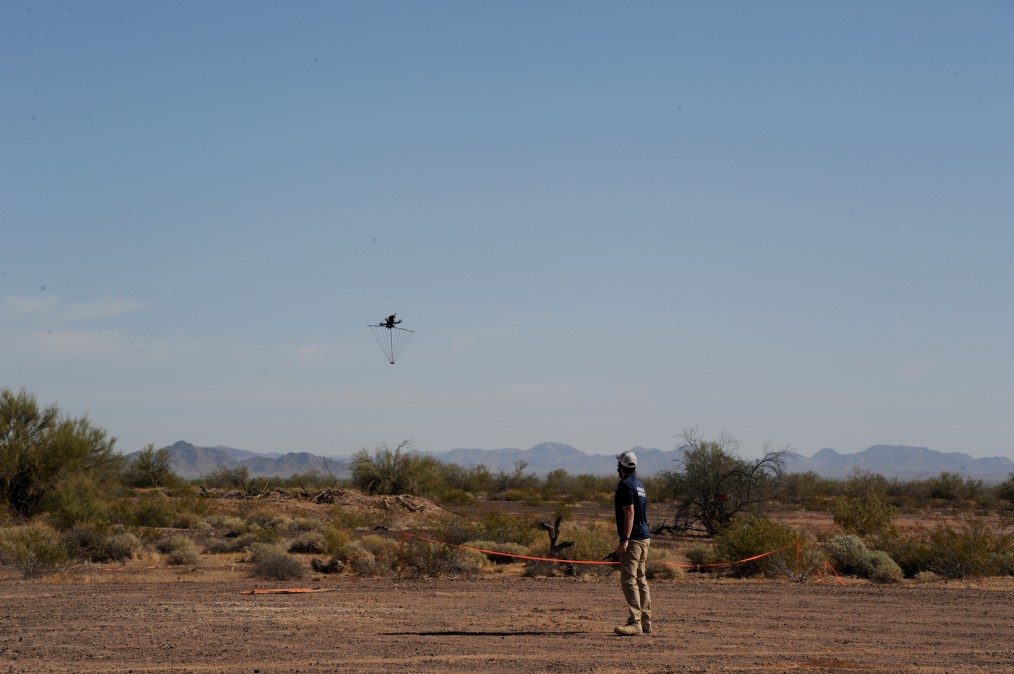
He said the term “kinetic” is often thought of as referring to “explosive” capabilities, but in this case it could mean other tools such as nets, which can come in the form of handheld launchers or drone-mounted systems designed to capture UAS in mesh.
“When we say kinetic, we think explosive. [These are] not explosive. I’m talking about, like, kinetic energy or nets. It’s just drone-on-drone, just taking it out of the sky,” he said.
Ross did not specify which kinetic systems he had in mind.
“I may have that capability and not need it based off the threat. I may have it and need it, and I could engage inside the fence-line over the airfield and then there’s no collateral,” he added. “Or based off the threat, I may find that I should engage just outside of the fence-line, but in a way that I can responsibly manage any collateral damage to the population or infrastructure.”
JIATF-401 was established to not only proliferate the military’s c-UAS capabilities, but also work with other federal agencies to do so. Ross said it’s important to capture drones that make these incursions, rather than let them fly away so the military can determine their origin and activity — whether it be signals or visual collection, for example — in partnership with law enforcement.
“We can do all of that,” he said. “We just got to put the right tools into the hands of commanders.”