Pentagon unveils top performers in latest ‘Gauntlet’ for Drone Dominance Program
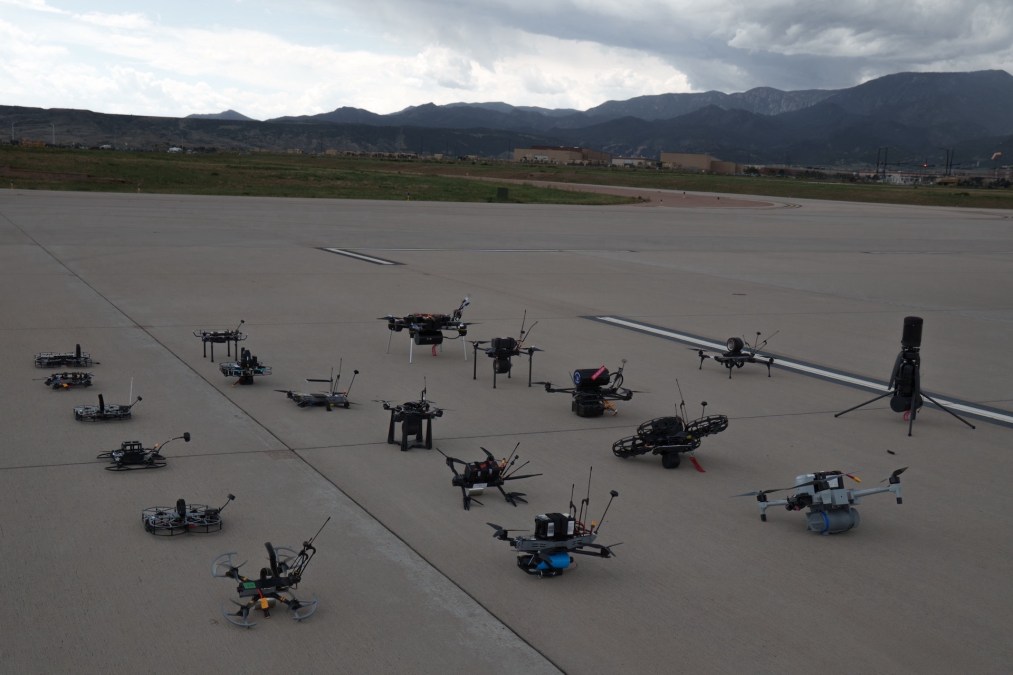
The Defense Department this week announced the winners of the second “Gauntlet” competition under its Drone Dominance Program, the Pentagon’s signature effort to ramp up the U.S. military’s arsenal of small unmanned aerial systems.
Since its inception last year, the program has been primarily focused on evaluating and procuring large quantities of low-cost, one-way attack drones for the military, with the goal of rapidly fielding them across the force. The department aims to acquire more than 200,000 UAS across several phases of the initiative by 2027.
The first Gauntlet that put drone vendors’ technologies through their paces via military operator evaluations was held earlier this year at Fort Benning, Georgia, which led to the order of approximately 30,000 UAS from contractors. Gauntlet 2 took place in recent weeks at Fort Carson in Colorado.
“Gauntlet 2 was the Drone Dominance Program’s most demanding test to date. Operators pushed participants to their limits, flying 1,858 sorties across 23 platforms from 19 companies. Vendors rose to the challenge with improved capabilities. Each of the 11 platforms evaluated at long distance made it to 15 km. (In Gauntlet 1, only 24% of drones managed to reach 10 km),” officials wrote in a social media post on the Defense Innovation Unit’s X account. DIU, which is now under the leadership of director Owen West, is shepherding the initiative.
The latest Gauntlet included two “mission areas”: deep strike and close quarters battle.
The leaderboard for the deep strike part of the competition was topped by Perennial Autonomy, followed by Hyperscale, Neros, Skycutter and Swarm Defense Technologies. For the close quarters battle element, Neros came in first place followed by ORQA US, XTEND Reality, Vector and ModalAI, according to the program’s website.
The department plans to purchase a total of about 60,000 drones from that pool of vendors.
Compared to Gauntlet 1, these drones are “cheaper, more capable, and sourced from a supply chain more closely tied to the American industrial base,” officials wrote in a social media post.
Other performers in Gauntlet 2 that didn’t make it onto the deep strike leaderboard included Ascent Aerosystems, Auterion Government Solutions, Griffon Aerospace, ORQA US, Stellarion and UDD Tech Corp. The close quarters participants that didn’t end up on the leaderboard included Griffon Aerospace, Grim Tech, a team of Mountain Horse and AG3 Labs, Renegade UxS, Skycutter, Teal Drones and Wilcox Cherry Defense, according to the program website.
Meanwhile, officials are planning to kick off Gauntlet 2.5 next month, which will be focused on so-called “bomber” drones. The Pentagon unveiled plans for that effort in July.
Gauntlet 3 is slated to start approximately six months after Gauntlet 2. Gauntlet 4, which has been billed as the final Gauntlet under the Drone Dominance Program, is expected to take place about six months after Gauntlet 3 wraps up.