Questions about DOD’s frontier AI organization linger after Trump-ordered rebrand and website redesign
Questions are swirling about recent reforms to the office that leads the Defense Department’s enterprise artificial intelligence deployments after a public rebrand and subsequent redesign that removed basic details about the team’s current priorities and organizational structure from the government website.
This week, Pentagon spokespersons declined to confirm the official serving as the Maven Smart System program director or describe other high-level positions inside the hub formerly known as the Chief Digital and AI Office, which was recently renamed as the Super Intelligence Office to match the second Trump administration’s ongoing push to replace government references to “AI” with “SI.”
“Reorganizing is normal, and every new team gets to put its own mark on the mission,” said Savan Kong, CEO and co-founder of AI startup Your Roster, who previously served as the DOD’s first-ever chief experience officer. “But who runs a program like Maven isn’t a minor detail.”
He and others told DefenseScoop that industry partners, Congress, and U.S. military personnel who depend on the office for algorithms and other in-demand frontier AI tools need to know who is accountable for their use inside the government.
“Being open about leadership during a transition builds trust,” Kong said. “Removing that information does the opposite, and it makes a hard transition even harder.”
These changes at the Pentagon’s one-stop AI shop follow an executive order issued by President Donald Trump in September, requiring all federal agencies to call artificial intelligence capabilities “super intelligence” in official correspondence, websites, reports and job titles.
The president and his staff suggested that adopting SI as the official term would ensure the government is dedicated to maximizing and accelerating the technology to counter America’s adversaries advancing in the influential field.
However, this shift in terminology does not change existing U.S. regulations around AI without legislation from Congress. It also does not represent a new technological milestone. In academia and industry, “artificial superintelligence” typically refers to hypothetical future systems that exceed human-level general intelligence.
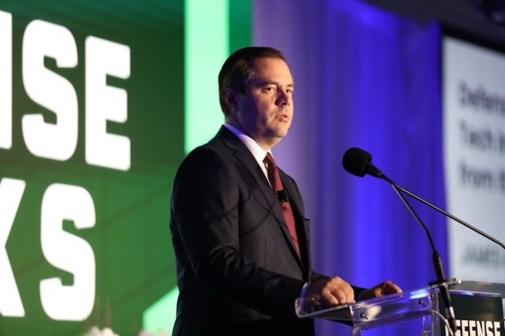
In a statement revealing the DOD’s shift from CDAO to SIO, Cameron Stanley, who oversees the office, said that this “redesignation is a clear signal of where the Department of War is going.”
(Trump issued an executive order rebranding DOD as the DOW last year, though formally changing the agency’s name also requires an act of Congress.)
Stanley’s announcement indicated that the office’s existing operational programs, solicitations and partnerships will continue “uninterrupted under the new banner.” The transition, he said, would be rolling out across the department’s digital systems, enterprise applications and component headquarters in the near term.
Since then, the office has been iteratively changing the design and contents of its public-facing website, which was formerly AI.mil, and is now SI.mil. As of this week, the site’s “Leadership” landing page lists only two positions — Stanley’s and the principal deputy, Andy Mapes.
Unlike previous versions, the website no longer discloses any other positions or officials serving in the AI shop.
A source who requested anonymity to discuss the internal workings of the office this week told DefenseScoop that Army Col. Molly Solsbury is no longer the Maven Smart System program director inside the SIO. They also suggested that several other senior roles there are unfilled.
Built by Palantir Technologies and anchored under the SIO, the Maven Smart System is considered the Pentagon’s flagship AI-enabled software platform for command-and-control, battlefield awareness and complex intelligence fusion.
MSS adoption and investments have been surging across the military this year, largely influenced by a directive from DOD leadership to mature the platform into a formal program of record.
Pentagon spokespersons did not directly respond to DefenseScoop’s questions regarding who is serving as the Super Intelligence Office’s program director for the Maven Smart System at this time, or confirm Army Col. Molly Solsbury’s current role.
“Given the ever-increasing role AI plays in planning and executing military missions across the globe and how interwoven it is throughout our military networks, especially Maven, transparency is a must,” a former U.S. military official told DefenseScoop on Tuesday. “Without transparency, there’s a real risk of AI being misused or misapplied which could lead to a whole host of security concerns at home and abroad.”
Pentagon spokespersons also did not provide updated information this week about the office’s current organizational setup and leadership lineup, in the wake of the rebrand and digital redesign.
In an email on Monday, an individual who asked to be referred to as a War Department official told DefenseScoop: “Our organization routinely aligns personnel to meet operational requirements. We do not comment on individual assignments below the Senior Executive Service level.”
Regarding that response, sources also urged DOD to share more information about the SIO’s workforce and priorities with the public — as the CDAO historically supplied.
Virginia Burger, a senior defense policy analyst for the Project on Government Oversight’s Center for Defense Information, noted that the Maven platform is “a permanent, billion-dollar program” that more than 100,000 defense and military personnel use.
“It’s the foundational software for military targeting. The department’s own memo said making Maven a program of record would create clear lines of accountability,” Burger, who served for almost a decade as an active-duty Marine Corps officer, told DefenseScoop. “If there’s been a leadership change, the Pentagon should say so.”
In her view, “declining to confirm who runs the program while scrubbing the website of leadership details is the opposite of accountability.”
Burger also noted that experts’ calls for transparency are emerging as “a new Congress prepares to ask hard questions about AI in targeting” after a U.S. Tomahawk missile strike reportedly hit an elementary school in Iran during Operation Epic Fury.
“The person in charge is the one who answers when something goes wrong. That’s the standard across the military. Transparency is how Congress and taxpayers make sure these systems work as promised and that someone is responsible when they don’t,” Burger said. “If the department doesn’t want to put that face forward, let’s hope senior leaders are willing to take the heat and answer the hard questions.”