DOD components face ‘aggressive’ timeline for Maven Smart System transition
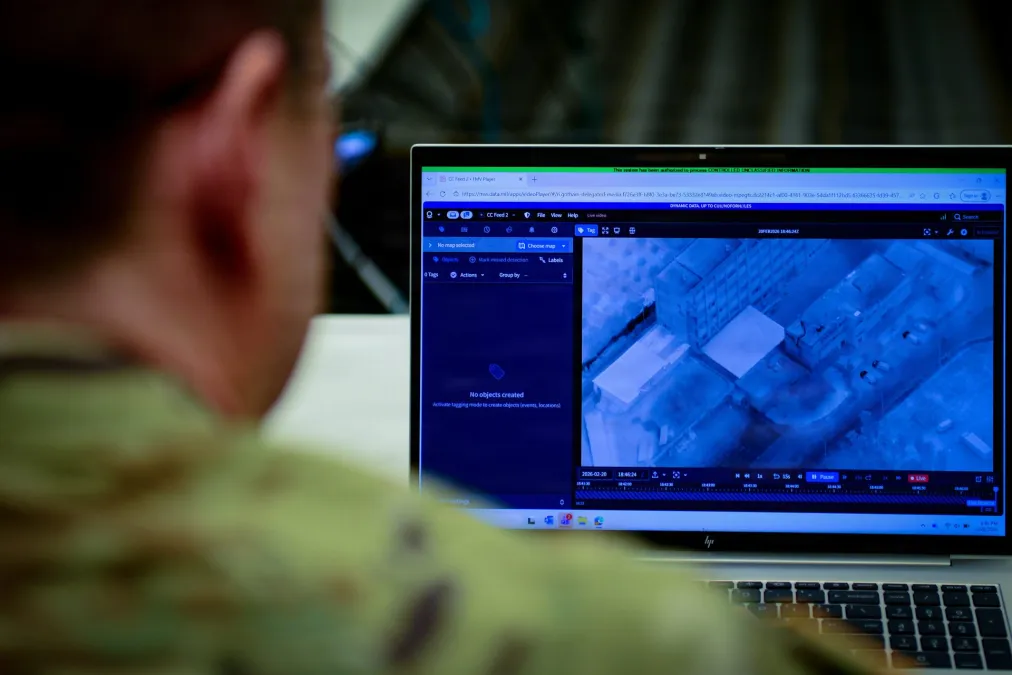
Deputy Defense Secretary Steve Feinberg’s March 9 memorandum sets an ambitious deadline for Pentagon and military leaders to transition the Maven Smart System (MSS) into a formal program of record by the end of this fiscal year.
That Palantir-supplied, AI-enabled platform fuses disparate military systems and intelligence sources into one interface that rapidly integrates data and compresses the military’s processes for finding and striking targets.
The transition will allow for more stable funding streams and put the technology on an accelerated path to becoming an even more widely adopted fixture embedded across U.S. military operations. MSS has been deployed in live-fire exercises and is actively being used in real-world conflicts by multiple combatant commands.
“This designation will streamline acquisition, ensure use of rigorous testing and evaluation standards, and create clear lines of accountability for performance, oversight, and management,” Feinberg wrote in the four-page memo, which was obtained by DefenseScoop.
Notably, among a variety of instructions he provided to several Defense Department undersecretariats to fully establish the new program of record, Feinberg stated that if the Office of the Under Secretary of Defense for Research and Engineering identifies any transition task that will “negatively impact delivery of MSS capability to the warfighter,” the directorate should make any “necessary adjustments to the timelines” outlined on his behalf.
Spokespersons from the military’s 11 combatant commands and DOD were largely unforthcoming when responding to questions from DefenseScoop over the last few weeks regarding whether or how the transition could disrupt their ongoing usage of MSS.
“We decline to comment citing operational security,” a Pentagon spokesperson said.
DOD officials typically cite operational security, or OPSEC, as a means to protect sensitive information about military operations and capabilities from reaching adversaries. However, in recent years experts have increasingly warned that Pentagon leadership misuses — and overuses — the term in ways that can be restrictive to transparency and public accountability.
One former senior defense official who requested anonymity to speak freely about MSS said that the second Trump administration is missing an opportunity to educate the American public about the responsible use of AI in warfare — “because people are honestly hearing things and making a lot of assumptions and inferences about lethal autonomous weapons systems.”
Actions and targets
MSS’s roots trace back to Project Maven, which Pentagon leadership under the first Trump administration officially launched in 2017 to expand personnel’s adoption of AI-enabled technologies that autonomously detect, tag and track objects or humans of interest via massive amounts of surveillance footage captured by U.S. military aircraft, drones, satellites and other means.
The Pentagon’s Chief Digital and AI Officer Cameron Stanley demonstrated MSS for the public in March.
Stanley — who, according to his LinkedIn profile served in the Office of the Undersecretary of Defense for Intelligence and Security from late 2021 to early 2024 as the lead for Project Maven and then AI development and oversight, among other roles — said those early days of the system’s development were built around goals to pull insights from the military’s “airborne surveillance assets” so personnel wouldn’t have to spend as much time staring at computer screens.
“They get lazy, they get tired, they get distracted, they miss things. And so what we ran into was, ‘Let’s use AI to try and tip and cue the right systems, so that humans didn’t just have to stare at a screen 16 hours a day and get tired. So with that, this is where we started,” Stanley said in the demonstration.
Around 2022, responsibilities for most of the program’s elements started to split between the National Geospatial-Intelligence Agency and the CDAO, while certain duties moved over to the Office of the Under Secretary of Defense for Intelligence and Security.
All three of those organizations have been mostly taciturn about Maven — and the associated MSS capabilities — since that transition.
Broadly, MSS has evolved over the years from a system that identifies objects of interest to one that can also integrate real-world data and visualize it on shared maps, track targets, recommend available weapons, and cut sensor-to-shooter timelines from hours to minutes or less.
“This is Maven Smart System, Palantir’s software-as-a-service product that we are deploying across the entire department,” Stanley said in the recent tech demonstration. “As you can see, it’s not just one data feed, it’s multiple. And instead of having eight or nine systems for those decision-makers to look at every single day in order for them to make decisions, you then fuse it into a single visualization tool.”
Users can then select and deselect different types of data, and generate different actions to weigh scenarios in the same system that action plans are being developed in.
“This is what we do — left click, right click, left click. Magically, it becomes a detection. That detection then gets moved into a workflow,” Stanley explained. “Once you have that decision, you’re trying to actually ‘action’ that process.”
From there, the system and process moves into code generation and course-of-action proposals. At that point, Stanley said officials work with MSS to try to “identify what the best asset to prosecute a target looks like.”
“Once we’ve got the different approaches and we select one, we then can move directly into how do we ‘action’ that target? So we’ve gone from identifying the target to now coming up with a course of action to now actioning that target — all from one system,” Stanley said. “This is revolutionary.”
While this was seven years in the making, the CDAO added that “there’s many things” left for the Pentagon to accomplish with MSS in the near term.
Commands and concerns
Feinberg’s memo on moving the initiative to a program of record includes almost two dozen explicit directions for certain department officials to complete by the end of September to secure the full transition.
The deputy secretary instructs the undersecretariats for R&E and I&S to steer the “transition of MSS system administration, oversight, support activities, and related responsibilities from NGA to the CDAO MSS Program Office.”
He also directs R&E to assume authorizing official (AO) responsibilities from the NGA for MSS and its associated commercial cloud enterprise infrastructure, and for all MSS contracts to be transitioned to “the existing Army Enterprise Agreement (EA) contract vehicle,” which will manage procurement for the Maven program of record moving forward.
The Defense Department inked the initial $480 million, five-year IDIQ contract with Palantir for MSS in May 2024. At that time, executives from the company told reporters that the work under that contract would initially cover five U.S. combatant commands: Central Command, European Command, Indo-Pacific Command, Northern Command/NORAD, and Transportation Command.
One year later, in May 2025, Pentagon officials revealed their decision to increase that contract ceiling for MSS to nearly $1.3 billion through 2029 — a move that they then billed as necessary in anticipation of future demand.
“It’s hard to understate how important this program — well, what is now a program — is, how much it’s grown, what an important role it’s playing, and what an important potential role it has,” Emelia Probasco, a senior fellow at Georgetown’s Center for Security and Emerging Technology (CSET), recently told DefenseScoop.
Probasco previously served as a surface warfare officer in the Navy and in the Pentagon as the speechwriter to the chief of naval operations, among other positions.
“I think that the timeline [to transition MSS to a POR] does feel aggressive for a program that has grown so substantially so quickly,” she said. “Maven is popular — and the reason it’s growing, in my opinion, is because people like it.”
Over the last few weeks, DefenseScoop has been in contact with spokespersons from the 11 U.S. combatant commands regarding whether they received Feinberg’s memo to initiate the MSS transition, and if there were any concerns raised on their end that the transition tasks could disrupt their command’s usage of the platform in high-stakes, ongoing missions.
Officials from Northern Command, Transportation Command, Special Operations Command and Space Command confirmed receipt of the transition directive.
“Establishing Maven as a Program of Record will provide the long-term stability and dedicated resources needed to expand AI-enabled command-and-control for [North American Aerospace Defense Command and Northcom]. We are actively engaged in the transition planning and anticipate no challenges or disruptions to current operations,” a spokesperson from that command told DefenseScoop in an email. “We view this transition to a Program of Record as a positive step and a valuable opportunity to accelerate and broaden our Maven implementation in support of our homeland defense mission.”
A Transcom spokesperson said that MSS is one of several tools that command uses “to streamline decision-making and provide increased connectivity as we simultaneously support multiple combatant commanders executing a wide range of missions across the globe.”
“We do not have any concerns,” the Transcom spokesperson told DefenseScoop.
Beyond acknowledging the memo, a Special Operations Command spokesperson said they had “no additional comment to provide.”
A spokesperson from Indo-Pacific Command said they “don’t have anything to provide on this one,” as well.
“[Southern Command] does not comment on internal communications or memos. Regarding the Maven Smart System, SOUTHCOM remains committed to leveraging advanced technologies to enhance mission effectiveness,” a spokesperson from that command said.
And after confirming the memo’s receipt, Spacecom deferred all of the publication’s questions to DOD. Officials from Central Command, European Command, Africa Command, Strategic Command and Cyber Command additionally directed inquiries to the Pentagon.
Separately, Palantir also refused to answer questions from DefenseScoop about MSS usage amid the transition. A spokesperson for the company referred “questions on Maven or any other military programs” back to the Pentagon — where spokespersons again declined to comment, citing OPSEC.
Experts and analysts expressed concerns about transparency and safety associated with the DOD’s speedy transition timeline and reluctance to discuss MSS adoption.
“I would suspect as quickly as they rush to put all this together, there’s probably a lot of flaws in there on the security side. How do they know that the system is secure as it should be?” a former senior defense official said.
They added that, in their view, Stanley’s recent video demonstration — which they labeled as an “extended Palantir commercial” — did not lay out the full scope of the MSS platform’s functions and deployment.
“People saw that and immediately said, ‘Well, shit, AI’s running this war [in the Middle East].’ It isn’t. But it’s easy to reach that conclusion after watching that video,” they told DefenseScoop.