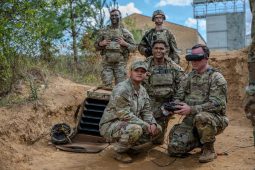
Gen. Dagvin Anderson, commander of U.S. Africa Command, participates in a small unmanned aircraft system demonstration with U.S. soldiers from the 1st Squadron, 2nd Cavalry Regiment, at Rose Barracks, Vilseck, Germany, Sept. 1, 2026. As the pace of innovation accelerates and tactics continue to evolve, sAUS integration is becoming increasingly critical to adaptation on the modern battlefield by improving how units coordinate detection, tracking and response capabilities against emerging aerial threats. (U.S. Army photo by Sgt. 1st Class Kenneth Tucceri, AFRICOM public affairs)
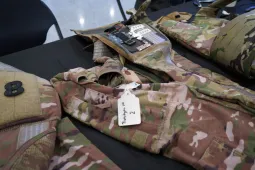
Army ManTech, a member of the Joint Defense Manufacturing Technology Panel (JDMTP), exhibited innovative smart fabrics at the Pentagon, July 8, 2025. (DOD Photo by Rebecca War/DVIDS)
SAP NS2 Chief Executive Harish Luthra explains why treating security compliance as a competitive edge, rather than a roadblock, is vital to mission readiness and vendors’ long-term…
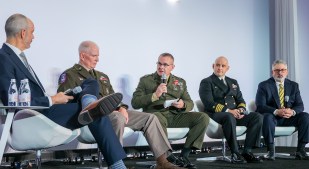
Participants discuss the need to prioritize the development of operating systems that more easily integrate with common command-and-control networks at GDIT’s ‘Battlespace of the Future’ summit. Panelists include, from left: Scoop News Group’s Billy Mitchell, Army Brig. Gen. Anthony Gibbs, Marine Corps Col. Jeremy “Hank” Hester, Navy Capt. JJ Murawski, and General Dynamics Land Systems’ Bill Tecos. (Scoop News Group photo)
Sponsored
The rapid evolution of software-centric vehicles on the battlefield has placed new pressures on the Department of War to restructure its acquisition models.
By adopting pre-accredited cloud platforms, defense organizations can bypass laborious compliance hurdles and redirect critical resources to AI tools, argues CIO.
Tech specialists discuss modern, adaptive solutions that work regardless of connectivity at GDIT’s ‘Battlespace of the Future’ summit. Panelists include, from left: Scoop News Group’s Billy Mitchell, Navy’s Michael Frank, Air Force’s Julianne Lefebvre, and GDIT’s Ben Gianni. (Scoop News Group photo)
Sponsored
Tech specialists from the Navy, Air Force and GDIT say modern, adaptive solutions that work regardless of connectivity are key to the battlespace of the future.
DIA’s CIO highlights the agency’s shift from application-centric to data-centric models and how embedding personnel in industry shops helps build workforce expertise.
Defense security leaders discuss the growing convergence of cyber and kinetic assets at GDIT’s ‘Battlespace of the Future’ summit. Panelists include, from left: Scoop News Group’s Billy Mitchell, U.S. Space Force’s Charlene Laughlin, U.S. Army’s Brandon Pugh, DOW’s Katherine Sutton and GDIT’s John Sahlin. (Scoop News Group photo)
Sponsored
Technical experts from DOW, the U.S. Army, the U.S. Space Force and GDIT highlight the need for advanced platforms, training and policies as physical and cyber domains…
Defense leaders discuss changing role of data management at GDIT’s ‘Battlespace of the Future’ summit. Panelists include, from left: Scoop News Group SVP Billy Mitchell, DOW Assistant Secretary Joseph Jewell, Army Lt. Gen. Jeth Rey, and GDIT President Amy Gilliland. (Photo by Scoop News Group)
Sponsored
To keep our military edge, we must stop treating software like a slow-moving construction project and start delivering at the speed the mission demands.