Pentagon taps 6 vendors for accelerated hypersonics R&D

The Defense Department’s Joint Hypersonics Transition Office (JHTO) has awarded six non-traditional vendors contracts to support advancements in novel technologies, officials announced Thursday.
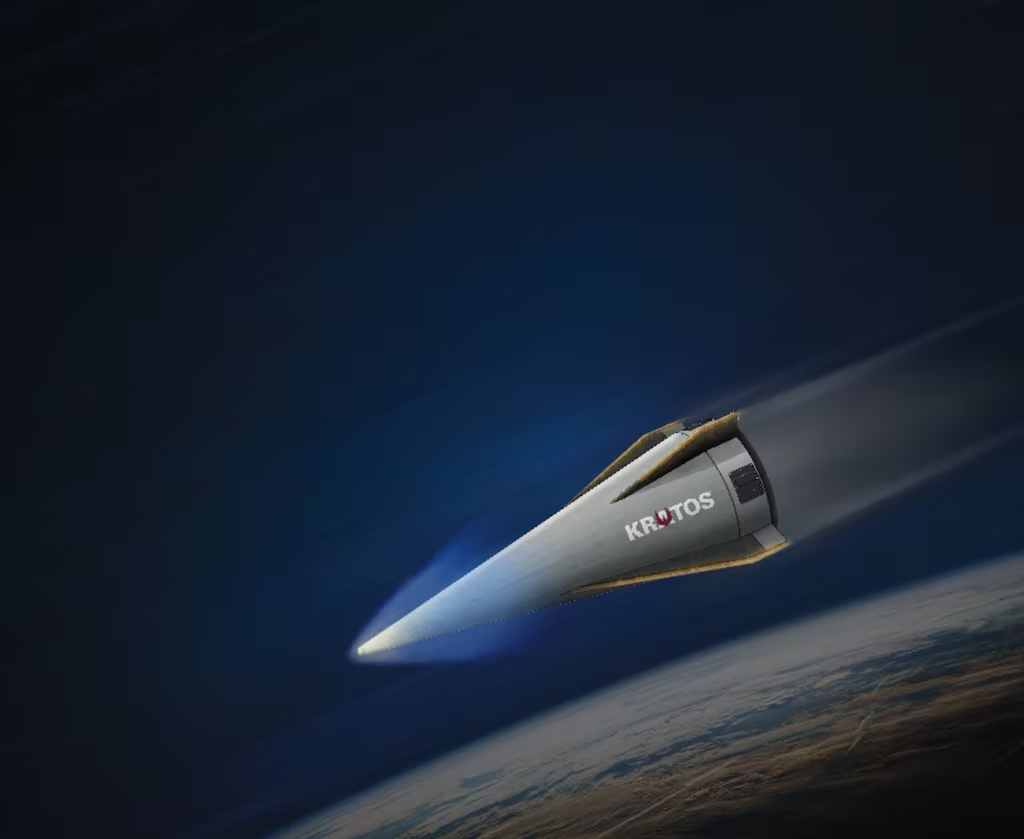
Leidos, GoHypersonic, Special Aerospace Services (Aurex), the Purdue Applied Research Institute, Halo Engines and Kratos have each received other transaction agreements from the JHTO and its partner, Naval Surface Warfare Center (NSWC) Crane Division. The awards are intended to help further advance the office’s ongoing development of next-generation hypersonics capabilities.
The OTA contracts were given through the Strategic and Spectrum Mission Advanced Resilient Trusted Systems (S2MARTS) mechanism, which is managed by the National Security Technology Accelerator (NSTXL). The non-profit organization is one of many that serves as a bridge between the government and private-sector to transition innovative technologies into the hands of warfighters.
According to NSTXL, the six vendors will work on multiple areas related to hypersonic development — including in-flight maneuverability; improved aerodynamics and propulsion designs; mission planning; and effectiveness.
“Through these [science-and-technology] priorities, the awarded organizations will develop and demonstrate new subsystem technologies, strengthen the scientific foundations behind hypersonics and explore emerging technologies with the potential to transform future systems. Each award will mature through modeling and simulation, and relevant ground or flight experimentation,” an NSTXL news release stated.
Although NSTXL could not provide specific details on how much the OTAs are worth, the organization’s request for services anticipated a total budget across all six awards to be $68 million. The estimated period of performance is three years, with the goal to have a flight-ready prototype ready before the end of the contract, an NSTXL person told DefenseScoop.
Development of hypersonic missiles has been a top priority across the Pentagon for years. The weapons are able to fly at speeds of Mach 5 or greater and maneuver through the atmosphere before hitting a target, making them difficult for enemy air defense systems to detect and defeat.
Although the Air Force, Army and Navy have their own respective hypersonics programs — each at different stages of development — getting the weapons across the finish line has proven difficult. Not only does the United States have minimal testing infrastructure for the systems, they are also difficult to design and deploy from an engineering perspective.
The Pentagon stood up the JHTO in 2020 to tackle the challenges associated with hypersonic development. The organization partners with NSWC Crane to conduct advanced research, create development strategies and transition the technology into operational capabilities.