EXCLUSIVE: Space Force’s role in Iran, Venezuela raids fueling push for more resources
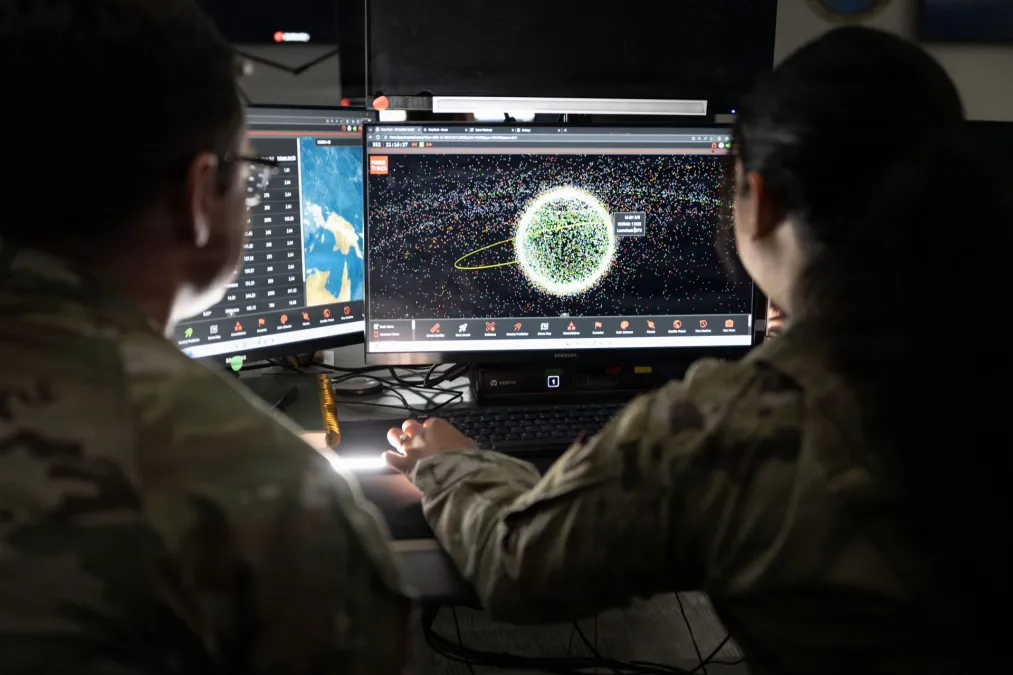
Space Force guardians provided critical support during high-profile U.S. military operations in Iran and Venezuela — experience that underscores the need for additional resources to prepare the service for future conflicts, a senior official told DefenseScoop in an exclusive interview Friday.
Operation Midnight Hammer and Operation Absolute Resolve were carried out by the joint force in June 2025 and January 2026, respectively. Pentagon leadership have touted the raids — during which over 100 aircraft and weapon systems were deployed — as proof of the department’s ability to project military power across the world.
But key to the success of both of those ops was control over what Lt. Gen. Gregory Gagnon, commander of the Space Force’s Combat Forces Command, refers to as “the invisible front line” of outer space.
“In the Middle East and into South America, also on mission were people in Colorado, in Europe and in Asia — sitting crew positions that are 24/7. From these locations, they helped operate a global sensor network that enabled us to have the high ground,” Gagnon said.
Combat Forces Command is the service’s field command tasked with presenting space-based effects to combatant commands, primarily U.S. Space Command. Guardians under Gagnon’s purview provide capabilities critical to modern military operations, such as preventing communications links from being jammed and keeping an eye out for missile launches.
Following the January capture of former Venezuelan President Nicolás Maduro in Caracas, Chairman of the Joint Chiefs Gen. Dan Caine highlighted Spacecom’s role in providing non-kinetic effects “to create a pathway overhead” for troops during Operation Absolute Resolve.
At the time of the raid, guardians stationed at Schriever Space Force Base in Colorado supplied satellite communications and position, timing and navigation (PNT) data to U.S. forces, Gagnon said. Notably, operators controlled elements of the electromagnetic spectrum to provide accurate geolocation data to forces deployed in U.S. Southern Command, while also monitoring for and preventing any interference.
Gagnon noted that similar overwatch capabilities were used during Operation Midnight Hammer, when the Defense Department attacked nuclear facilities in Iran. Guardians also played a crucial role in detecting Iran’s retaliatory missile strikes against U.S. forces in the Middle East only seconds after they were launched.
“Even though that was on the other side of the planet, there were hundreds of guardians working that same 24/7 shift out of Colorado, connected with guardians who also operate in other parts of the world, working radars that deliver that immediate notification to U.S. forces and our allies around the world,” he said.
According to Gagnon, Absolute Resolve and Midnight Hammer underscore the importance of having advanced space systems and skilled operators integrated into joint operations — a message Space Force leaders have stressed since the service’s creation in 2019.
Unlike the other military services, much of the Space Force’s current missions are supporting functions that happen behind the scenes. Guardians enable deployed forces by providing SATCOM, GPS navigation, missile warning and other other space-based capabilities that troops rely on to operate and fight successfully.
“The heart of the matter is that America does not project military power without space being involved,” Gagnon said.
The Defense Department was able to successfully complete both raids into Venezuela and Iran by leveraging years of investment in equipment and training against two adversaries that do not have robust space warfighting capabilities. But Gagnon warned that a future fight against near-peer adversaries wouldn’t be won as easily.
“What worries me is that we get too comfortable in our ability to do power projection, because often it’s against an adversary that doesn’t have a space force that will fight back,” he said. “Thinking that we will own the high ground without having to fight for it is a flawed assumption, and that’s what gives me concern.”
China’s People’s Liberation Army Aerospace Force dwarfs the United States’ service. Reports estimate that Beijing currently has at least 40,000 personnel in its Aerospace Force, while the U.S. Space Force has around 15,000 members, Gagnon said.
Furthermore, officials are concerned about China’s growing arsenal of space-based capabilities — including mega-constellations able to monitor, track and target forces on Earth, novel satellites that can conduct unpredictable maneuvers on-orbit and offensive counterspace systems, according to the Pentagon’s latest report to Congress on military and security developments in China.
With future conflicts in mind, the Space Force is taking its experiences from Absolute Resolve and Midnight Hammer and proactively working to expand both in size and its ability to outpace adversaries — as well as prepare for more direct conflicts that could happen on-orbit.
“What I challenge people to think about is, what do we need to seize the high ground against an adversary that may have a space force bigger than ours?” Gagnon said. “That is not a simple task, and the first part of that task is recognizing that protecting and defending our assets in space is necessary, but it’s also currently insufficient.”
A key focus for the U.S. Space Force will be upgrading its network of on-orbit and terrestrial sensors used to monitor activity in space, especially in geosynchronous orbit where several critical platforms are located, he noted.
On Feb. 12, the service launched the seventh and eighth satellites in the Geosynchronous Space Situational Awareness Program (GSSAP) constellation, expanding its ability to keep track of objects.
But during that same launch, the Space Force also deployed a research-and-development payload that Space Delta 9 will use to practice their tactics, techniques and procedures for orbital warfare, Gagnon said. Broadly, orbital warfare involves operations conducted in space that protect friendly satellites and disrupt adversary assets via rendezvous and proximity operations (RPO), non-kinetic effects such as jamming, orbital maneuvering and more.
“What’s different about this R&D article from previous R&D articles is that this one will allow for more precise maneuvers,” he added. “It’s like the difference between taking an airliner jet with their maneuverability and moving more to a military aircraft with their maneuverability.”
The service is also upgrading its sensing capabilities on Earth so that it can continue monitoring and tracking even smaller objects orbiting in GEO, Gagnon noted. That includes developing new systems like the Deep-space Advanced Radar Capability (DARC), as well as modernizing elements of the Space Surveillance Network (SSN).
Officials are in the process of upgrading the Ground-Based Optical Sensor System (GBOSS) telescopes that can see deep into space. Originally built in the 1980s, the service is adding new features that double each telescope’s field of view and search rate, as well as triple their sensitivity, Gagnon said.
However, an influx of new systems will also require more guardians trained to operate them. Even though the Space Force has already surpassed its recruiting goals for fiscal 2026, the service estimates that it will need to double in size to meet current demands, according to Gagnon.
“We want America to know that we are ready to deliver the high ground if tasked and asked by our chain of command. But in order to do so, we need guardians, we need resources and we need funds to do so,” he said. “We are doing the best with what we’ve got, but the Space Force you have is not the Space Force you need in order to win against another country that has a formative space force.”