Army awards Anduril $20B contract with an eye toward counter-drone capabilities
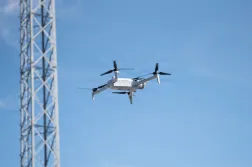
The Army has awarded a mega contract to Anduril Industries that the U.S. military hopes will boost its ability to defeat drone threats.
The Pentagon unveiled the $20 billion deal Friday evening as part of its daily list of contract announcements.
That announcement addressed the types of technologies involved, but was scant on details about the mission areas the capabilities would be applied toward.
Under the agreement, Anduril will “consolidate current and future commercial solutions — including the proprietary, open-architecture, AI-enabled Lattice suite, integrated hardware, data, computer infrastructure, and technical support services — into a unified, mission-ready capability supporting the Army’s evolving operational and business needs. Work locations and funding will be determined with each order, with an estimated completion date of March 12, 2036,” according to the contract announcement.
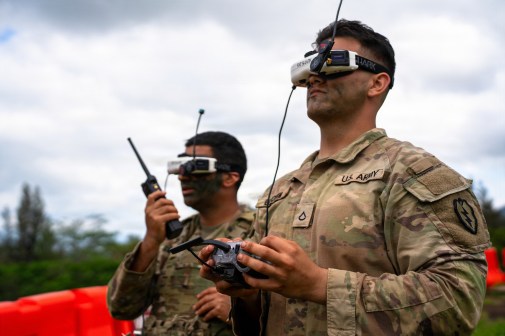
A separate news release from the Army-led Joint Interagency Task Force 401 — which is focused on strengthening the U.S. government’s drone defenses overseas and stateside — about the contract stated that the organization has “championed a groundbreaking enterprise-level agreement to provide a cutting-edge command-and-control solution through a strategic action.”
The military’s push for better C2 capabilities was supported by a recent visit to Kyiv by members of JIATF 401, which DefenseScoop was first to report.
“Based on our testing and evaluation, it became clear that a common command and control system is needed to effectively counter adversary drones. These results were confirmed during my visit to Ukraine, when I saw firsthand how drones have changed the modern battlefield,” Army Brig. Gen. Matt Ross, director of the task force, said in Friday’s news release.
Officials touted the $20 billion deal as an enterprise vehicle that will streamline the Pentagon’s procurement of tools to counter unmanned aerial systems and enhance interoperability among government partners.
Army Col. Tony Lindh, JIATF 401 deputy director of acquisitions, suggested that the initiative will help agencies achieve “common air domain awareness,” with Anduril’s Lattice platform serving as the C2 backbone for their efforts.
“By establishing a common technological backbone, this agreement paves the way for an integrated, multilayered defense network that will allow warfighters and federal agents to seamlessly share data, coordinate responses and neutralize threats faster and more effectively,” the news release stated.
The need for better interagency coordination on counter-drone activities was highlighted by two high-profile incidents in Texas last month, which caused temporary airspace closures, lawmakers have said.
The widespread use of drone attacks in recent conflicts, including in the Ukraine-Russia war and across the Middle East, have spurred the Pentagon to ramp up its efforts to acquire new counter-UAS capabilities. Large numbers of drone incursions on or near U.S. military installations and other sensitive sites in the homeland have added to that sense of urgency.
Last year, Secretary of Defense Pete Hegseth ordered the Army to stand up JIATF 401 to get after the problem.
The UAS threat was highlighted during the ongoing U.S. war with Iran. In the early days of that conflict, Tehran launched more than 2,000 drones against targets in the Middle East, U.S. Central Command commander Adm. Brad Cooper said in a video earlier this month about Operation Epic Fury. Six American troops were killed in an Iranian drone attack on a location in Kuwait that occurred March 1.

Anduril, which was founded in 2017 by Palmer Luckey, has landed large contract awards in recent years from the Pentagon for a variety of defense technologies, including hardware and software for uncrewed systems and counter-UAS tools. The company’s AI-fueled Lattice software platform, which provides a C2 interface, has been a centerpiece of many of those capabilities.
An Anduril spokesperson did not immediately reply to a request for comment Saturday about the new $20 billion contract award.
In a call with reporters on Monday, Matt Steckman, Anduril’s president and chief business officer, described the enterprise contract vehicle as “an ordering guide” where any buyer within the federal government can buy Anduril commercially made products.
“Sort of step one here is just streamline access to commercial tech,” he said. “Obviously the Army will centralize their spend on this, but there’s going to be a push to centralize other DOD and federal spend against it. And that will all sort of add into the overall discounts that the government receives. So kind of everyone wins here,” he said.
The company on Monday also announced the first “task order” under the agreement, valued at $87 million, by which JIATF 401 is selecting Anduril’s Lattice tech as the government’s tactical C2 solution for counter-drone capabilities.
“Software is what enables rapid updates. It’s what enables you to change components in and out in response to an ever-evolving threat. And so as the JIATF 401 command-and-control software foundation, Lattice will integrate a broad range of sensors and effectors from legacy systems to newly fielded capabilities, enabling distributed detection, tracking, classification, and ultimately engagement of UAS threats,” Parks Hughes, Anduril’s managing director for air defense, told reporters.
“We will leverage commercial software best practices, development and deployment processes to deliver a continuously improving Lattice capability, and we will continue to draw on operational lessons learned from across the globally deployed footprint to continuously improve the product,” he added.
Hughes told DefenseScoop that the company’s software can enable the type of anti-drone network that Ukraine has deployed and that JIATF 41 leadership have touted.
“It will ultimately depend on how the JIATF and the various users, you know, what operational problem they are dealing with and what the best solution is. Lattice is a very flexible, you know, command-and-control platform, and so absolutely enables network, absolutely enables a range of sensors and effectors — be those acoustic, visual, RF, radar, otherwise,” he said.
“I would point out that, at least in our experience, the fundamental challenge of counter UAS is detection, tracking, and then ultimately identification,” he added. “Without that, you can’t really have or generate effects.”
Drew F. Lawrence contributed reporting.
Updated on March 16, 2026, at 8:23 PM: This story has been updated to include comments from a media call with Anduril executives and information about a task order that was announced Monday.