Transcom leaders briefed on recent West Coast maritime drone demo
CONCORD, Calif. — U.S. military officials who run strategic port operations and deployment logistics on the West Coast hosted a maritime technology demonstration last month to prove out the feasibility of using a commercial unmanned surface vessel to investigate watercraft of interest without jeopardizing the security of crewed patrols.
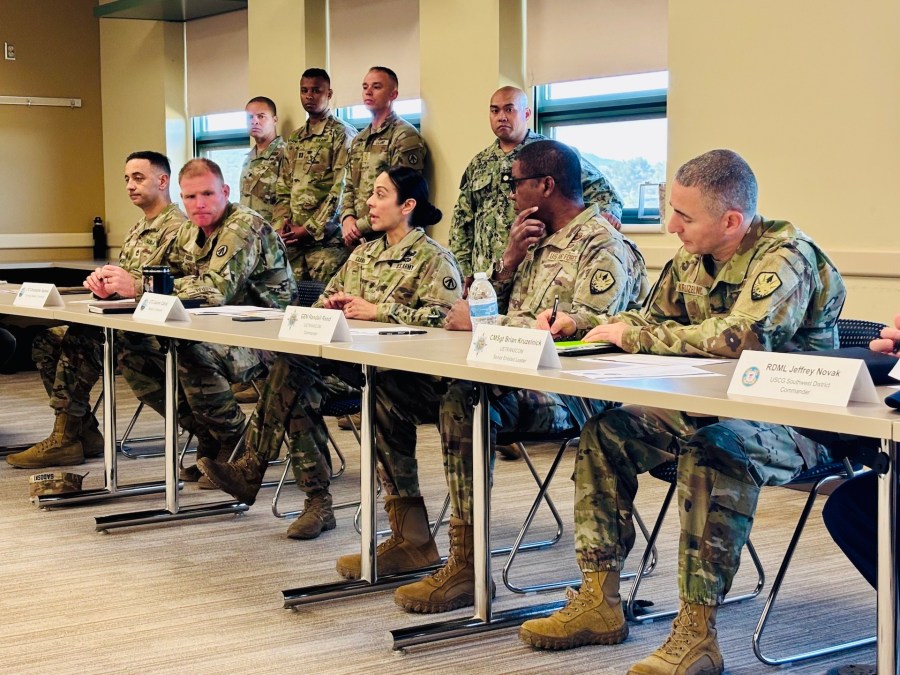
Senior military personnel from Army Combat Capabilities Development Command and the 834th Transportation Battalion, who led the demo in mid-May, discussed their top takeaways from that showcase with U.S. Transportation Command leaders on Tuesday.
They briefed Transcom commander Gen. Randall Reed and his team on port diversification and civil utilities initiatives at Military Ocean Terminal Concord (MOTCO), a military base and ammunition seaport in California.
“There is an opportunity for us to be able to utilize this equipment and this piece of technology here that would help us in protecting that restricted area along the waterside. It’s another phenomenal opportunity for the Coast Guard to be able to use this type of equipment, as well as most of the authorities sort of lie under their portfolio to be able to exercise that,” said Lt. Col. Lauren Cabral, commander of the 834th. “They have a number of different activities that they’re monitoring, to include some of that counter-narcotics mission as well.”
The demo unfolded as adversaries are increasingly aware of and targeting America’s critical infrastructure with kinetic and cyber threats — and as the nation is investing in and deploying autonomous USVs to patrol regional chokepoints and access areas deemed unsafe for human patrols.
Officials involved suggested that a notable portion of the effort focused on developing and validating the tactics, techniques, and procedures for manned-unmanned teaming.
“For the particular nature of this work, the platform here a few weeks back is of interest. And more broadly for Coast Guard efforts, we’re looking at how we leverage a variety of [uncrewed systems],” Rear Adm. Jeff Novak, commander of the U.S. Coast Guard Southwest District, said. “And especially down on the border, where we’ve got broad expanses [and] where, at the end of the day, there’s just not enough people to put on target, so we’re looking towards capabilities.”
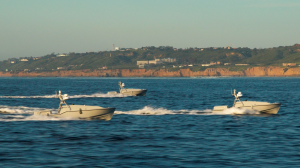
The maritime drone at the heart of this demo was Saronic’s Corsair USV. It can operate at speeds greater than 30 knots and is equipped with sensors that provide 360-degree passive sensing capabilities for day and night operations. The drone demonstrated key autonomous behaviors, like loitering, obstacle avoidance, and Beyond Line-of-Sight (BLOS) control — and also executed several tasks associated with force posture and tracking vessels of interest.
“This platform here has a ton of bells and whistles that you can tag on to it,” Cabral noted.
The demo indicated that the platform’s capabilities align most naturally with Coast Guard authorities and mission sets for port security and national maritime protection.
“Using it in a port environment, there’s a lot to be looked at and further understood. But much like it is with [unmanned aerial systems], we only know what we know today, and we’ll know far more tomorrow, because it is exponentially growing in that regard,” Novak said.