Two days, one drone killer: How defense companies built a wheeled counter-UAS robot at the Army’s Operation Jailbreak
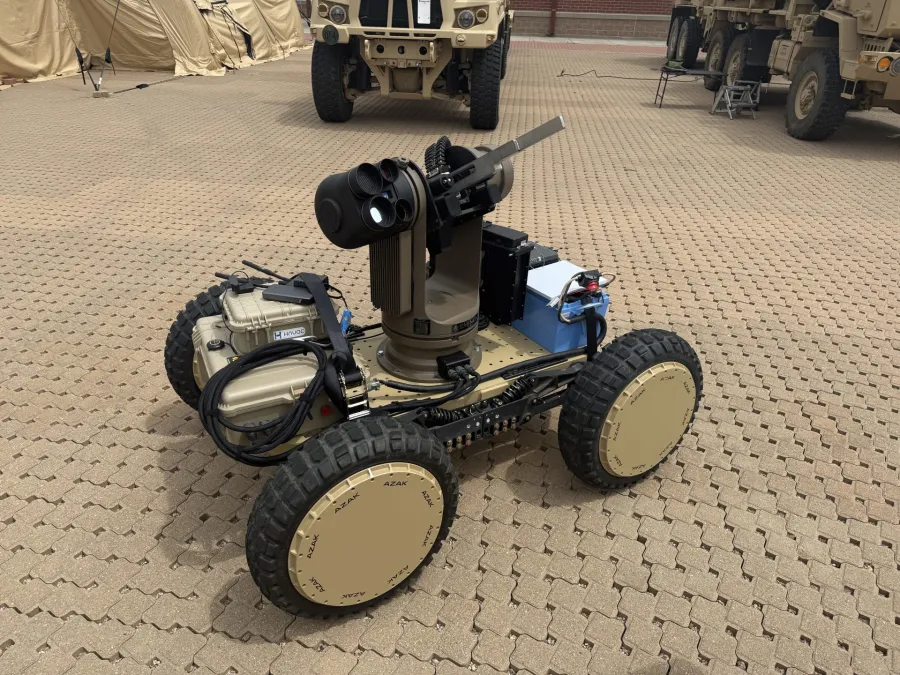
Out near the Rocky Mountains, Ben Meager found a good spot to park his robot vehicle. It was the best place to park in a lot packed with some of the defense industry’s newest tech, but it also happened to sit next to a counter-drone turret he’d been eyeing for more than a year.
Meager had made renderings of the turret, an autonomous machine gun drone killer made by Allen Control Systems known as “the Bullfrog.” He thought it could fit on top of his company’s small, ruggedized ground robot to help blow swarms of unmanned aerial systems out of the sky.
“I won’t lie,” Meager, the CEO of AZAK, told DefenseScoop in a recent interview. “I parked the vehicle next to the ACS Bullfrog in hopes of an actual incorporation of that product onto ours, and that is exactly what happened.”
Within about two days, according to two CEOs involved in the effort, six defense companies ended up building a pair of wheeled drone killers that soon began zipping around the lot. AZAK and ACS provided the mobility and firepower, Havoc plugged the autonomous driving software, Leonardo DRS installed the radar, Picogrid tied the systems together, and it all ran through Anduril’s battle management platform known as Lattice.
The result: a “hunter-killer” team of ground robots meant to autonomously roam contested and denied battlefields to shoot down UAS swarms looking to target U.S. troops, the CEOs said. One senses the target and the other shoots it down, moving in tandem.
“You see what’s happening in Ukraine and these drones are now directly targeting individual soldiers,” said Paul Lwin, CEO and co-founder of Havoc. He said the new ground robots could maneuver away from human-staffed formations, creating perimeters to target UAS swarms before they get to units without troops having to dig into stationary trenches. “I think this is how we overcome the proliferation of these easy and cheap drones.”
Those companies were among more than 50 to descend on Fort Carson, Colorado, last month for an Army initiative called Operation Jailbreak. The overall purpose of the effort was meant to get the service’s disparate military systems to talk to each other. The defense vendors built the ground robots during Jailbreak’s first “sprint,” which ended earlier this month.
After years of expensive efforts to connect its platforms, the Army has been campaigning for a way to get old and new capabilities to exchange data. Officials have said modern conflict around the world has shown that fast, accessible distribution of information across a unified suite of sensors, weapons and units will define success on the battlefield, and the service wasn’t moving fast enough.
So the Army launched Jailbreak, which mimics Ukrainian efforts to build a robust battlefield awareness network to help repel Russian onslaughts. The Iran war also put pressure on the Army to deliver counter-drone patches to U.S. troops facing lethal one-way attack UAS gliding around the Middle East.
The “hunter-killer” ground robots — built in a matter of days by companies that share different slices of a unified systems network — wrought another type of promise, according to the CEOs DefenseScoop interviewed. In another way, the Army “called our bluff,” Lwin said.
“Ben’s, [my company], all the other vendors who will all say ‘hey, we can work together, we can provide capabilities right now,’” said Lwin. And [the Army] said ‘show it to us.’ They gave us the infrastructure to do it, and we did it.”
The ticket to entry for Operation Jailbreak was for defense companies — small, new, old and big — to share their interfaces, not only with the Army, but with each other. Historic military-defense industrial convention saw companies working in silos, reluctant to share with each other.
Army Chief Technology Officer Dr. Alex Miller recently said Jailbreak marked a change in this convention, but that the service had to unwind decades of acquisition missteps that never meaningfully required system “interoperability” in the first place to compel a more open environment for industry.
Part of that “openness” means creating common infrastructure so different companies with different, but potentially translatable capabilities, can plug and play, much like the commercial industry. Another part of the effort is meant to get away from “exquisite,” or otherwise case-specific and expensive capabilities that the service had been buying for decades.
Operation Jailbreak, according to the CEOs, represented an opportunity to tackle both.
“One company can’t do everything,” Lwin said. “You can’t do autonomy, you can’t do ground autonomy, you can’t do ground vehicles, put the payload on, control the payload, sense the threats. To deploy real weapon systems requires a team and people focused on the right thing.”
One of the markers of success for Jailbreak is being able to produce military technology at scale. The CEOs of Havoc and AZAK both told DefenseScoop they’d be up to the challenge to produce thousands of their hunter-killer robots. In fact, the two companies signed a memorandum of understanding to jointly produce and scale the systems.
While there will be “some moving pieces” to work out for mass development, Meager said, the first step in pumping out the counter-drone vehicle is for the Army to ask for scaled production. And if it does, the service would need to determine how many it wants.
Driscoll and other Army leaders were impressed by the development of the system, according to the Financial Times and the CEOs. When asked whether the Army had plans to buy the robot or whether its creation was simply an exercise in interoperability, a spokesperson said the service had nothing to announce at this time, but would respond “when we do.”
“We need even more than a rough excitement level to really start to scale this product,” Meager said, adding that Havoc’s hardware kit is “ready to go” and AZAK’s frame is ready to accept it. “I think from that perspective, it becomes a very real product very, very quickly. The scale portion really needs to come in so many ways from the Army to push us into the appropriate path forward.”