Military services leaning into handheld blood testing devices to diagnose TBIs
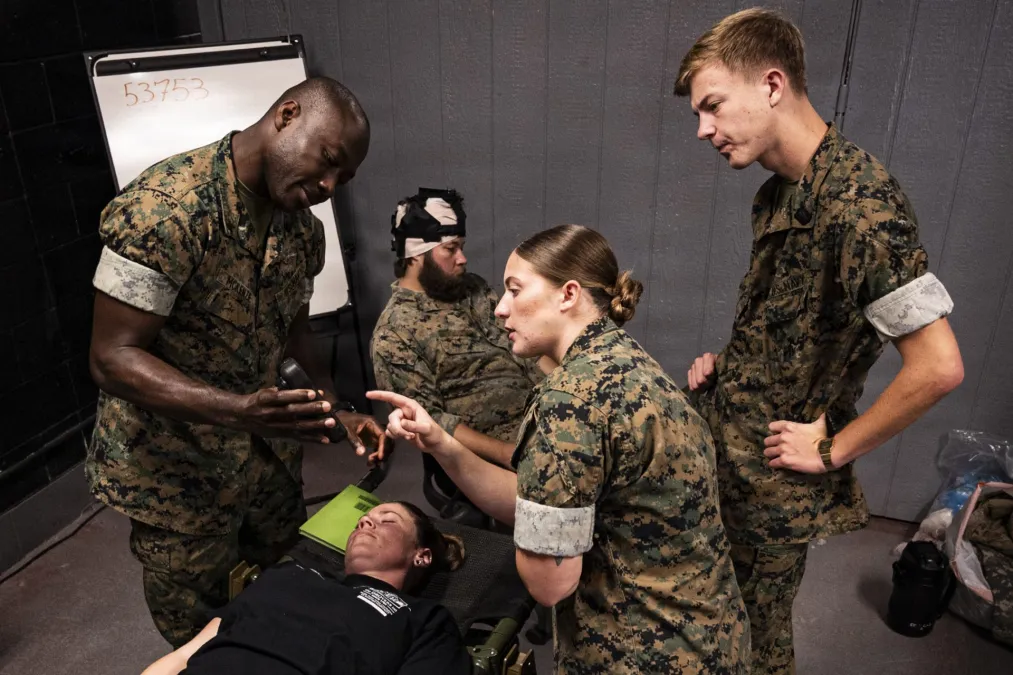
Multiple military services are leaning into handheld blood testing devices to diagnose traumatic brain injuries, technology that officials said will give frontline medical providers quick, objective analysis needed in large-scale conflict.
Troops have reported roughly half a million TBIs to the Pentagon since 2000, according to Defense Health Agency statistics, a type of injury that became synonymous with the Global War on Terror and blasts from improvised explosive devices that caused vast numbers of them.
During the contemporary Iran war, Tehran targeted U.S. troops with drones and missiles. Fourteen U.S. troops have died during the conflict, six of whom were killed during a drone strike in Kuwait during the first days of the war. Hundreds of others have been injured. While officials from U.S. Central Command — which is overseeing operations in the region — said most have returned to duty, a majority have suffered TBIs.
“In Central Command, we’re seeing disproportionately high traumatic brain injury rates in air defense,” said Col. Jessica Peck, the surgeon for 10th Army Air and Missile Defense Command which is integrating one of the devices, said in a release. “These jobs demand extremely high cognitive performance. Even a mild traumatic brain injury can significantly degrade effectiveness, impacting coordination, emotional regulation, spatial awareness, and decision-making.”
Over the last week, multiple military services publicized developments with handheld diagnostic tools that can identify TBIs. One tool, known as the i-STAT Alinity device, can diagnose TBIs in just 15 minutes, officials said. They noted that the tool has been sent to the Middle East, but did not specify where or exactly when.
Army officials said the test of the i-STAT marked one of the first service-funded research programs to start at Walter Reed Army Institute of Research, pass clinical trials, receive a Food and Drug Administration stamp of approval and deploy to combat.
The device measures certain “brain-specific” proteins that secrete through the blood-brain barrier during a TBI, according to officials. Medical providers draw blood and insert it into the device, which measures whether the proteins are elevated. If they’re elevated, it means the patient has a TBI. It can detect “acute” brain injuries up to 24 hours after initial trauma.
“This is probably the single most important advancement in traumatic brain injury care in the last 15 to 20 years,” Lt. Col. Bradley A. Dengler, the neurosurgery consultant to the Army Surgeon General and director of the Military Traumatic Brain Injury Initiative at the Uniformed Services University, said in the release. “Historically, we’ve missed a lot of these injuries.”
Late last month at Camp Lejeune, North Carolina, Navy corpsmen and members of the Defense Health Agency evaluated several TBI diagnostic devices. The intent of the “end user touchpoint” was to give device developers feedback from frontline medical personnel.
DHA, which published a separate release about the event, said the ability for troops to have access to frontline neurological assessments was a top priority for the agency. Because the nature of conflict has changed, rife with drones, precision missiles and contested airspace, GWOT practices such as quick medical airlift capability are vastly more difficult.
Military medical officials, especially those who have observed the war in Ukraine, anticipate that frontline medics will need to provide prolonged field care, where they assess, treat, stabilize and sustain wounded troops for long periods of time in austere conditions with only the resources and team they’ve been given.
This, according to DHA officials, is a particularly stark issue for the Navy and Marine Corps, which operate in decentralized, maritime environments and will undoubtedly face significant casualties in the Pacific should a war arise with China.
Like the Army’s justification, the TBI assessment tool is meant to help accurately, quickly and without many logistics burdens, diagnose patients in such austere situations.
“Our process is a continuum, with flexibility to evolve alongside emerging threats and meet the needs of front-line warfighters, combatant commands and joint staff,” said Damien Hoffman, a product manager with DHA’s Warfighter Readiness, Performance and Brain Health team. “Our goal is to rapidly develop a TBI assessment capability at the speed of relevance and these touchpoints are imperative to achieving that goal.”
A DHA spokesperson acknowledged DefenseScoop’s questions Friday about other services accessing TBI testing devices and other technology the agency was testing, but could not respond by deadline.
The military failed to adequately assess these types of injuries for years, frequently sending troops with what it considered mild TBIs back into combat where they were often re-exposed to blasts, a Military.com investigation found. Those with even mild TBIs often saw long-lasting, deleterious effects and experienced suicide at rates several times higher than the general population.
The Army press release said that during the Global War on Terrorism, 68% of troops evacuated for head CT scans ultimately returned to duty, calling the evacuations to Landstuhl Regional Medical Center in Germany “a major cost in transportation as well.”
Military medical providers also historically relied on a subjective test known as the Military Acute Concussion Evaluation to assess for TBIs, which is a brief exam focused on memory and concentration.
“People can intentionally perform better or worse depending on what they want the outcome to be,” Peck said of the test. “A lot of special operations personnel have memorized the word lists, so they can essentially ‘beat’ the test.”
A key aim of developing a handheld TBI diagnostic device is to reduce time and human error during large-scale combat operations, which military planners anticipate will be wrought with mass casualty events and overworked medical personnel. A blood test, officials wrote, removes human error and cannot be duped. Blood will be refrigerated with frontline Role 1 medical units.
“In a chaotic triage environment filled with unresponsive, intubated patients,” officials wrote, “a medic can test the blood of all of them and instantly prioritize who takes the first medical evacuation seat.”