U.S. military forms first bilateral AI task force with United Arab Emirates
The United States and United Arab Emirates are setting up a new bilateral military crew that will hustle to integrate their forces’ artificial intelligence capabilities, and deploy joint assets to monitor and enhance regional security.
Task Force Talon Synapse is slated to soon be fully operational, U.S. Central Command announced Tuesday. Approximately 20 American and Emirati personnel with expertise in AI, data, cybersecurity and related technology areas will serve on the Abu Dhabi-based team.
“The first step in launching the task force is finalizing a memorandum of understanding,” Centcom spokesperson Capt. Tim Hawkins told DefenseScoop. “We’re working to sign the agreement in the weeks ahead.”
The UAE shares maritime borders with Oman, Saudi Arabia, Qatar and Iran. It’s considered one of America’s key strategic and geopolitical partners in the Middle East.
The two nations’ increasingly close cooperation over recent decades has been largely anchored by combined defense operations, major arms sales and the technological interoperability of their militaries. Nearly 5,000 U.S. service members are currently stationed across military installations in the UAE, where they support a range of intelligence, surveillance, transit and combat operations.
Defense Secretary Pete Hegseth initiated a comprehensive U.S.-UAE Major Defense Partnership in 2025. That special designation allows the countries to engage in deeper military collaboration, advanced technology sharing and joint production efforts — without a formal treaty alliance to back the work.
Most recently, the UAE armed forces have actively supported the U.S. and Israel in the ongoing war with Iran.
The Emirati military has intercepted thousands of incoming Iranian projectiles, conducted joint military strikes targeting Iran’s weapons arsenal, supplied data and intelligence, countered domestic networks linked to the adversary and helped keep oil moving through the Strait of Hormuz. Iran has responded with extensive retaliatory strikes against the UAE’s critical infrastructure — and U.S. data processing facilities based there.
Once it’s operating at full capacity in the coming weeks, Task Force Talon Synapse will primarily focus on providing and integrating AI capabilities directly for military end users to quickly deploy in real-world operations.
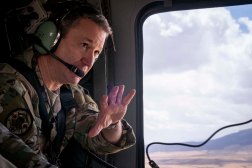
“This will be a historic milestone as we work with one of our most capable regional partners to rapidly deliver evolving AI advancements to our warfighters,” Centcom commander Adm. Brad Cooper said in a statement. “Together, we and our Emirati partners share a strong commitment to adopting AI applications that will foster innovation at speed and scale.”
Cooper and UAE National Security Advisor Sheikh Tahnoon bin Zayed Al Nahyan explored the potential value in forming the task force in discussions last year. It surfaced again last month when Centcom leaders met with AI industry representatives and Emirati defense officials on a trip to the region.
“This initiative was long envisioned by senior American and Emirati military leaders to strengthen bilateral defense cooperation and accelerate the integration of cutting-edge AI technologies,” Hawkins told DefenseScoop. “Equipping our troops with the newest and most innovative AI tools will enable CENTCOM to remain a highly effective and lethal fighting force in a dynamic regional security environment.”
Earlier this month, the Trump administration reportedly rewarded the UAE for its access and alignment in the Iran war by loosening certain export controls and offering expedited access to advanced AI chips, high-end computing servers, and sensitive military tech assets.
Some critics in Congress and other parts of the federal government subsequently raised concerns about those moves, pointing to China’s influence in the UAE.
A former senior defense official who requested anonymity to speak openly about the new U.S.-UAE task force said that Centcom’s announcement is “unusually broad” in terms of what the new team will work on.
“I’m a bit skeptical about whether this is more of a splash announcement for signaling purposes, or the beginning of a constructive AI relationship agreement that will lead to tangible results with fielded, scaled capabilities — and under what timelines,” they told DefenseScoop.
Gaining access to Emirati data and intelligence sources that they otherwise might not have access to would likely prove useful to Centcom personnel.
But the former senior defense official wants to know what the UAE will receive from U.S. forces in return.
Bilateral and multilateral AI partnerships generally offer promising benefits to the U.S. military, in their view, “and especially with a partner in the Middle East, one that is under daily threat from across the Strait of Hormuz.” However, they said Centcom’s brief press release also sparks serious uncertainties about technology and data integration, cybersecurity, common access to information networks and other risks.
“My biggest questions revolve around classified information-sharing: What can be shared, at what classification level, and by whom, or who’s the approval authority? Is this all only unclassified work, Secret U.S.-UAE level, or something else? What networks will this combined work be performed on? How are those networks protected against inevitable Iranian cyberattacks?” the former senior defense official told DefenseScoop. “Until I know those answers, I put this in the category of ‘a good idea in principle — but it remains to be seen what value it provides in practice.’”