Army pilots AI-backed maintenance program to digitize manuals, streamline repairs
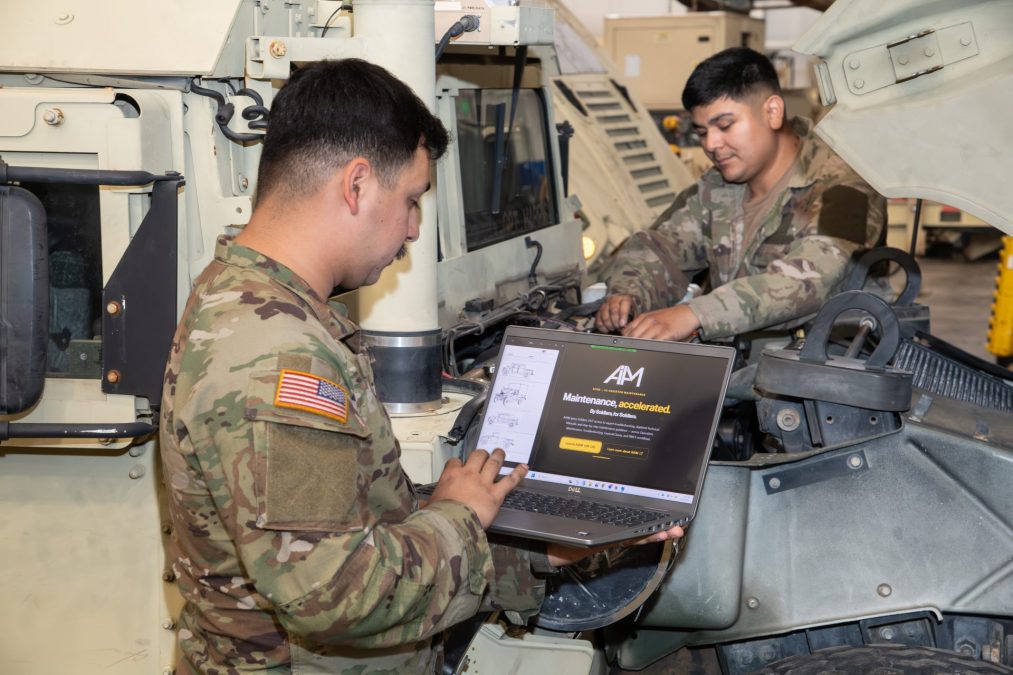
The Army is piloting an AI-backed maintenance program the service hopes will make fixing equipment faster and easier for soldiers.
Developed by Army Communications-Electronics Command, the idea is to digitize thousands of cumbersome, physical maintenance publications into a central ecosystem known as the Artificial Intelligence-Assisted Maintenance (AIAM) program.
In that platform, according to CECOM officials, soldiers can query the program for repair references, document maintenance issues for their supervisors to vet, connect with civilian logistics assistance representatives for help and access parts inventory.
AIAM “is basically taking you from a paper-based maintenance process to a more digitized, more modernized technical manual and system-of-record interface than ever before,” Col. Cory Armstead, military deputy for the Integrated Logistics Support Center under CECOM, told DefenseScoop in an interview at the annual AUSA conference in Washington last week.
The Army has, for more than a decade, attempted to digitize its preventative maintenance checks and services (PMCS) process. With the proliferation of AI in recent years, the service appears to be banking on a new tack through AIAM.
The effort began nearly two years ago when CECOM was looking to help civilian logistics assistance representatives troubleshoot field repairs, he said. The service toyed with an early version of the program at the National Training Center, where soldiers offered feedback on what an AI-backed application could look like in their own hands.
Since then, roughly 4,000 users have provided feedback to the program, Armstead said, with most asking CECOM to add more systems to AIAM or tweak the maintenance procedures it offers.
Traditionally, soldiers across the Army start their weeks off in the motorpool toiling away on fixing and maintaining vehicles, communications equipment and all sorts of systems — flipping through bulky, often grungy physical copies of manuals meant to guide them through fixes.
So far, AIAM has digitized between 200 and 250 of those technical manuals, according to a CECOM spokesperson, meaning soldiers can query the program and it will pull relevant information from the publications to guide them through fixing the equipment.
“When we first started this effort, we would take a publication, take AI, and just jam them together and say, ‘hey, inquiry,’ and what we learned is that at the time we’re getting a lot of hallucinations,” Armstead said. After “multiple iterations” the service turned the AI to navigating digitized publications and pulling from them directly to reduce fabricated responses, he said.
Soldiers can also use AIAM to document fixes, according to Armstead, swapping a hand-written analog process for a digital series of “filters and checks and balances” so supervisors can determine the appropriate level of repair.
If they have issues that the AI can’t help them with, troops can submit a request through the platform to civilian logistics assistance reps located “locally or globally” to help answer questions through video or chat, Armstead said.
Right now, there is no hardware associated with AIAM, so soldiers use it via a web application on their phones, tablets or laptops, Armstead said.
“What we’re trying to do is use existing hardware solutions to then access our software solution to then solve their problems,” he said, adding that a future AIAM hardware component could include virtual reality headsets or goggles.
Supply clerks can also see current supply stocks through AIAM and access roll-ups of maintenance requests to order parts through the Global Combat Support System-Army, a years-old enterprise system the service uses to manage its logistics.
Through its Next Generation Command and Control (NGC2) effort, the Army has been working with vendors to help logisticians predict repairs through sensors and historical performance data, including by tapping into GCSS-A. Other services, such as the Marine Corps, have experimented with AI to help with predictive aviation logistics.
AIAM is looking to do the same, Armstead said, so that soldiers can better forecast repairs and maintenance periods.
“That’s the direction we’re going, that is the vision,” he said. “That is what’s going to make us different than any other application that’s doing maintenance today.”