In a sign of more to come, the Corps certified forward-deployed Marines on FPV drones for the first time
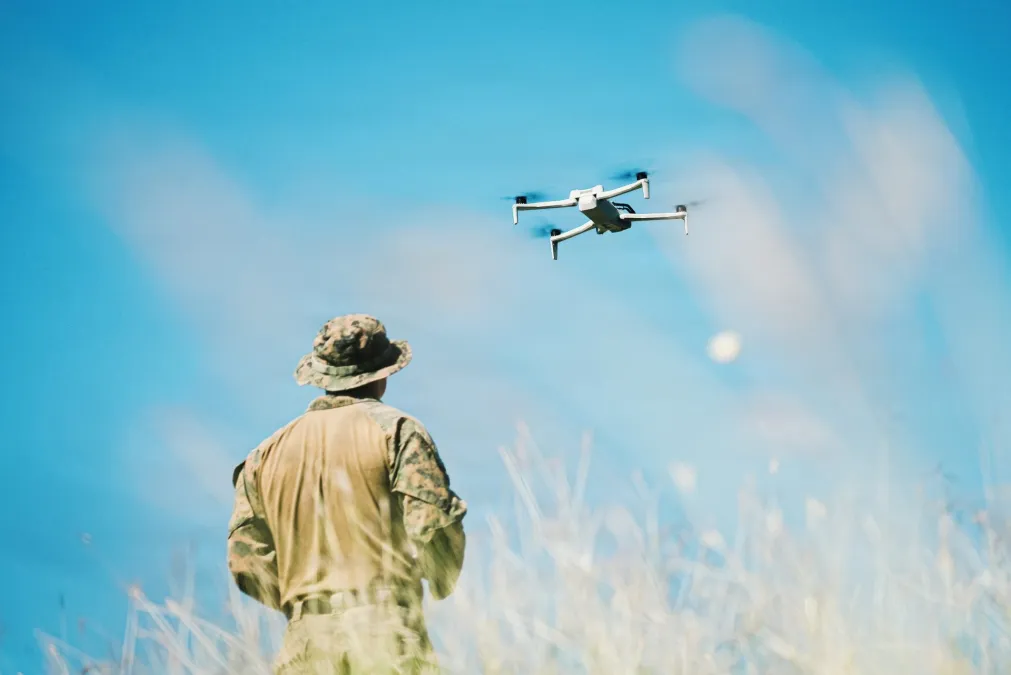
It was nearing midnight just two days before Thanksgiving when a small Marine Corps drone buzzed to life, obscuring the sound of insects chirping away at the Puerto Rican military facility known as Camp Santiago.
Then there was an explosion, briefly illuminating the drone’s target — a container — and the flora surrounding it in an otherwise dark night, according to a Marine Corps video of the exercise. A voice then cracked over the radio: the target was destroyed.
The explosion marked the end of about a month-and-a-half of training for more than two dozen troops with the 22nd Marine Expeditionary Unit, an element deployed to the Caribbean amid President Donald Trump’s massive military buildup in the region.
It was also the first time that forward-deployed Marines were certified on the use of these new first-person-view drones, Marine officials told DefenseScoop, an important milestone for the service keen on making unmanned aerial systems ubiquitous across the Corps.
“It gives us another tool [so] we don’t have to put humans forward,” Col. Thomas Trimble, commander of the 22nd MEU, told DefenseScoop via video call aboard the USS Iwo Jima in a recent interview. “It decreases my risk to force, decreases my risk to mission, but increases my lethality as a forward-deployed tactical commander.”
The exercise was a harbinger for things to come. The Corps plans to equip all of its infantry reconnaissance battalions and littoral combat teams with FPV drone capabilities by spring 2026, according to a Pentagon news release Wednesday.
While the 22nd MEU has not used them for operational purposes yet, the prospect of Marines training with FPV drones during a major military campaign was essentially unheard of just a year ago. In mid-December 2024, the service recognized just how far behind it was on using these systems, ones leaders had been closely watching hum over battlefields in the Russia-Ukraine war.
Around that time, Col. Scott Cuomo, an infantry officer who commands the Weapons Training Battalion at Quantico, Virginia, was tasked to help fix that problem. By the early days of January 2025, the Marine Corps Attack Drone Team was born — a small group of Marines that now represent the nucleus of the service’s FPV drone effort through experimentation, research, competition and training.
Cuomo and the MCADT joined the 22nd MEU for this exercise, guiding some of its Marines through a “crawl, walk, run” training pipeline so they could effectively use FPV drones and share their new-found expertise with the broader unit.
“It didn’t matter where they were in the world. It mattered that they were our forward-deployed crisis response unit,” Cuomo said. “The implied task to us was to get them the capabilities as fast as we possibly could.”
The result: 14 drone operators and 11 payload specialists (who arm the drones with ordnance) were certified, Cuomo said, following classroom instruction, 30 hours on simulators that monitor battery outputs and other metrics, drone flights, hands-on experience with building the systems and connecting payloads, and then certification with a variety of anti-personnel, anti-materiel and other explosives for live-fire scenarios. Two Marines, Cuomo said, didn’t make the cut and were working through additional training.
For Cuomo, the significance of this event was in-part personified by a sergeant who took part in the exercise. Cuomo knew this Marine, Sgt. Courtland Mabe as a lance corporal from a previous unit years ago. Now a non-commissioned officer, Mabe’s leaders depended on him “to be kind of the foundation of the capability,” Cuomo said.
And with that foundation came the realized need for these drones at the small-unit level across the Corps: distance. Now, Cuomo said the reach in which these 22nd MEU Marines could operate “had just gone from around max effective range of about 1,000 meters to 20 kilometers.”
The road to this certification was not easy. For a year, the MCADT had been contending with a litany of challenges when it comes to integrating FPV drones into the American military: how to use them, how to get the systems, competitions with other services, developing training and tactics around a service that had never used them like this before, for example.
Policies, acquisition processes and even mindsets had to (and in many ways still have to) change for that small Marine Corps drone to blow up the container at Camp Santiago a year after the MCADT’s conception. Secretary of Defense Pete Hegseth prioritized “drone dominance” in a June memo meant to address those types of barriers.
The MCADT also trained and certified 3rd Marine Division troops in Okinawa, Japan, primarily in early December.
“I think that’s a reasonable timeline,” Mark Cancian, a retired Marine colonel and senior adviser with the Center for Strategic and International Studies Defense and Security Department, said of the Corps’ efforts.
“Are they where they need to be? I think they would say no and I think most people would say no, just because this is not a destination, it’s a journey,” he said. “It’s a very new capability, and the Marine Corps needs to figure out how to use it, how to organize it and how to train people.”
Still, the exercise represented a microcosm of what the service is trying to replicate across the fleet and addressed many of the issues it had been contending with, such as preparing ranges that have never seen FPV drones and developing a training plan for Marines to learn how to use them.
Trimble acknowledged the Puerto Rican National Guard for certifying the range the Marines used for this exercise. And just this week, the Marine Corps released standardized training for the entire fleet, which includes six pilot courses and eight certifications intended to “meet the immediate operational need” for FPV drone proficiency.
“It was a very systematic approach to training about how we did this,” Trimble said of the Puerto Rico certification. “It was definitely the right way to do it, and if I had to do it all over again, there’s not a whole lot that I would change about that.”
In August, the 22nd MEU left Virginia on “regularly scheduled deployment” as part of the Iwo Jima Amphibious Ready Group and at the start of the Trump administration’s military buildup in the region.
Since September, the military has destroyed more than 30 boats in the Caribbean and eastern Pacific it has accused of smuggling drugs, killing more than 100 people in the process. The lethal strikes — which have garnered criticism over their legality — come amid the administration’s broader campaign against Venezuelan president Nicolas Maduro, and tensions in the region are high.
Around the same time as the drone certification, the 22nd MEU provided humanitarian aid to Jamaica in the aftermath of Hurricane Melissa.
“I can’t get into exactly how we would employ this capability down in the Caribbean,” Trimble said. “But when you look at our mission sets on the MEU being forward deployed and that contingency response force able to respond within hours of a mission set, I could definitely see where I would take this specific skill set and apply it in potential missions in the future here in the Caribbean.”
While Cuomo said its location wasn’t relevant, the MEU concept, paired with its naval counterparts, is “our priority formation” and that it was critical to get the FPV drone capability to the Corps’ most forward-deployed unit, the 22nd MEU.
“Events could go in a different direction and maybe they would need these,” Cancian said, noting how a need for these drones in the Caribbean would be unlikely at this time. “So it makes sense if you’re going to have one unit get this capability, this would be the one to get it because of that possibility — even if it’s relatively remote that it might have to use them.”