Marine Corps to replace corroding struts across its new ACV fleet
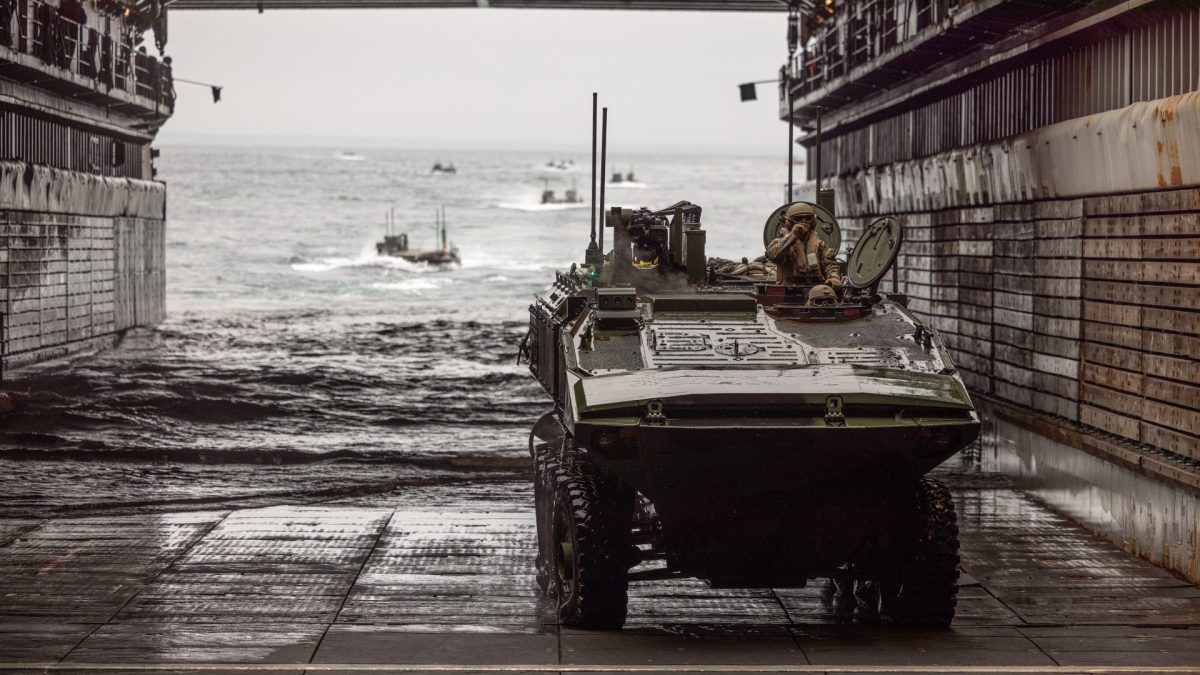
Less than two years after its operational debut abroad, the Marine Corps is looking to replace corroding struts on its Amphibious Combat Vehicle fleet.
With a gross weight of 35 tons, the eight-wheeled ACV is capable of carrying up to 16 Marines (including its three-person crew) from ship to shore and has emerged as a critical tool in the service’s amphibious repertoire since the first batch of vehicles arrived to units in 2020.
In a notice publicly posted last month, officials said the Corps was anticipating a requirement to retrofit the ACV with alternative struts — which are part of the vehicle’s suspension system — because of ocean corrosion and extensive use.
A spokesperson for the service told DefenseScoop that the Corps does not expect any safety issues from the strut corrosion, but that “all Marine Corps ACVs are affected as this is a fleet-wide upgrade.”
“The vehicles are exposed to open ocean, intertidal, and brackish environments for hundreds of hours over the operational lifetime of the vehicle,” the notice said. “The high deployment schedule combined with the high training tempo of the United States Marine Corps creates an extremely corrosive environment for the ACV not typically experienced by other vehicles.”
The service anticipates a requirement of more than 5,000 struts over a period of two-and-a-half years starting in fiscal 2026, according to the notice.
Early on, the ACV was sidelined multiple times following non-fatal surf rollovers and a tow-rope issue. Officials have largely attributed early ACV problems to training shortfalls, though the service said a vehicle suffered an unspecified “mechanical malfunction” in an October 2022 incident, USNI News reported at the time.
In 2023, the Corps’ then-commandant, Gen. David Berger, told lawmakers that the service was contending with “two major component issues” for the new ACV, one of which was a problem with the “struts / shock absorbers,” according to his written testimony. He said that these issues caused part failures, “resulting in a decrease in reliability” and readiness.
“As with any vehicle that operates in this environment, external and exposed parts are subject to corrosion and wear and tear,” said David Jordan, a spokesperson with the Corps’ program executive office for land systems. He added that corrosion “is not unexpected” given the briny surf the ACV frequents.
“Severe strut corrosion impacts the ACV ride quality and maneuverability but does not deadline the vehicle,” he added, using military parlance to describe when a piece of equipment gets sidelined for maintenance. “Identifying and procuring better replacement struts improves operational availability and provides better operating conditions for drivers and embarked Marines.”
The Corps said it first used the ACV overseas in a spring 2024 exercise in the Philippines. By 2025, it had codified training and operations standards for the platform after the early rollovers pushed the service to review safety and training procedures.
The ACV replaced the Assault Amphibious Vehicle (AAV), which had a more than 50-year operational history and came under intense scrutiny after eight Marines and a sailor were killed when an AAV sank during a California training exercise in 2020.
The Amphibious Combat Vehicle comes in four types: a personnel carrier, a communications variant, a recovery vehicle and one mounted with a 30-millimeter cannon. Lockheed Martin Skunk Works was also testing an ACV with a small uncrewed aerial systems component in 2023.
Task & Purpose reported that the service was looking to field roughly 400 personnel carriers, which make up the majority of the ACV fleet. Jordan said the service has fielded about half of the approved acquisition goal to date.
He added that the program office “routinely monitors reports from fleet operations and continually seeks ways to mitigate, minimize, or prevent anything that may impede operational readiness or performance, including corrosion-related issues.”
User feedback has wrought “a few readiness drivers to study,” he said, one of which “revealed the struts were a good candidate to improve readiness and operational availability” and that such a replacement was in line with other ACV improvement efforts.
Years of congressional stop-gap measures have also hampered the Corps’ ability to buy the ACV in bulk, at one point resulting in an additional $17.7 million cost for the program because of changing foreign exchange rates and lawmakers’ inability to pass a budget on time. The Corps received $241 million in funding last year for its amphibious vehicles under the One Big Beautiful Bill Act.
Jordan did not say how much the Corps expects to spend on new ACV struts when asked by DefenseScoop, but added that the program office “constantly looks for improvements to availability and affordability.”
BAE Systems, which manufactures the vehicle and was awarded a $184 million deal earlier this month to produce 30 more ACVs for the Corps, did not respond to DefenseScoop’s request for comment Wednesday.
“The alternate strut will be more reliable and less costly to the USMC over the ACV’s lifecycle,” Jordan said, adding that the program office tested strut alternatives and is now “seeking a solution that’s more cost effective and better performing than the current solution.”