Pentagon, FAA sign safety agreement over counter-drone laser
The Pentagon and Federal Aviation Administration inked an agreement over the use of domestic counter-drone technology, the agencies said in a joint statement Friday, following back-to-back airspace incidents earlier this year and recent laser safety testing.
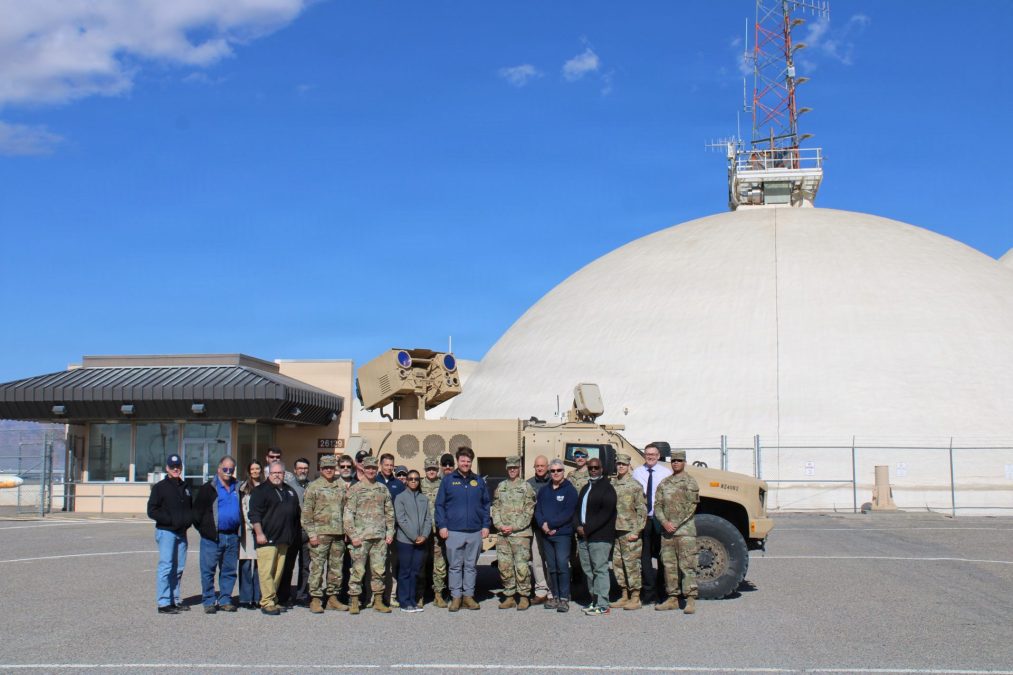
In March, government officials met at White Sands Missile Range in New Mexico to test the Army Multi-Purpose High Energy Laser, an evaluation aimed at quelling FAA concerns about the system’s safety and whether it posed a danger to aircraft.
DefenseScoop exclusively reported details of the test last month. At the time, the FAA was notably silent about the results of the evaluation, which defense officials said successfully demonstrated the AMP-HEL’s automated safety shut-off system and lack of damage against civilian airplanes.
Now, and two months after the laser caused dual airspace closures in Texas along the southern border, both agencies are saying the laser’s safety controls work and “do not pose undue risk to passenger aircraft,” according to the joint release.
“Following a thorough, data-informed Safety Risk Assessment, we determined that these systems do not present an increased risk to the flying public,” FAA Administrator Bryan Bedford said. “We will continue working with our interagency partners to ensure the National Airspace System remains safe while addressing emerging drone threats.”
The FAA did not immediately respond to requests for a copy of the deal or additional details about what the agencies described as a “landmark” safety agreement. A spokesperson for JIATF-401 declined to provide the agreement, but said its framework will be used “from the start” for any counter-drone systems employed in the U.S.
“This successful test showcases the significant advancements we’re making in counter-drone technology to ensure that our warfighters have the most advanced tools to defend the homeland,” said Army Brig. Gen. Matt Ross, director of JIATF-401. He added that coordination between the FAA, military and other interagency partners “is proving that these cutting-edge capabilities are safe, effective, and ready to protect all air travelers from illicit drone use in the national airspace.”
Military officials have said in recent years that there are more than 1,000 drone incursions at the southern border per month. The Trump administration has made combatting what it says are cartel-operated unmanned aerial systems part of its border security mission, and the military has flowed significant money to counter-drone technology for the operation.
In February, federal personnel mistakenly employed a laser twice in one month, causing public confusion over the resulting airspace closures and consternation from lawmakers from both parties.
The first incident, which occurred near El Paso, saw U.S. Customs and Border Protection personnel use a laser on-loan from the Pentagon to shoot down an object, DefenseScoop first reported, which was later identified as Mylar balloons.
Just weeks later, soldiers shot down a CBP-operated drone near Fort Hancock. CBP launched the unmanned aerial system without notifying the military task force assigned to the U.S.-Mexico border.
Reuters first identified the laser used on the border as a LOCUST system, which is built by AeroVironment.
The shootdowns drew bipartisan concern from senators about the lack of interagency coordination over the use of lasers domestically, including after a close-door meeting with administration officials in early March that did little to curb those worries.
“Everyone wants to see hostile drones that are a threat incapacitated, but obviously we want to do so in a way that doesn’t pose a threat to civilian aircraft, and it ought to be possible to do both at the same time,” Sen. Ted Cruz, R-Texas, who chairs the Senate Committee on Commerce, Science and Transportation, told reporters at the time. “It’s clear that in the early implementation of this technology, coordination fell far below what should have happened.”
The Trump administration fast-tracked the laser safety test — the genesis of the recently announced agreement — in the wake of the Texas incidents.
Between March 7-8, government evaluators from multiple different agencies, including the FAA, gathered at White Sands Missile Range to test the AMP-HEL’s automatic safety system and its effect on a decommissioned Boeing 767 fuselage, among other evaluations.
Officials told DefenseScoop that testers fired the AMP-HEL at its maximum effective range for several seconds to assess its effect on the aircraft part. They also flew multiple aircraft behind simulated targets to demonstrate that the laser wouldn’t fire even if it detected commercial aircraft signals, which triggered the AMP-HEL’s safety system.
“I liken it to the fact that it actually doesn’t ever really want to fire, you almost have to force it to fire, and there has to be multiple things that line up to allow the system to fire,” Col. Scott McLellan, deputy director for JIATF-401, told DefenseScoop last month. “And what we did demonstrate was with the use of multiple different types of aircraft, to include a threat aircraft and friendly aircraft and unknown aircraft, the system will inhibit and prevent the operator from firing on multiple different scenarios in multiple different ranges.”
At one point, DefenseScoop reported, the laser picked up a signal from an airplane that had nothing to do with the test as the aircraft approached an Albuquerque airport miles away from the range. McLellan said the laser automatically shut down, momentarily perplexing testers until they discovered the system detected the aircraft’s signal and automatically shut itself off.
According to the release, both agencies will continue to coordinate “to safely employ this system and ensure civilian aircraft, pilots, navigation equipment, or air traffic services are not impacted.”