Space Force cancels contract with RTX for next-gen ground segment for GPS satellites
The Space Force has terminated its contract with RTX for the Global Positioning System’s Next-Generation Operational Control System (OCX) after years of technical issues and delays, the service announced Monday.
The decision was made by Tom Ainsworth, acting service acquisition executive at the Department of the Air Force, according to a Space Force press release. OCX’s cancellation comes after a government-led testing program revealed significant issues with the system that are unresolvable, according to the service.
“Despite repeated collaborative approaches by the entire government and contractor team, the challenges of onboarding the system in an operationally relevant timeline proved insurmountable,” Col. Stephen Hobbs, Mission Delta 31 commander, said in a statement. “We discovered problems across a broad range of capability areas that would put current GPS military and civilian capabilities at risk.”
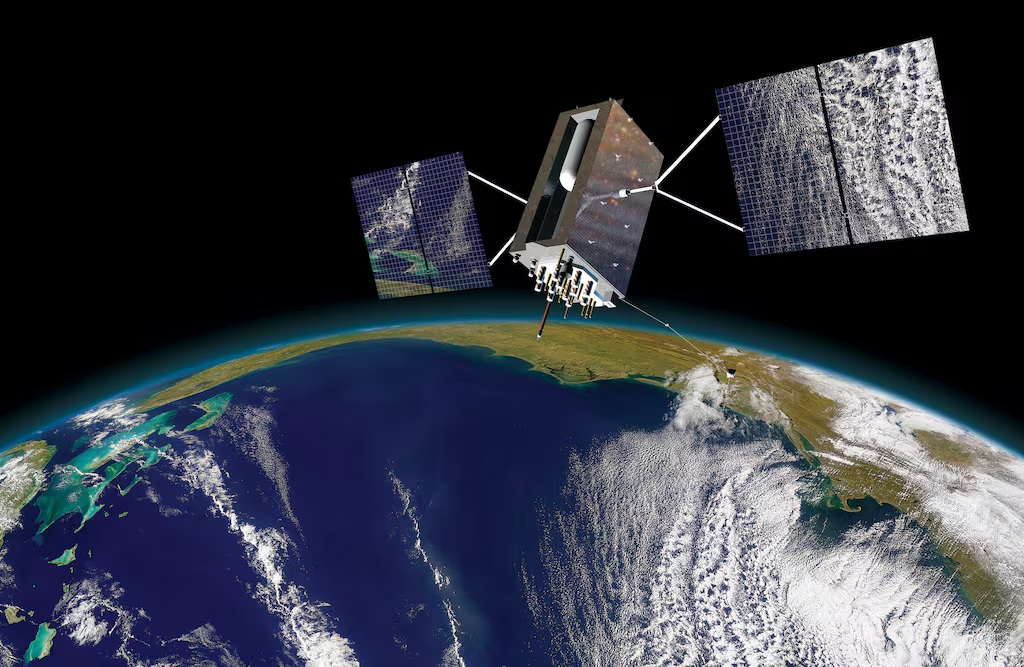
The OCX program has been a thorn in the Pentagon’s side for over a decade. RTX-subsidiary Raytheon received a contract in 2010 to design the system, intended to provide a modernized ground control system for the latest fleet of GPS III satellites with additional cybersecurity, jamming resistance and command-and-control capabilities.
RTX was slated to deliver the system in 2016, but rising costs and programmatic delays triggered a Nunn-McCurdy breach that same year. Despite persistent software complexities and technical failures, a light at the end of the tunnel seemingly appeared in July 2025 when the Space Force moved the program into a testing phase.
That phase revealed that OCX was unable to meet the Space Force’s requirements on “an operationally relevant timeline at an acceptable level of risk,” according to the service. As of January 2026, the program had reached a staggering cost of around $6.27 billion — almost double previous cost projections of $3.7 billion.
“RTX is aware of the U.S. Government decision regarding the GPS OCX program,” an RTX spokesperson told DefenseScoop. “Raytheon delivered the system in 2025 and has continued to support the U.S. Space Force in post-delivery activities. We remain committed to supporting our customers and will work closely with the government on the next steps.”
The Space Force planned to request $332 million for OCX’s continued research and development in fiscal 2027, according to budget documents.
“It’s important we refine and update acquisition processes to prioritize rapid, incremental capability delivery versus complex ‘all or nothing’ system deliveries,” Ainsworth said in a statement. “The Department of War has made clear that we need to deliver warfighting capability at a faster rate. We must continue to work with industry to meet the needs of our warfighters as we focus on delivering the right technology on the right timeline to enhance our capabilities and maintain space superiority.”
As a result, the Space force now plans to modernize the current GPS ground control segment known as the Architecture Evolution Plan (AEP). After consistent delays with OCX prompted the service to continue updating AEP over the years, the Space Force recently awarded prime contractor Lockheed Martin a $105 million contract for the system’s continued modernization.
“Ultimately, we analyzed the work remaining on OCX and compared this with the current GPS control system capability,” Hobbs said in a statement. “The analysis revealed additional investment in OCX was no longer the best solution for protecting and advancing GPS capabilities. Instead, we will continue enhancing the current control system to operate the GPS satellite constellation.”