Army wants unmanned ground vehicle for ‘last tactical mile’
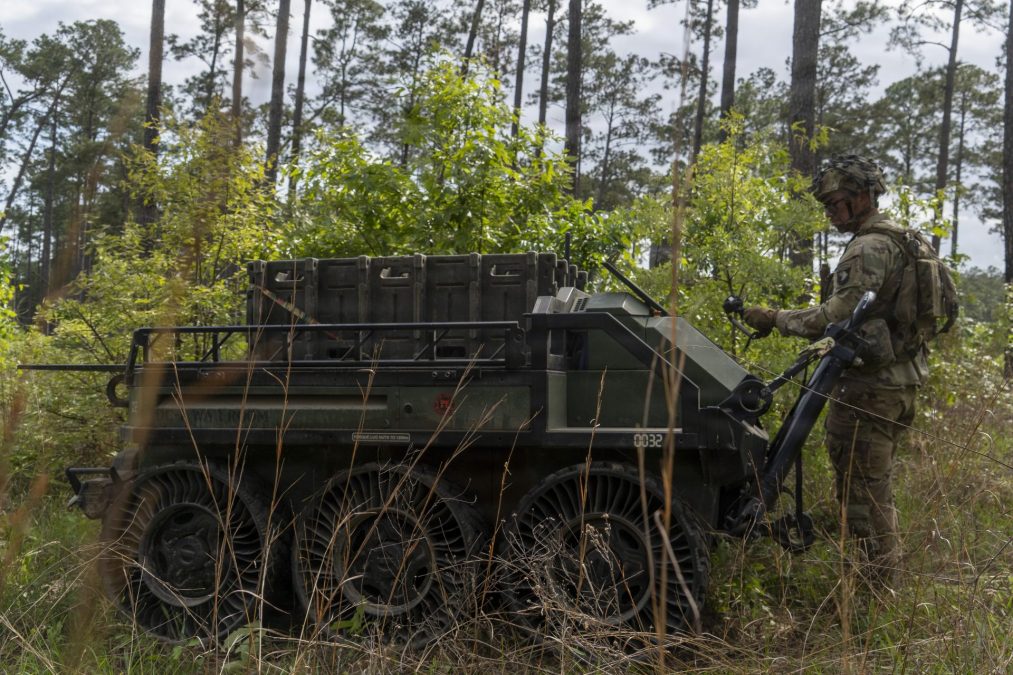
The Army is looking for an autonomous, unmanned ground vehicle (UGV) to supply frontline troops and evacuate wounded personnel across “the most dangerous and logistically complex” segment of the battlefield, according to a government notice posted Thursday.
“The last tactical mile” is the final space between support units and forward lines where equipment, ammunition, supplies and casualties pass “under the greatest threat from enemy observation and fires,” officials wrote.
It is an overwhelmingly deadly area, as demonstrated by the grinding, drone-saturated war between Russia and Ukraine, but critical to traverse for resupply and medical evacuations.
The Army, which has already been testing UGVs (in some limited cases for years), is looking to expand its stable of ground drones as technology advances and their need becomes increasingly stark in the face of casualty-heavy land operations of the modern era.
“The modern battlefield is characterized by persistent enemy surveillance and rapid application of lethal effects at and behind the forward line of troops (FLOT), making any movement to and from the FLOT highly vulnerable,” officials wrote in the notice. “This environment challenges commanders’ ability to resupply units and evacuate casualties.”
The UGV the Army is requesting via a commercial solutions opening contracting pathway will be centered around supporting a dismounted rifle platoon or company headquarters, according to the notice. It needs to have two primary functions: transport cargo and evacuate at least two casualties without exacerbating their injuries.
“This dual use UGV shall feature a configurable payload to meet the dynamic needs of maneuver formations,” officials wrote, and should be able to resupply and casevac “with minimal reconfiguration.”
The notice did not specify how much total weight the UGV should be able to carry or how far it would need to travel under such load. But officials said it should autonomously traverse multiple terrains, navigate without GPS, keep a low signature and integrate with military networks.
While officials did not identify the modern battlefield the notice was referring to, the war between Russia and Ukraine has become a proving ground for such technology as both sides continue to incur heavy casualties across the now four-year conflict.
The Ukrainian military, which has become a key developer of unmanned systems since the beginning of the Russian invasion, has been increasingly relying on UGVs to deliver food, ammunition and other supplies for frontline soldiers. According to the Guardian, these land drones now make up 90% of Kyiv’s military logistics arm.
“As recently as six months ago, casualty evacuation using ground robotic systems was sporadic,” Ukrainian Defense Minister Mykhailo Fedorov said, according to a February press release. “Today, robots routinely enter high-risk areas — delivering ammunition, sustaining logistics, and evacuating the wounded where deploying personnel would create additional risk.”
The press release said ground robots completed over 7,000 combat and logistics missions on the front line in January, “reducing risks to service members and increasing mission effectiveness.”
The Army has already been testing UGVs, most recently this week when the 101st Airborne Division used a six-wheeled robot known as the Hunter Wolf to transport cargo during a training exercise in Louisiana. Troops used another version of the platform that carried a remotely-operated .50-caliber machine gun.
Other services are gradually turning to unmanned, autonomous platforms for a variety of missions. DefenseScoop has extensively reported on the military’s small drone crusade and recently covered Marine Corps EOD techs using remotely operated vehicles to detect undersea explosives. The military has also purchased unmanned ground platforms for EOD missions.
Industry responses to the UGV notice are due April 28.