Marine Corps’ inaugural agentic and genAI workshop spotlighted need for training, more trust
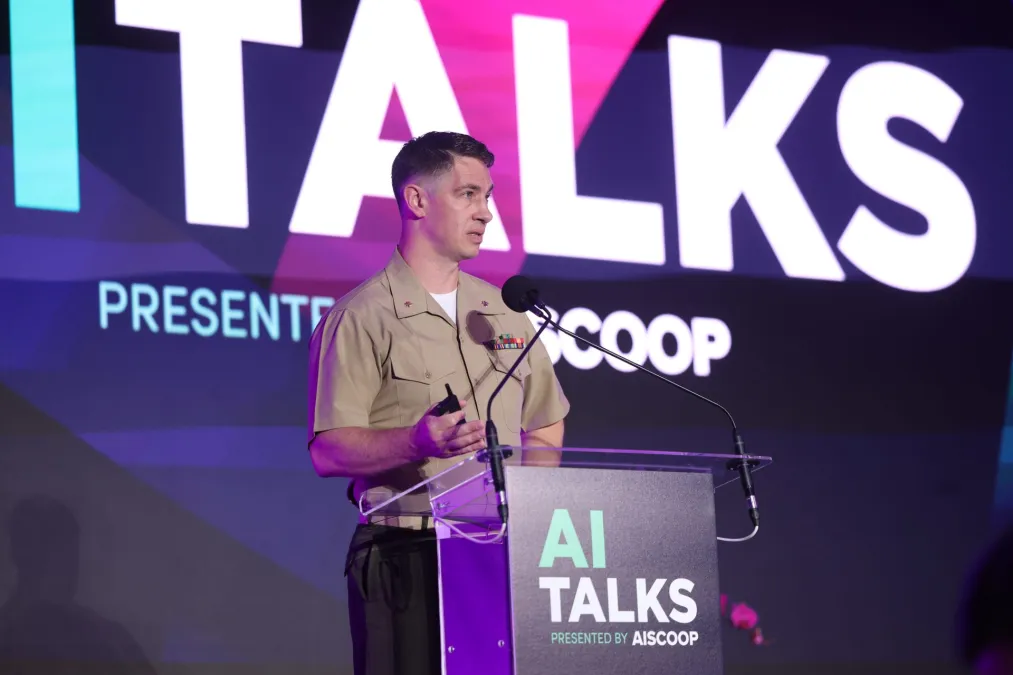
Senior military officials are reviewing all the insights and input gained from the Marine Corps’ first Generative and Agentic AI Workshop that was held in Quantico last month, according to Maj. Christopher Clark, who said the service aims to use those findings to inform integration plans and reliable tech deployments.
Clark is deeply involved in this work as the Corps’ AI lead. He spotlighted some of the major, early takeaways from that well-attended, four-day event during Scoop News Group’s AITalks conference on Tuesday.
“We are doing an analysis of our workshop. We had 350 individuals from across the department and 102 companies [participate] in it — and we have a lot of feedback that we’ve collected. So, we’re planning to use that to then drive our priorities,” Clark said. “How do we ensure that we understand where AI needs to be integrated to solve [operational problems] and how do you do it in a way that’s safe and effective?”
As they rapidly mature, advanced AI and machine learning models offer the military advantages associated with speed, data processing, targeting and more. Yet they also introduce serious uncertainty and risks of potential technical failures, unpredictable behavior, and unintended escalation.
The term “generative AI” or genAI refers to systems that can respond to human prompts by generating a range of media and content. Agentic AI completes tasks by interacting with data and digital tools with little human supervision, and can apply genAI.
The Marine Corps’ AI workshop was originally slated for November 2025. The service announced in October that it would be postponed due to the lapse in appropriations related to the federal government shutdown that disrupted agencies’ work at that time.
Held at Quantico’s Warner Hall March 9-12, the event was designed to explore high-impact AI use cases that could address Marines’ contemporary needs and identify industry-made capabilities that could be integrated into military environments to solve some of those existing gaps.
“We’re not doing AI just to do AI. We’re doing it because we know there is an advantage, and we need to ensure that the solutions are provided as a response to the problem, and to do that, we have Marines who understand the problems they have and the challenges that they’re facing,” Clark noted.
Moving this way helps guarantee AI solutions adopted by the military are “governed and trustworthy,” he added, and that they are ultimately able to provide “the value [users] actually are asking for.”
“If the Marines don’t trust the technology, they won’t use it,” Clark said during his keynote Tuesday. “And they’re not going to get the benefit out of it.”
On the sideline of AITalks, he told DefenseScoop that was one of the major lessons he took from the workshop.
“It was a good turnout. We had a lot of participation. We maintained the attendance for the most part from day to day, which, for a four-day event, was pretty substantial,” he said. “I think the biggest takeaway was one of our breakout sessions focused on AI impediments for adopting and implementing AI.”
Many attendees emphasized concerns around policies, governance, and a lack of instruction on how to access and apply AI and machine learning models in their work.
“Training has actually come to the top many times as the most important thing we need to do,” Clark told DefenseScoop. “They’ve continuously stated training as one of the main issues that they want, and that we need to provide them.”
The Corps’ AI implementation plan, launched last year, includes clear directions to help educate and train Marines across all levels, from leadership to small tactical units.
Clark noted that challenges with deploying AI at the tactical edge marked another topic that garnered much discussion at the recent workshop. Broadly, the “edge” refers to often extreme and austere, front-line areas where military personnel and first responders operate, which require rugged technology for real-time data processing.
For the Marines, Clark said Al at the tactical edge can compress sensor-to-shooter timelines and keep decisions local when bandwidth, latency, or connectivity fail — but every gain is constrained by size, weight, power, cooling, heat signature, mobility, and the fact that forward systems often run smaller, less capable models.
“One of those ways that we’re getting after this is called Project Dynamis,” he explained.
That service-level campaign marks the Marine Corps’ primary initiative to modernize and accelerate AI-powered command and control, which is intended to enable a resilient, joint mesh network connecting sensors and weapons across warfighting domains.
Clark said the Project Dynamis team is also leading the Corps’ ongoing, large-scale integration of Palantir’s Maven Smart System.