Navy CIO: Investing in connectivity key to continued ‘maritime dominance’
As the U.S. Navy finds itself engaged in conflict in the Strait of Hormuz and anticipates rising tensions in the Pacific to come, maintaining the nation’s “maritime dominance” depends on delivering ubiquitous connectivity — and providing the ability to sustain operations when those communications are degraded — the service’s top IT official said Tuesday.
Navy CIO Barry Tanner’s top priority in maintaining that so-called maritime dominance is “investing heavily in that communication layer” and “trying to ensure that we can use whatever is available to us at whatever time.”
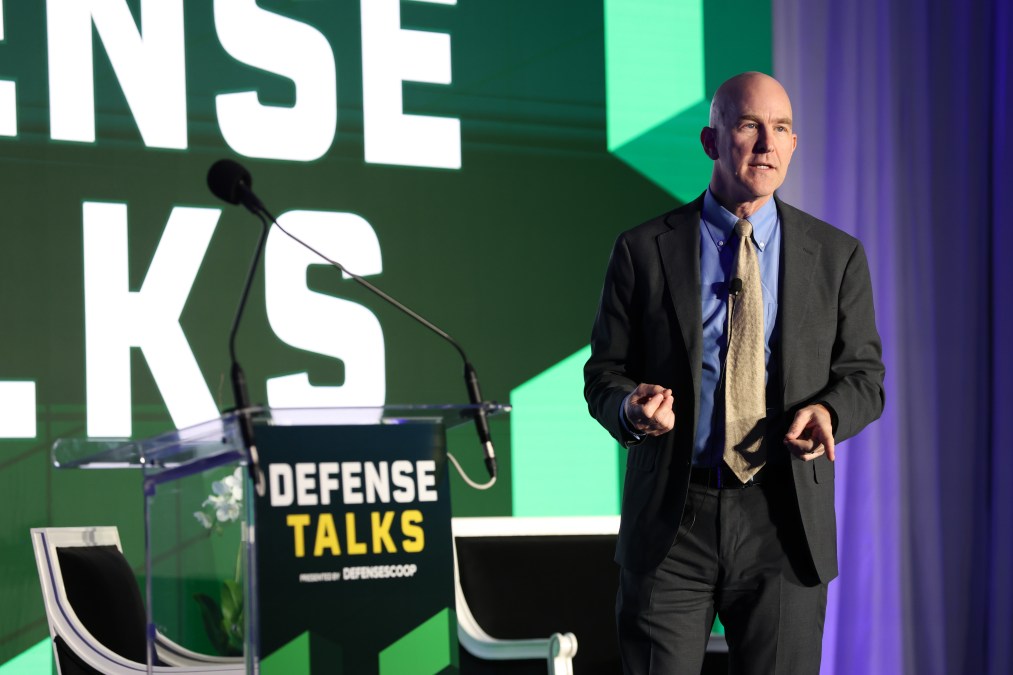
“The Marines have a nice way of putting it. They say, ‘my job is shoot, move, communicate.’ Right? And that third thing is as important as the first two, because you don’t know where to shoot or where to go if you can’t talk to each other,” Tanner said during a keynote at DefenseTalks, hosted by DefenseScoop.
Beyond just basic communications, connectivity is the lynchpin for advanced technologies that now define modern naval conflict, such as AI, autonomy and rapid data-sharing, Tanner explained.
“The establishment of ubiquitous and resilient transport is critical to strategies like [Chief of Naval Operations Adm. Daryl Caudle] talks about, his hedge strategy moving forward with both ships and autonomous systems to flood the battlespace with all the capability necessary to maintain that dominant posture,” he said. “All of that, all obviously predicated on a very robust communication network between all of those nodes.”
To get to such a state, the Navy’s Operation Cattle Drive effort — an initiative to divest of outdated IT and then reinvest those resources into more modern, secure infrastructure — will be key, Tanner said. “Let’s get them off the playing field and bring in the things that we need to get the job done. So that divest-to-reinvest strategy is core to how we are going to move forward and maintain maritime dominance into the next century.”
But that basic connectivity isn’t easy to come by and is often taken for granted, the CIO admitted, joking about how the service’s OV-1 operational diagrams often depict connectivity as “lightning bolts … and people just assume that they’re going to be there.”
The naval domain “is really challenging because we don’t trail glass behind ships,” Tanner said, referring to fiber optic cables used for high-speed network connectivity. Instead, sailors and Marines operate in “arduous environments, and are very dependent on using modes of communication that are challenging at best.”
And despite best efforts to provide ubiquitous connectivity, the Navy must also get comfortable operating when it’s denied, degraded, intermittent or limited, he said, calling it the sea service’s “biggest challenge going forward.”
“We also have to understand what happens when it’s not there, because it will eventually break down,” Tanner said.
That means making sure systems are edge-enabled and sailors and Marines are prepared for when that breakdown occurs.
“Our shipboard systems have to be resilient themselves and have to be able to support that battlespace, even if they’re not connected back home,” Tanner said. “Making sure … that we have the capabilities, the logistics, and the flow of supplies and parts and other things going forward into that environment is going to depend on both that robust communication infrastructure, but also the ability to gracefully degrade and operate even when it’s challenged or not there.”