Military leaders want a more integrated, joint approach to drone dominance
As the Pentagon goes all-in on “drone dominance,” the U.S. military must pivot away from existing service-by-service stovepipes and institute a connected, joint approach to deploying autonomous and robotics assets in warfare, according to Marine Corps Commandant Gen. Eric Smith and Chief of Naval Operations Adm. Daryl Caudle.
“I want to be direct on something here — the Navy and Marine Corps should not be independently building two versions of the same autonomous future,” Caudle said onstage Thursday morning at the Modern Day Marine conference. “Where requirements overlap, we should converge quickly. Where standards matter, we should align. Where speed matters, we should and must integrate.”
In response to questions from DefenseScoop after his keynote Thursday afternoon, Smith said he “absolutely” agrees with the CNO.
“It’s got to be integrated, because it can’t be one thing for one service and one thing for another,” Smith said. “Our industrial base won’t support that — and frankly, our budget won’t support that.”
Their comments come as the Pentagon is heavily investing in a variety of aerial and maritime drones, and hustling to adopt them for modern missions and in ongoing conflicts across multiple regions of the world.
The U.S. military’s adoption of drones and counter-drone tech has been historically fragmented, with each service branch typically pursuing its own purchases and strategies.
“The department has a real opportunity right now to move faster than legacy acquisition models would suggest, but only if we stay disciplined and connected. To our industry teammates, hear me clearly: I do not need another flawless slide deck. I need capabilities that work in salt water. I need systems that can survive jamming. I need payloads that can be maintained by operators. I need software that updates quickly over the air, like an app. I need platforms that can deploy now, not in some mythical future block,” Caudle said. “And when we get autonomy right, it will amplify both our sailors and Marines in ways we can only begin to imagine and appreciate.”
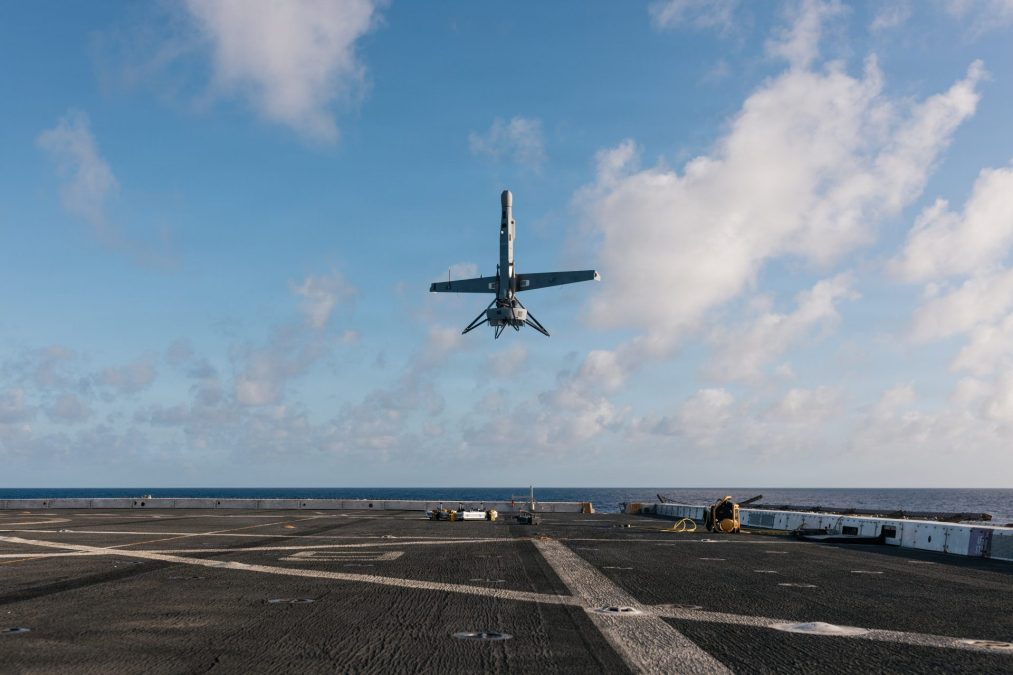
Autonomous surface and subsea vessels, and unmanned aerial systems offer military personnel scalable, adaptable, and lower-cost options that create outsized operational advantage, in his view. They’re key enablers of distributed fires and sea denial, as well as sensing, screening, deception, strike support and more.
“These systems are not here to replace warfighters. They’re here to extend the warfighters’ lethality. They create reach, they create mass, they create time, and they create dilemmas for the enemy,” Caudle said.
In his keynote, Smith echoed that sentiment and shed light on how the Marine Corps is prioritizing unmanned systems and capabilities to fight adversarial drones that are increasingly threatening U.S. forces.
“Counter-UAS is a real challenge,” the commandant said. “And we’re trying very hard to mimic what’s going on out in the real world. What you see in the ‘Ukraine fight’ versus the ‘Russia fight,’ to where the UAVs are ubiquitous across the battlefield, to where we don’t need to deconflict airspace for a small UAV — just keep it below 1,000 feet and you can fly anywhere, anything you want to do. We’ve got to automate our drones so we launch them in swarms and they’re talking to each other.”
He further noted that the U.S. needs to increase production capacity in a way that enables the services to treat drones as they do munitions.
“Just like a hand grenade — you don’t need permission to throw a hand grenade. The operator knows when that picture is safe, that you’re not going to frag yourself or frag your mates, then you throw out a grenade,” Smith noted. “It’s the same thing with a drone. That’s what we’ve got to get to.”
Regarding the need for an integrated drone and robotics approach to fuse the joint force’s disparate activities, he also called for one, single set of standards that many vendors can provide for.
“It doesn’t matter to me who makes the drone. I just want the drone. It doesn’t matter to me who manufactures my artillery shell. I just need the shell,” he said.
The Defense Department launched its $1.1 billion-dollar Drone Dominance Program late last year, setting a goal to buy and equip forces with more than 300,000 domestically-produced, weaponized drones by 2027.
DOD’s budget request for fiscal 2027 also proposes $54.6 billion for the nascent Defense Autonomous Warfare Group, or DAWG.
Pentagon officials have been mostly tight-lipped about the DAWG’s progress and functions since it was unveiled in 2025. It has been broadly billed as a specialized, high-level team that’s a successor of the Biden-era Replicator initiative to purchase and deploy thousands of attritable drones.
When asked who could lead a single unmanned strategy for the joint force, Caudle pointed to the complexity of the current operating environment, where there’s multiple overlapping venues and hubs prioritizing drones — including but not limited to the Navy’s warfare systems directorate and Rapid Capabilities Office, the DAWG, and the Pentagon’s Defense Innovation Unit.
“So, we’ve got a lot of this going on, and I do think we need to get our house in order,” Caudle said. “So, we’re moving out with [command and control] along the force generation, but I don’t know that we’re there from a force employment [perspective] yet.”
The CNO said he believes Chairman of the Joint Chiefs Gen. Dan Caine and Defense Secretary Pete Hegseth recognize this requirement.
Notably, Hegseth briefly told lawmakers on Wednesday that his team is looking to establish a new sub-unified command for autonomous warfare. The Pentagon has not supplied details about that plan or answered questions about how the new hub would work with the services and the DAWG.
“As we think about how we bring unmanned capabilities to bear in the theater, does that roll up under a new warfare command construct? I tend to think — when we package it correctly — it probably will,” Caudle said at Modern Day Marine. “So, in the strike group world, we have an integrated air [and] missile defense commander. We’ve got a sea combat commander. We, of course, got the information warfare commander. Could you think about a robotic and autonomous system commander? I think you could. The way these things are packaged, and the way you deliver that combat power and that lethality, it’s going to be an ensemble of unmanned [systems], and so I think that’s best.”