Air Force, Space Force announce acquisition changes amid Hegseth’s reform push
The Department of the Air Force has taken initial steps to implement Secretary of Defense Pete Hegseth’s plans to overhaul Pentagon procurement by creating seven new acquisition organizations aligned with specific mission areas.
The Air and Space Forces intend to overhaul several of their program executive offices and consolidate them into seven new organizations called portfolio acquisition executives (PAEs), officials announced Thursday. The changes are the first of several moves the department will take to implement Hegseth’s sweeping reforms designed to improve how the military buys capabilities.
“This transformation is a generational opportunity for the Department of the Air Force,” Secretary of the Air Force Troy Meink said Thursday in a statement. “It enables us to holistically reform our enterprise — from requirements, to acquisition, to test — in order to support the rapid and efficient development of our warfighting capabilities in order to get the operators what they need when they need it.”
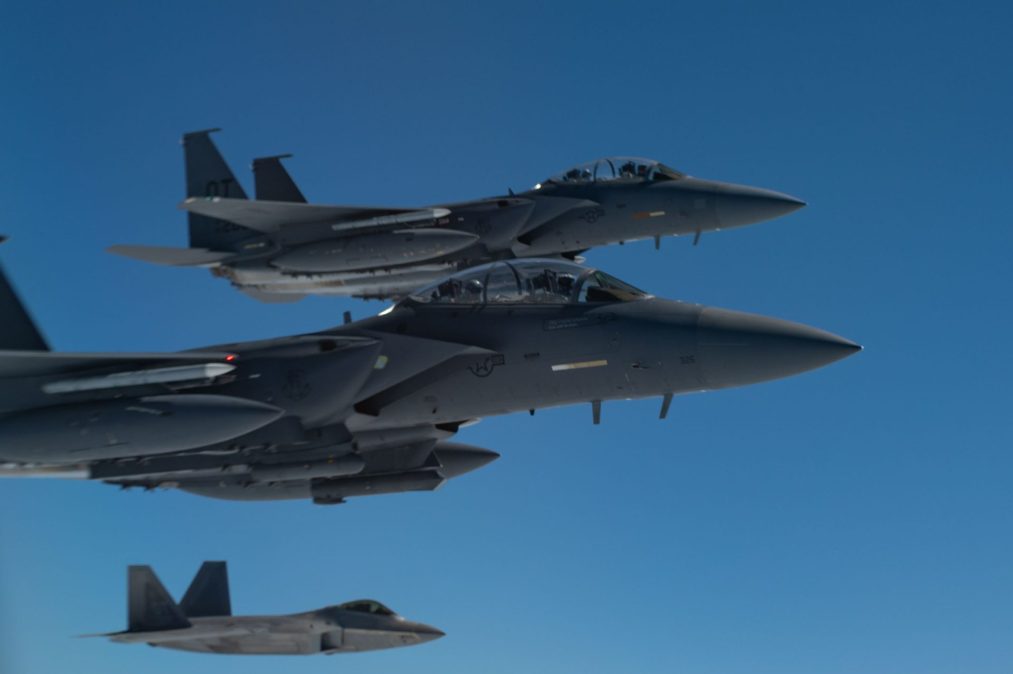
The department revealed that the first batch of PAEs for the Air Force will be: command, control, communications and battle management (C3BM); fighters and advanced aircraft; nuclear command, control and communications (NC3); propulsion; and weapons.
The Space Force will also establish one for space access and another for space-based sensing and targeting.
In November, Hegseth announced his intent to overhaul the Pentagon’s acquisition process to establish more accountability within the system, as well as speed up the delivery of new capabilities and promote innovation of emerging technologies.
The plan included the establishment of PAEs — which will replace program executive offices that have traditionally been responsible for development, procurement and fielding. A key element to the new organizations will be that a single official will oversee acquisition efforts for a single mission area to ensure individual efforts are aligned.
“By redesignating our PEOs as PAEs, we are pushing authority and accountability to the mission level. We are telling our leaders, ‘You own this mission set,’” William Bailey, the official performing the duties of the assistant secretary of the Air Force for acquisition, technology and logistics, said in a statement. “For the Airman on the flight line, this means getting the tools they need before they become obsolete. This move unlocks their expertise, cuts through bureaucracy, and ensures our acquisition enterprise is fully integrated with the warfighter’s needs at all times.”
The Air and Space Forces are the latest Pentagon components to implement Hegseth’s reforms. In November, the Army initiated a similar transformation across its acquisition structure and also established a new office dedicated to rapidly scaling emerging technologies into the field. The Department of the Navy — which comprises the Navy and Marine Corps — has reportedly moved to establish a PAE for robotic and autonomous systems.
The Space Force’s new PAEs come after years of the service working to revamp and accelerate its procurement processes in response to a number of programs that have been delayed or otherwise troubled.
Efforts include integrating commercial capabilities into operations and establishing new unit structures that align acquisitions and operations with mission areas. Recently, leaders have noted that the service is trying to accelerate system delivery by reducing stringent test and evaluation requirements.
“Acquisition is now a warfighting function. We cannot be locked into decade-long development cycles,” Maj. Gen. Stephen Purdy, acting assistant secretary of the Air Force for space acquisition and integration, said in a statement. “Our ‘commercial first’ approach allows us to harness the incredible innovation happening in the private sector, getting cutting-edge technology into the hands of our Guardians at the speed of a startup, not a bureaucracy. This is how we maintain our edge.”