Golden Dome budget plan gets $10B plus-up to accelerate space capabilities
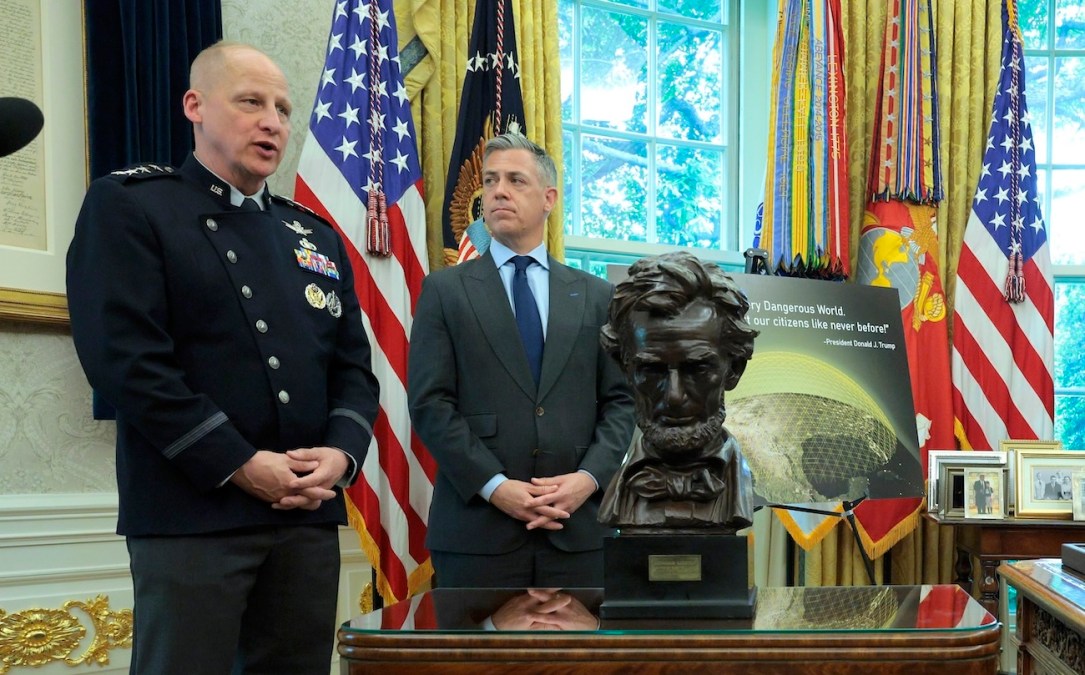
The Defense Department’s ambitious homeland missile defense architecture known as Golden Dome is now expected to cost around $185 billion to account for additional space-based systems, according to the project’s director.
The Office of Golden Dome for America has been approved to spend an additional $10 billion in order to procure space capabilities needed for the architecture, Golden Dome director Gen. Michael Guetlein said Tuesday during the McAleese Defense Programs conference. The extra funding will be used to accelerate key capabilities, including airborne moving target indication (AMTI), the Hypersonic and Ballistic Tracking Space Sensor (HBTSS) and the Space Data Network.
“We were asked to procure some additional space capabilities. So we are at $185 billion for the objective architecture, which delivers way out into the 2035 timeframe,” Guetlein said.
Golden Dome is envisioned as a sprawling network of advanced sensors and interceptors that would serve as a missile defense shield for the United States homeland against threats such as ballistic, cruise and hypersonic weapons. Initiated by President Donald Trump in the early days of his second term, the architecture is expected to comprise various legacy systems and new capabilities across multiple domains.
Trump approved a draft architecture and implementation plan for Golden Dome in May 2025, as well as an overall budget of $175 billion. Last year, Congress approved $25 billion for the project in the One Big Beautiful Bill Act that the Pentagon is using to build Golden Dome’s foundation, Guetlein said.
As Golden Dome’s direct reporting program manager, Guetlein is tasked with managing multiple other DOD organizations and military services that are responsible for the individual elements of the missile defense architecture.
The Space Force has been working to develop space-based AMTI constellations — which can track targets flying through the air — alongside the Intelligence Community for years. The service currently has prototype AMTI satellites on orbit that could be operational in the 2030s, and the $10 billion plus-up will contribute to the capability’s overall development, according to Guetlein.
The HBTSS satellites will also benefit from the additional budget, he added. A joint effort between the Missile Defense Agency and the Space Force, the constellation is designed to detect and track advanced missile threats like hypersonic weapons.
Two demonstration HBTSS satellites were launched into low-Earth orbit in 2024, and have since successfully proved their ability to track missile threats and send targeting data to interceptors.
The Space Data Network is a communications infrastructure that connects data relay satellites and spacecraft in orbit to ground stations. Its function is to support space-based activities via high-speed, secure and continuous comm links.
Although multiple organizations across the Pentagon will contribute to Golden Dome, Guetlein’s office is solely responsible for developing the architecture’s command-and-control network, he said. A recent live demonstration of Golden Dome’s C2 architecture showed that the capability was “comparable” to MDA’s legacy system, according to the general.
“We recognized on day one that command and control was going to be our secret sauce of how we pulled together all the various capabilities that were built by various services or agencies,” Guetlein said.
Currently, there is an industry consortium comprising nine prime vendors — with Lockheed Martin, RTX and Northrop Grumman recently joining the group — that each have contracts with the Golden Dome Office for C2 development.
“They operate as a unity. They decide what they’re building, when they’re going to build, how they’re going to build it and who the best athlete amongst them is to build it,” Guetlein said. “Then they hold themselves accountable on a weekly, biweekly basis. … Then at any point during that week, if one of them did not carry their load they can vote that company off the island.”
When Trump unveiled the proposed budget for Golden Dome, he claimed that the missile defense shield would be fielded before the end of his second presidential term. Guetlein noted that by the summer of 2028, he is required to field and demonstrate an operational capability that enables the United States to defend itself.
He emphasized that his biggest challenge to executing the project successfully is not developing the technology, but fielding the entire Golden Dome architecture at the scale required within budget.
“Can we scale those solutions fast enough and affordable enough to be effective against the threat? [That] is really where the challenge is going to be,” he said.