After 20 years of deployment, Marine Corps receives final Osprey amid upgrades and some flight-hour restrictions
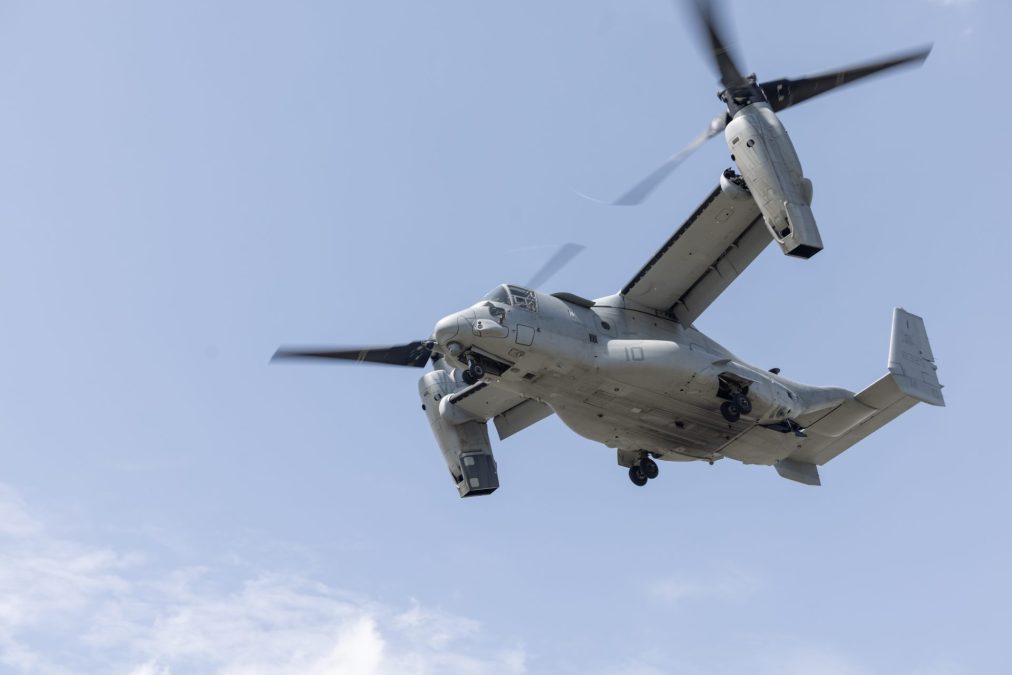
The Marine Corps received its 359th MV-22B Osprey on Tuesday, marking the completion of the tiltrotor’s program of record nearly 20 years after it was first deployed by the service.
The Marine Corps expects to keep and upgrade the Osprey through 2055, according to a service press release. Officials have also alluded to looking at other aircraft, such as the Army’s MV-75 tiltrotor, DefenseOne reported in April.
The service calls the MV-22 the “cornerstone” of the Marine Air-Ground Task Force, the service’s principle fighting organization. A tiltrotor aircraft capable of vertical take-off and fixed-wing performance features, it is key to the service’s amphibious mission and can transport two dozen Marines from ship to shore, and elsewhere around the world.
“From concepts sketched on paper decades ago, through the XV-3 and XV-15 demonstrators, to the V-22 we celebrate today, this program endured technical challenges, funding uncertainty, program restructures, operational setbacks, and tragedy,” Lt. Gen. William Swan, deputy commandant for Marine aviation, said during a ceremony celebrating the milestone in Amarillo, Texas on Tuesday, according to a pre-written speech shared with DefenseScoop.
“There were moments when its future was genuinely in doubt. I think it is important that we acknowledge that history,” Swan said. “Not because we want to dwell on the challenges – but because you cannot fully appreciate what has been accomplished without understanding how difficult the journey has been.”
The announcement said the final delivery fully shifts the Corps’ focus from fielding the aircraft to sustaining and modernizing its Osprey fleet. Officials said current Osprey initiatives include improving nacelle wiring, reducing maintenance hours and improving mechanical components to enhance safety and sustain its use for the next three decades.
Twenty military personnel have died in V-22 Osprey crashes since 2022, including nearly three years ago when eight airmen assigned to Air Force Special Operations Command crashed near Yakushima, Japan. Those incidents, as well as other fatal crashes since the aircraft’s development flights decades ago, were blamed on pilot error, mechanical issues, mission planning or a combination of issues.
A hard clutch engagement, or HCE, is a specific mechanical issue in the aircraft’s proprotor gearbox that has caused several deaths in the Osprey, such as a 2022 crash that killed five Marines. After the AFSOC crash, the military temporarily grounded its entire Osprey fleet and lawmakers began raising questions about the aircraft’s safety.
Some limitations on the aircraft continue today, which a Marine Corps spokesperson said contributed to the fleet not having HCEs since early 2023. Naval Air Systems Command lifted the Osprey’s grounding in 2024, issuing a fleet-wide bulletin to inspect the flight hours on each proprotor gearbox on an Osprey prior to each flight.
Aircraft that meet or exceed a certain threshold, which the service did not share citing security reasons, can operate under NAVAIR’s 2024 guidance, a Marine Corps spokesperson said. Those below the threshold follow “risk mitigation measures” until their proprotor gearboxes are upgraded or the threshold is exceeded. In 2025, the Marine Corps introduced a new proprotor gearbox and began developing a new input quill assembly (IQA) to address the HCE issue.
“In the meantime, the present flight-hour restriction on the IQA implemented in February 2023 has resulted in no further Hard Clutch Engagements,” Capt. Jacob Sugg, the spokesperson, told DefenseScoop in an email Tuesday. Some Ospreys have continued to make emergency or “precautionary” landings, with one experiencing a cracked gearbox failure earlier this year.
The service’s 2026 aviation plan says that as of earlier this year, the Osprey’s 10-year Class A mishap rate — the most severe category of accidents that includes death, permanent disability, the total destruction of an aircraft or more than $2.5 million in damage — is lower than the Marine Corps overall average. A Marine Corps spokesperson said the overall average also includes the CH-53E, F-35, F/A-18 and AV-8B aircraft.
The Osprey, developed by Bell and Boeing, reached initial operational capability in 2007. It has flown more than 686,500 flight hours over 114 deployments, according to the Corps, including those involving combat, logistics, medical evacuations and humanitarian missions.
There are 16 active duty V-22 squadrons in the Marine Corps and two in the reserve component. The aircraft accounts for roughly 75% of the Marine Corps’ rotary wing capability, according to the service. The unit that received the final aircraft was Marine Medium Tiltrotor Squadron 162 (VMM-162), 2nd Marine Aircraft Wing out of North Carolina.
DefenseScoop reported in April that the service was prototyping AI tools for aviation supply and predictive maintenance, historically enduring and costly challenges across the military. At the time, Swan told reporters that the Marine Corps’ aviation branch was on average 62-64% mission capable.
“We cannot assume that because the MV-22B transformed Marine aviation once, its evolution is complete,” Swan said in a press release. “It is our responsibility to carry this legacy forward and ensure this aircraft remains ready, relevant, safe and lethal for the fight ahead.”
Updated on July 28, 2026, at 7:05 PM: This story has been updated to include additional information provided by the Marine Corps.