101st Airborne unit put ‘steel’ between soldiers and the breach, tested limits of AI in recent exercise
Col. Ryan Bell gave one of his company commanders a tall order at the Joint Readiness Training Center at Fort Polk, Louisiana, earlier this year.
“I want you to make this breach uncontested for your riflemen when they enter,” Bell, commander of the 3rd Mobile Brigade Combat Team, recounted to reporters on Thursday.
He was referring to a combined arms breach, a deadly but standard task for a rifle company — typically along with artillery, engineers and a host of other carefully synchronized, human-centric capabilities — that entails punching through a heavily fortified defensive position.
But in the age of military robots, according to Bell, that’s not quite what happened.
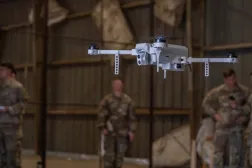
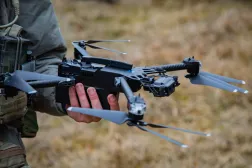
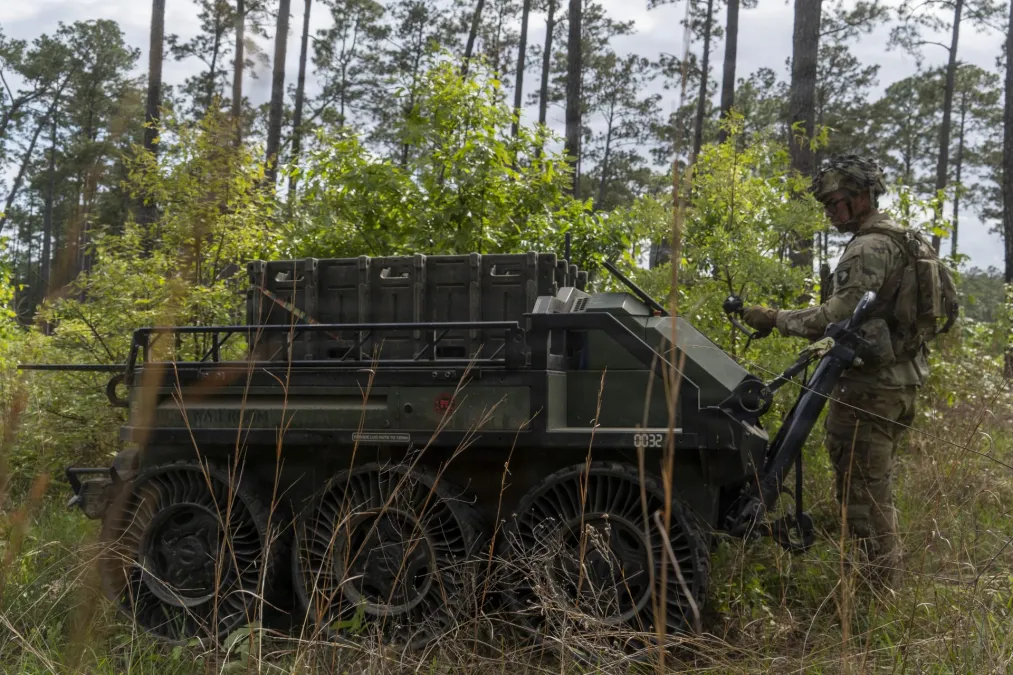
The company commander launched 25 one-way attack drones soldiers had been 3D-printing themselves, which wrought havoc on bunkers, machine gun nests and triple-strand concertina wire. Other drones targeted electronic warfare sensors and jammers, and dropped smoke canisters to blind the adversary. For the finale, two unmanned ground vehicles crept toward the breach with C4 charges to clear away landmines and remaining wire obstacles.
“So, when the riflemen got there, the breach was uncontested,” he said. “Every target had been struck, and you didn’t have an engineer or a Sapper squad running out with a grappling hook trying to low-crawl with a Bangalore torpedo. It took us 35 drones and a little over 100 pounds of C4, but under the cost of three 155mm artillery barrages.”
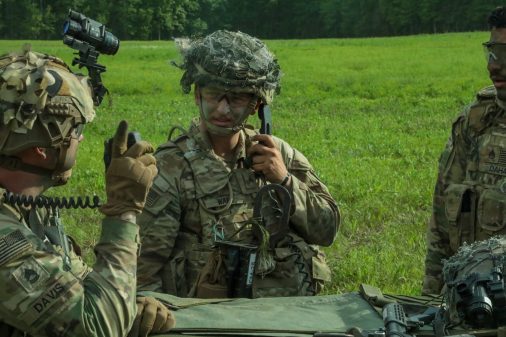
The breach occurred in April during a rotation to JRTC, where 3rd MBCT — a part of the 101st Airborne Division out of Kentucky — deployed a host of burgeoning military technologies against a simulated enemy.
The exercise also demonstrated the push and pull of new tech for Army units now employing it. For Bell, that meant focusing on the basics for his brigade, using technology — such as AI and robotics — as an enabler to his soldiers, without having to become dependent on it completely and recognizing its limits.
Bell considered the robot-heavy combined arms breach, a wall of “steel” between his soldiers and adversaries, a prime example of how the Army will deploy unmanned assets in future conflicts as the service races to mass-produce such technology.
“We are using them to fight in front of us — a ‘drone contact layer’ … where I’m sending robots in front of my riflemen to defeat or disrupt the enemy in depth,” Bell said. “So when my riflemen get there, the enemy is already down and they are finishing the fight, but it’s an unfair fight.”
A UGV mounted with a machine gun protected one of his artillery batteries while soldiers were freed up to go on the offensive. A relatively new, specialized unit known as the Multi-Functional Reconnaissance Company, flew drones, launched electronic warfare effects and inserted onto the battlefield with Marine Corps V-22 Ospreys in what Bell described as a “proof of concept” for the Army’s own incoming tiltrotor aircraft.
While Bell touted the technological advancements his brigade wielded during the exercise, not everything was as uncontested as the smoking breach the riflemen seized.
He wanted more drones, for one. The brigade had 228 one-way attack drones, more than half of which were produced by the 101st’s innovation section called the Robotics and Autonomous Integration Directorate (RAID). The Attritable Battlefield Enabled, or ABE 1.01, is built entirely in-house for $750 in some configurations, but “the division doesn’t have the ability to scale it,” according to Bell.
“That’s where we absolutely need industry to produce these at scale, especially when you start thinking about the numbers that the Army would require,” he said, noting that it takes soldiers about a day to make two systems. He said, echoing senior Army leaders, the drones soldiers needed to use had to be cheap, mass-producible and easy enough for a young soldier to use after being awake for 48 hours in combat conditions.
“The challenge was making sure you don’t run out, because there was no shortage of targets,” he said of the exercise.
3rd MBCT also spent the last year integrating artificial intelligence tools into its planning process. They fed doctrine into large language models and each member of Bell’s staff — from personnel to logistics to intelligence — built their own bots. In one case, the intelligence bot processed about 25,000 battlefield reports to help staff “understand the operating environment,” Bell said.
“We found it useful in a number of ways and we found some areas we did not want to use it,” he said.
For example, some AI tools were useful in mission analysis. But when it came to defining the commander’s intent, the purpose of a mission delivered by the leader in charge, AI had no place.
“That’s my responsibility,” Bell said. Another example: “We didn’t use AI for course of action development. Large language models don’t really understand three-dimensional space, so they’re not good for developing courses of action, that’s where you need the expertise of a skilled staff to understand the art of fighting to plan the operation.”
However, they did use AI to poke holes in those courses of action and speed up the orders production by churning over directions from higher headquarters in under half an hour, for example. But its use was targeted, put on staff “where we could control it,” according to Bell.
“The focus of the training has got to be on the fundamentals of warfighting,” he said. Technology “has to enable them, and they still have to be able to fight without it.”