Memo outlines new policies for military families affected by war-triggered evacuation from Bahrain
An official Pentagon memorandum viewed by DefenseScoop on Tuesday provides U.S. military families who were instructed to flee Bahrain for safety six months ago with planning, logistics and relocation options, new timelines, and other details about the near-term support they may receive from the government.
The memo — issued Aug. 27 by Under Secretary of Defense for Personnel and Readiness Anthony Tata and his deputy Sean O’Keefe and addressed to Pentagon leadership and other senior officials — signals a transition from the State Department’s evacuation orders in March that were triggered by an escalation in warfare with Iran and its proxies during Operation Epic Fury, which included drone and missile assaults by Tehran against American military assets around the Middle East.
Bahrain sits near the Strait of Hormuz and is considered a hotspot for American naval forces’ command-and-control assets across the entire region covered by U.S. Central Command. It is home to the Navy’s 5th Fleet headquarters and has historically served as a major proving ground for the service’s unmanned surface vessels and drone integration efforts.
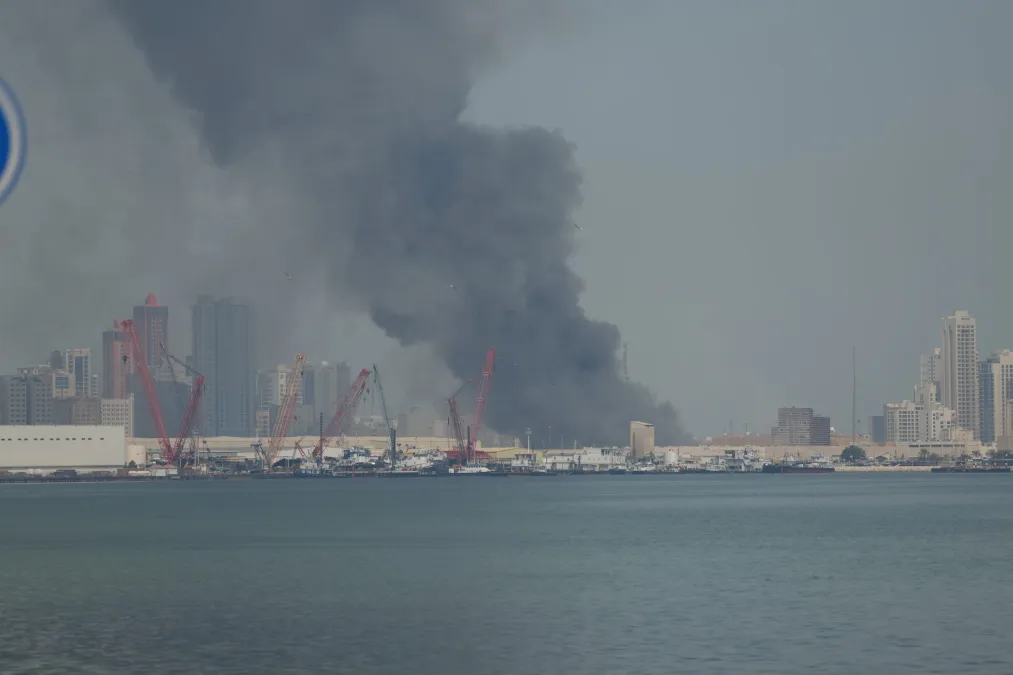
Naval Support Activity Bahrain — a key American military base in the Middle East — was reportedly hit and seriously damaged by Iranian drones and other weapons in those waves of strikes early this year. Amazon Web Services’ data centers based in Bahrain and supporting joint force operations were also slammed by multiple Iranian drone and missile strikes in early March and April.
“I recognize that the sudden, ordered departure from Bahrain placed immense strain on our Service members, civilian employees, and their families, and I appreciate their resilience throughout this difficult transition,” O’Keefe and Tata wrote in the new memo.
News reports emerged in late August that families and personnel who were instructed by the State Department to leave Bahrain in March had been uncertain and “in limbo” about their futures — with many living in hotels and short-term rentals elsewhere — as the 180-day mark on those orders approached.
The evacuation could not legally be extended by the State Department after that point.
Broadly, the new P&R directive — titled “Termination of Ordered Departure – Bahrain” — presents options through Nov. 30 for U.S. military and civilian families to transition off temporary evacuation and safe-haven funding, and into permanent duty station moves or approved long-term separated housing allowances.
Tata and O’Keefe indicate that State “has terminated the Ordered Departure from Bahrain for eligible family members (EFMs)” — including Defense Department EFMs and non-emergency civilian employees — and “transitioned its posts to a Restricted Operations status.”
“Therefore, adult EFMs (18+) under [Chief of Mission or] COM authority who are authorized to return to Bahrain are expected to depart in the most expeditious manner possible within 10 calendar days of the effective date,” the officials wrote.
Restricted Operations status is essentially a middle ground between “fully evacuated” and “normal operations.” It generally comes when the 180-day period is up or acute threats have eased, but conditions are not safe for a full and unrestricted return.
The memo also terminates a Stop Forward Movement order halting U.S. government-funded travel to Bahrain, which the Pentagon’s P&R directorate issued in early March.
Notably, during a “worldwide town hall” on Monday, a sailor who said she was recently displaced from Bahrain asked Chief of Naval Operations Adm. Daryl Caudle for a “household goods” update on the personal belongings she and other personnel left behind.
The sailor wanted to know whether, when, and how her possessions would be returned or replaced.
“What a timely question. I just was in conversation with our Acting Secretary of the Navy, the Honorable Hung Cao, on this very question, and it’s so near and dear to both of our hearts,” Caudle replied. “There is nothing more frustrating than basically not having your stuff, and we get that and understand that very well.”
The CNO said he was working hand-in-hand with Navy leadership to determine “how we can go get this done.” That work includes figuring out the best way to pre‑stage shipments and if sailors must be physically present to handle the pickup and movement of their stuff.
“We’re not getting back in there anytime soon — I just want to be completely honest with that,” Caudle told the audience. “But we’re working real hard to develop a scheme of maneuver in order for you to get your things.”
Meanwhile, the war with Iran continues.
On Tuesday, Centcom officials announced that the U.S. launched a new wave of strikes against Islamic Revolutionary Guard Corps (IRGC) targets in Iran, in response to attacks on commercial shipping in the Strait of Hormuz and threats to American service members deployed in the region.
Pentagon spokespersons did not immediately provide answers to DefenseScoop’s questions about the new memo on Tuesday.