Air Force plans to field 500 CCA drones by 2032
NATIONAL HARBOR, Md. — The Air Force is targeting to have 500 of its first Collaborative Combat Aircraft (CCA) robotic wingmen by 2032, Secretary of the Air Force Troy Meink said Monday.
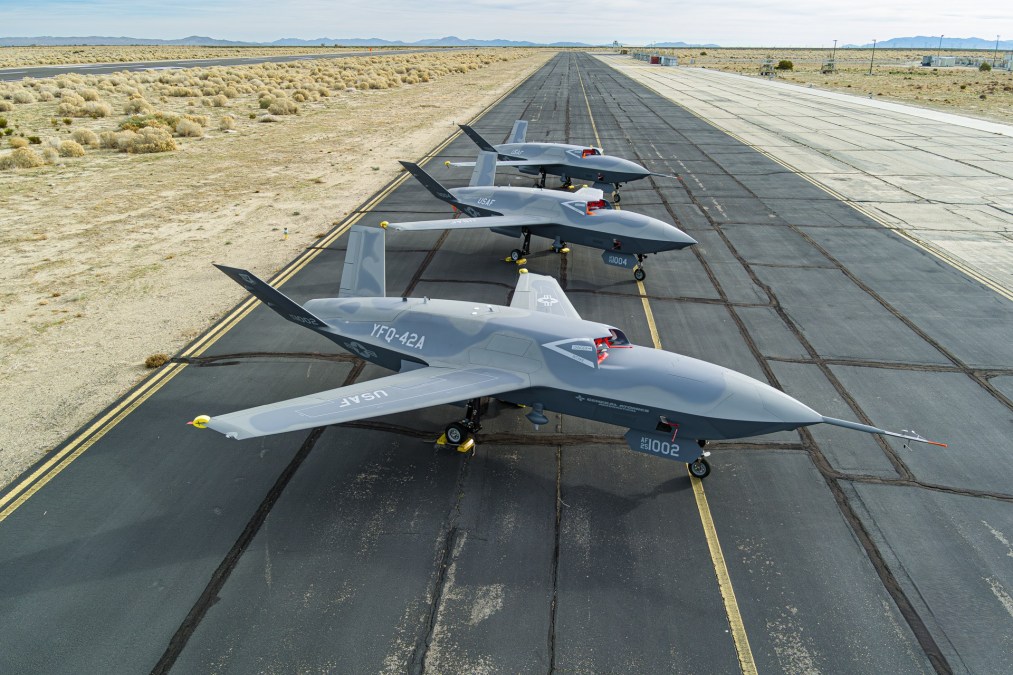
General Atomics and Anduril are manufacturing Increment 1 CCA drones, which have already begun rolling off their respective production lines, Meink said during the annual AFA Air, Space and Cyber conference.
General Atomics’ platform is now known as the FQ-42A Vengeance, while Anduril’s has been officially designated the FQ-44A Fury, he added.
The CCA platforms are envisioned as unmanned fighter jets able to fly alongside the Air Force’s manned fifth- and sixth-generation aircraft — providing additional reach, strike and intelligence-gathering capabilities.
“Because of the steps we are taking today, we will have a significantly different force by 2030 or 2032. By then, our special operators will have the ability to employ thousands of autonomous systems, and we will have autonomous fighters like the Collaborative Combat Aircraft,” Meink said. “We intend to have at least 500 of these in service by 2032, and they’ll be performing many of the same missions that we do with manned fighters today.”
Considered a linchpin of the Air Force’s modernization efforts for operations in the Indo-Pacific, the CCA program is one of the service’s most high-profile development efforts. The Air Force plans to rapidly field the drones in increments, with each iteration featuring the latest upgrades and capabilities.
The Air Force requested $996.5 million in 2027 to initiate CCA Increment 1 procurement. Previously, the service has claimed it wants to purchase one drone at roughly one-third the cost of an F-35 Lightning II fighter jet — or about $30 million per unit — but officials have asserted that the program is beating those projections.
A specialized squadron known as the Experimental Operations Unit (EOU) is tasked with testing the CCA platforms and outlining how the unmanned fighter jets will integrate into the Air Force’s fleet. Headquartered at Nellis Air Force Base in Nevada, the EOU is working with both General Atomics and Anduril to get the drones into exercises and simulate future operations.
The Air Force is developing several elements of the CCA drones across separate programs.
General Atomics and Anduril are responsible for delivering the Increment 1 platforms, while RTX-subsidiary Collins Aerospace and Shield AI are contracted to provide the program’s mission autonomy via a government-owned Autonomy Government Reference Architecture (A-GRA). The service is also working on a portable ground-control system under the Command and Control Enclave (C2E) program.
Although the CCA drones are a high-profile effort to integrate autonomous aircraft into the Air Force’s fleet, the service has other programs that are making significant progress — such as the Massed Modular Aircraft (MMA) and Family of Affordable Mass Munitions (FAMM), Meink said.
The service is accelerating development and fielding of the MMA drones, considered an affordable alternative and eventual replacement for the MQ-9 Reaper fleet. Meink said the Air Force is currently on track to deploy 100 MMA platforms by 2029 and have 500 in service by 2032.
As for FAMM, the Air Force expects to have “tens of thousands” of the low-cost munitions deployed by 2030. The systems differ from CCA and MMA in that they are intended to be inexpensive cruise missiles that can be manufactured in large numbers to overwhelm enemy air defenses.
FAMM’s production is expected to begin sometime this fall. Air Force FY27 budget documents indicate that the service intends to buy nearly 28,000 of the weapons over the next five years.
“We will be dramatically increasing our combat power by adding large numbers of highly autonomous systems,” he said. “We are using novel concepts such as open systems architecture to accelerate procurement — which has also increased competition from industry — resulting in better choices, better prices and, in the end, more combat power.”