American Army forces in South Korea adapting to new drone threats
The U.S. 8th Army deployed in South Korea is incorporating lessons learned from drone warfare in other theaters as it prepares for potential conflicts on the peninsula, officials said Monday at the annual AUSA convention.
Drones and missiles have played a major role in the U.S. conflict with Iran and the Russia-Ukraine war. North Korea, an ally of Russia, has also reportedly been conducting exercises to practice “swarm” operations that combine attack drones with missiles and other weapons.
During a media roundtable at the AUSA conference, DefenseScoop asked the commanding general of 8th Army about North Korea’s fielding of one-way attack drones and how that’s impacting his force’s modernization plans and operational contingency plans.
“I’m going to answer it a little more generally than specific to the DPRK,” Lt. Gen. Joe Hilbert replied, using an acronym to refer to North Korea. “We know that on the battlefield, the one-way attack drones are becoming an ever-present reality, and so … as far as you know, modernizing our air defense systems, but also just looking at our own tactics and how to defend against some of those one-way attack drones, in some ways, you know, there’s a similarity to defending against any other air defense threat, whether it’s a reconnaissance threat or it’s a one-way attack drone. So, we’re incorporating that into our training, we’re incorporating that into our modernization, and we’re incorporating that into the experimentation that we do as we continue to learn those lessons of both [Operation] Epic Fury and Ukraine. And … the same assumption is the DPRK is learning that as well.”
Reuters recently reported that Ukrainian President Volodymyr Zelenskyy said Russia may have provided its North Korean ally with jet-powered drone technology, which Moscow has been employing against Ukraine.
Hilbert declined to say specifically whether Moscow is transferring its attack-drone tech to North Korea.
He noted that Pyongyang is sending forces to fight in Ukraine on behalf of Russia.
The 8th Army has been learning from what’s happening in Ukraine and the Middle East, and working through changes in its own tactics, techniques and procedures to be able to react to those threats and to be able to defend against them, Hilbert told reporters.
“We have the advantage of we live on and we train on the terrain that we defend. So, we’re able to take the things that we observe and apply them to the terrain where we currently defend and fight. And that’ll play itself out in a host of ways, whether it’s looking at that exercise and thinking about how the adversary might use the capability inside that terrain or inside that environment, and then being able to think about ways to counter it and gain an advantage from it,” he said.
“We’re certainly watching more than just drones,” he added. “We look at … what strike warfare or fires look like elsewhere. We also look at candidly what a battlefield looks like when you don’t know how to maneuver. And so therefore we see the advantage of operational-level maneuver as we work to train toward operational-level maneuver.”
Col. Rosanna “Ro” Clemente, commander of 35th Air Defense Artillery Brigade, said troops are training and preparing for scenarios in which their systems and units would be “hunted” by adversaries.
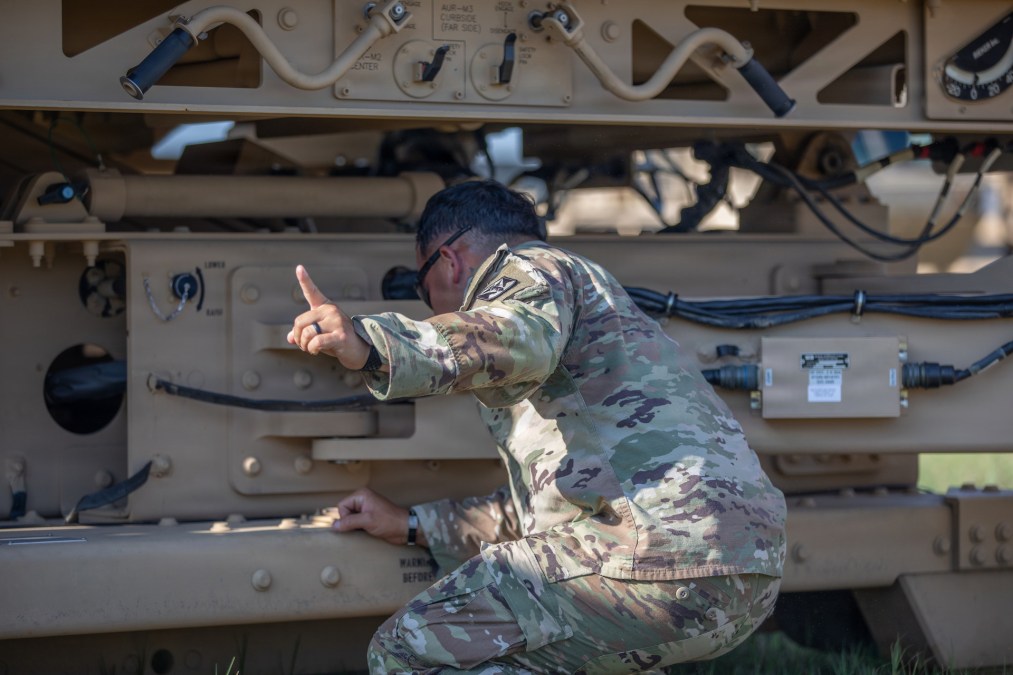
“As we conduct our own internal exercises, all of our air defenders are practicing something as simple as mobility and survivability jumps, which is being able to reposition and displace your systems to different alternative locations based on any type of threat warnings that we receive. So they’re very, very well trained. I think all of our soldiers … know how to move their systems extremely well and move them quickly, and they are able to move them and reposition them into different locations across the peninsula that still maintains that ballistic missile defense coverage,” she told reporters during Monday’s roundtable.
“But in addition to that, we also have to rely on the other pillars of integrated air and missile defense, most specifically the passive defensive measures that we also have in place. A little bit more than just hardening, but a couple of other techniques that we’ve learned from the Russia-Ukraine war in terms of deception, how to move things around, create distractions, and make sure that we create different types of dilemmas for the adversary in terms of where our capabilities are and where they’re positioned” to protect and defend assets, she added.
U.S. forces in Korea are integrating new tools into their arsenals, such as Integrated Battle Command System (IBCS) technology.
“It’s going to be IBCS-enabled Patriot, and then … we will also have Integrated Fire Protection Capability, the IFPC,” Clemente noted.
That tech allows air defenders to “pick best sensor and best shooter” and “kind of contain it all into one interface so that we can have a better control of those systems,” she said. “Those concepts, I think, are obviously still being tested, and we’re testing those capabilities as well in Korea.”