White House, Anduril announce plans for new ‘software-defined’ shipyard to help build attack submarines
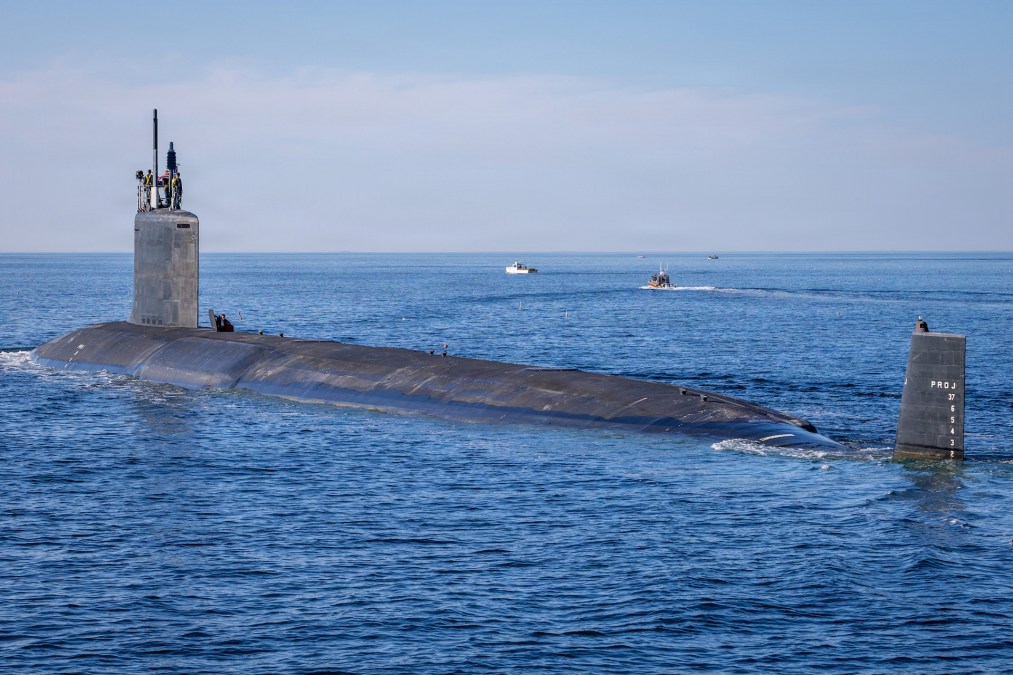
The Trump administration and Anduril Industries unveiled plans Tuesday for a new “software-defined” shipyard that will help build attack submarines for the Navy.
The announcement comes as the Navy aims to boost its undersea arsenal, which could play a key role in a potential future conflict with China in the Pacific, and President Donald Trump seeks to enhance domestic manufacturing.
The Navy has awarded Anduril a contract worth up to $2.9 billion to support the effort, according to a press release from the contractor. The firm plans to invest $3.7 billion of its own funding to help stand up the facility, grow the workforce, and add new tech and other capabilities that will be required for the project.
“The United States Navy, together with Anduril Industries, will invest $6.6 billion to create a new facility in Baltimore County, Maryland, which will manufacture critical components for the Virginia-class submarine. This delivers on President Trump’s promise to bolster America’s defense industrial base while revitalizing our manufacturing industry, creating over 13,000 direct and indirect jobs, and driving $2 billion in annual economic output,” White House Principal Deputy Press Secretary Anna Kelly said in a call with reporters Tuesday.
The facility, dubbed Arsenal-2, will be constructed at Tradepoint Atlantic in Baltimore County.
“Permitting and site preparation will begin immediately, with construction commencing as soon as the necessary approvals are in place. Initial operations are expected to come online in 2030, with production scaling progressively thereafter as Anduril builds the workforce, supplier base, infrastructure, and manufacturing throughput required for submarine production,” the company said in a press release Tuesday.
Anduril described Arsenal-2, which is expected to sit on a 187-acre site and be more than 2 million square feet, as a “modern shipbuilding system built around software-defined production and advanced manufacturing.”
Anduril’s industrial software platform, called ArsenalOS, will provide the “digital backbone” for the facility and its production systems, according to the press release.
“It will connect fabrication workflows, outfitting sequences, material movement, inspection protocols, and documentation requirements in a single system, giving workers and managers real-time visibility into the state of production. Digital work instructions, embedded quality controls, modern sensing, and automation will support the expertise of welders, pipefitters, electricians, shipfitters, inspectors, and other skilled trades. By making production requirements more visible and processes more consistent, ArsenalOS will help new workers train faster while preserving the technical rigor, judgment, and quality required for submarine construction,” per the release.
The company plans to build components of the Virginia-class submarine at the facility and deliver them to Electric Boat and Newport News Shipbuilding for final assembly.
Although Anduril is primarily known for its advanced drones and AI-powered software tools, the company is looking to expand into the manned submarine business.
“The Virginia-class submarine program is, you know, one of the most critical warfighting capabilities that our nation has,” Chris Brose, Anduril’s president and chief strategy officer, told reporters during Tuesday’s call with reporters.
“And I think for us, you know, this is an opportunity to really reimagine how a shipyard is built and how this work is done,” he added. “As we’ve had this conversation with the administration and with the Navy, really for the better part of the past two years, you know I think the core insight that the administration had and the Navy had is we just need new production capacity. You know, we need to grow the maritime industrial base, the submarine industrial base so that we can produce more submarines. So the goal here for Anduril is to contribute to that.”
He touted the company’s digital tools as capabilities that could boost shipbuilding efforts.
“It’s not about, you know, the inability to bend steel in America. We know how to do that. You know we have phenomenal workers who are doing that. It’s really about really kind of taking advantage of manufacturing revolutions that are occurring in our commercial aerospace and other commercial industries, bringing software and other digital technologies in, really kind of reconceiving how the work is done. You know, taking what are very complex tasks performed by very skilled workers and breaking them up into a larger number of simpler tasks that a larger workforce can contribute to much faster and really try to get production capacity up,” he said.
The company is standing up a facility in Orange County, California, to get a head start before Arsenal-2 comes online.
“We have already made investments. We are already standing up a facility in California to get moving on the … relatively simpler, kind of more straightforward components,” Brose said. “Things like torpedo tubes and other things that … the industrial base desperately needs to produce more of. And our goal is to help produce more of those types of systems, and then over time, as the yard comes online in Baltimore, scale up to larger modules, larger ship sections. And for us, this is being done in partnership with our traditional shipbuilders who are phenomenal partners and phenomenal builders of these systems. They just need help in terms of capacity. So again, this is about helping to create more of the critical systems that we need to produce more submarines.”
A senior administration official, who spoke to reporters during Tuesday’s call on condition of anonymity under ground rules set by the White House, said the Baltimore Country shipyard could provide about 9 million hours of labor a year.
“That would be the equivalent of about a 15% increase,” the official said. “So, you know, just in terms of the pure … capacity that it brings, it would absolutely translate to increased Virginia-class submarine production. And to the point of torpedo tubes, you know, today that is … what we refer to as a gating component that we need to be able to move forward with some of those Virginia-class submarines that are under construction. So having those torpedo tubes earlier would let us, you know, move production of current Virginia submarines under construction faster.”
The official added: “They’re going to start with these critical components, prove that they meet the quality standards, prove that they’re safe to submerge with human lives on board and hold the pressure boundary, and then they’ll move on to increasingly complex assemblies that will even increase our ability to produce even faster as we move through and get more and more done at this shipyard.”
President Donald Trump visited the planned location for the shipyard on Tuesday afternoon and suggested that the facility could produce “autonomous” submarines.
“I love the idea of the autonomous sub,” Trump said. “It just makes sense because I wouldn’t — I’m not sure that I would have the courage to go into submarines too much. You guys love them, but me, I’d rather be floating on the sea. So I like the idea of an autonomous sub all down there by itself, but just as accurate. I mean, it’s incredible what they can do. I saw some research-and-development papers on it. It’s unbelievable the things that we’re coming up with over the next five-year period.”
Updated on Oct. 6, 2026, at 5:50 PM: This story has been updated to include comments from President Donald Trump.