Navy comes ‘full circle’ on nuclear power for next-generation battleship

Navy leadership’s recent decision to make the future Trump-class battleship nuclear-powered introduced a new twist in the saga of one of the service’s most controversial programs.
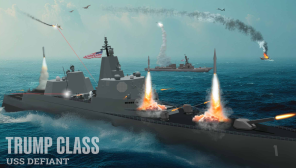
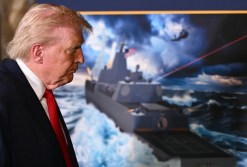
President Donald Trump unveiled his vision for the platform in December when officials shared their desires to arm the vessel with a variety of high-tech weapons such lasers, railguns, hypersonic missiles and nukes.
The Pentagon plans to spend more than $17 billion on the lead ship in the class, according to budget documents released last month.
Earlier this year, Chief of Naval Operations Adm. Daryl Caudle said the battleship would be conventionally powered so that the Navy could deliver it to the fleet sooner.
“The question about nuclear power [for the battleship] — we looked at that,” Caudle said in January at the SNA symposium.
“I think it’s a logical question to think, hey, here’s a big capital ship. It’s going to be carrying a lot of load, you know, in places that we don’t necessarily need a strike enforcement air wing as a large ship there that’s in command of a flotilla … wouldn’t it be logical to be nuclear powered? And that brings a tail to the construction of that that just really fell outside the scope of what we want to do on the speed to get this thing in the water. And so what you trade off with, with persistency that only nuclear power can do, is you end up having, you know, the ability to go produce that — it pushes the battleship into a timeframe that just didn’t meet the operational need of the ship,” he said.
A conceptual rendering of the vessel released by the Navy indicated that the ship would be gas turbine- and diesel-powered.
However, in April, shortly before he was forced out of his job, then-Navy Secretary John Phelan suggested that a final decision hadn’t been made. “I think we’re trying to understand all the proper tradeoffs,” he told reporters on the sidelines of Sea-Air-Space conference.
The Navy’s new shipbuilding plan that was released last week revealed a “BBGN” designation for the Guided Missile Battleship program, also known as BBG(X), and stated that it will in fact have nuclear propulsion.
Navy leaders have since been on Capitol Hill touting the benefits of that type of system.
“I’m thrilled that we finally landed on the fact it’s going to be nuclear. That was the initial idea. And we batted around to deliver it sooner, to make it conventional, and we came back around full circle to make it nuclear. And that’s the exact right answer as a command-and-control ship that I can forward posture and run surface action groups out of,” Caudle told lawmakers during a House Appropriations defense subcommittee hearing last week.
Caudle further lauded the decision at a House Armed Services Committee hearing a couple of days later.
“We walked away from surface nuclear power decades ago, and that was one of the largest mistakes the Navy ever did, and we’re bringing it back. We need nuclear-powered surface ships to sustain combat operations with our nuclear-powered aircraft carriers,” he told lawmakers.
He suggested that such a platform would have come in handy in the Middle East during recent conflicts.
“Imagine what that would have looked like in the Arabian Gulf if I’d had a nuclear-powered battleship there to give the air defense and firepower that it could sustain while I rotate, you know, ships that roll that need gasoline around it. So the imperative for this is crucial to develop that level of payload capacity,” Caudle told lawmakers.
Hung Cao, the new acting secretary of the Navy, said a nuclear propulsion system would enable battleships to sail fast.
“The nuclear battleship would basically be able to bring firepower very quickly to a place” where it’s needed, he said at the HASC hearing, noting that the nuclear-powered USS Gerald R. Ford aircraft carrier was able to sail from the waters near Venezuela to the Mediterranean in just five days.
Caudle told lawmakers that for the battleship, the Navy plans to have a reactor that’s similar to the one on the Ford.
“We’re going to use an existing design. We’re going to use the Ford reactor, the A1B reactor, and the components that support that from the vessel, the steam generator, pressurizer, loop components, reactor coolant pump components. So all of that technology that’s going into the design of the battleship, the nuclear battleship, from the reactor plant perspective, is all pull-through technology from the Ford class,” he said.
“What’s new is the hull form and … how that’s going to be tied to the propulsion system and, you know, the electrical system and distribution system. So there is some research that needs to be done on that. But the fact it’s nuclear is going to give it the sustainment it needs. In particular, in the Pacific, you know, an ocean that’s three times the size of the Atlantic, I need those types of legs and endurance to serve as a capital ship that comes with that firepower to be able to deliver that combat payload,” Caudle added.
The battleship has plenty of critics, including some lawmakers and others who cite the platform’s high price tag, plans to integrate unproven technologies, and shipbuilding challenges as reasons to oppose investing large sums of money into that type of program.
Bryan Clark — a retired Navy officer who also served as special assistant to the chief of naval operations and director of his Commander’s Action Group — argued that the service would be better off investing in cruiser-sized surface combatants that aren’t as enormous as the envisioned battleship.
Currently a senior fellow and director of the Center for Defense Concepts and Technology at the Hudson Institute, Clark said a cruiser-sized platform could provide needed air-and-missile defense capabilities and vertical launch systems for offensive strike, at lower cost.
“I don’t think the battleship is a good idea as a ship class, although the Navy does need a bigger surface combatant going into the future,” he told DefenseScoop.
However, if Navy leadership is determined to pursue a battleship, making it nuclear powered would have upsides, he said.
“If I was going to build the battleship, though, and it was going to be like a 35- to 40,000-ton vessel, then nuclear power is not a bad idea, because what ends up happening is, once you get to ships that are that big and they’re going to drive around fast, [if] they’re going to use gas turbines they’re going to consume a lot of fuel. It’s very inefficient,” Clark said. “You end up having to have big fuel tanks, and then you end up probably getting refueled more often and it creates … liability.”
Oilers are vulnerable to attack, he noted.
“The Chinese know that. The Chinese even talk about it going after our logistics flows. So now … if you create a ship that big that creates a demand for even more oiler traffic, you’re going to have that many more oiler trips. That makes your logistics chain more vulnerable to interdiction by the Chinese or whoever. So if you have a nuclear-powered ship, then at least you could have your carrier and your escort, your main escort, your area air defense commander be nuclear powered … they don’t need to be refueled as often, and it reduces the number of oiler trips you have to make as a minimum,” he told DefenseScoop.
Clark noted that the high cost of petroleum means a nuclear-powered vessel might have a similar operational cost as a more conventionally powered platform.
“Those are reasons why you might want to do this if you’re if you were going to build a battleship,” he said. However, there are downsides, such as the strain it would put on the industrial base.
“The cost of the ship is very, very high. And then the question then is where are you going to build it? Because our nuclear shipyards are already behind on the ships they’re supposed to be building. So we’re going to add yet another new class of ship to the already over-subscribed … shipbuilding workforce and infrastructure. So it doesn’t seem to be even feasible to add this ship to our existing industrial base’s workload, even if we want to pay the money to do it,” Clark said.
Making the battleship nuclear-powered could add years to the delivery timeline for the lead ship in the class, he suggested.
“It’s probably a couple more years to design it, and probably a couple more years to build it. So you’re looking at 16 years maybe to get to the point where you’re actually delivering the first of these nuclear battleships,” he said.
One problem is that the existing shipyards that construct nuclear-propelled vessels are “tapped out,” according to Clark.
The Navy could potentially start transitioning another shipyard into the nuclear production pipeline, he suggested.
“You could see that being a path forward to do it, but … I don’t see any way that the battleship shows up in less than 15 years,” Clark told DefenseScoop.
Caudle told lawmakers that he thinks a mid-2030s delivery date for the first nuclear battleship is “realistic.”
Clark suggested that taking certain steps to speed up delivery could lead to problems.
“Like most shipbuilding plans, a lot of it’s aspirational,” Clark told DefenseScoop. “You could certainly do enough of a design that you could start construction even within three years, but if you do that, there’s a lot left that hasn’t been done in terms of the detailed design, so you’d up in the same situation you were with the Zumwalt [destroyer] where the ship isn’t fully designed, you start construction, you find a lot of things that need to get changed, and the concurrency … delays the ship construction, adds cost.”
The Navy plans to procure the lead ship in the Trump-class in fiscal 2028, with delivery slated for fiscal 2036. It plans to procure two more over the course of the Future Years Defense Program, which is a five-year planning period. The service’s new 30-year shipbuilding plan lists 15 battleships to be procured and 11 to be delivered in the FY28-FY56 time frame.
“I guess if they were to build it, then nuclear power … might be the right answer, but there’s a bunch of things that go along with that,” Clark said. “You’d essentially need to do it right. You’d have to create another nuclear construction yard and use that to augment your submarine production, and then you could build the cruiser and you could build aircraft carriers in Newport News. So I think with that caveat, I mean, I would say it’s a good idea if you use it to increase our nuclear production capacity, because if you add that third nuclear submarine production yard, you could not only use it for submarine construction, but you could then also use it for submarine repair, which would give us additional capacity.”
He continued: “There are some logistical advantages to it being a nuclear-powered warship [but] it’s gonna be more expensive to build and more expensive to maintain, a little bit. To me, the main benefit of going with a nuclear-powered battleship … would be to be able to augment your nuclear industrial base.”